Atriplex argentea var. longitrichoma
Pahrump orach
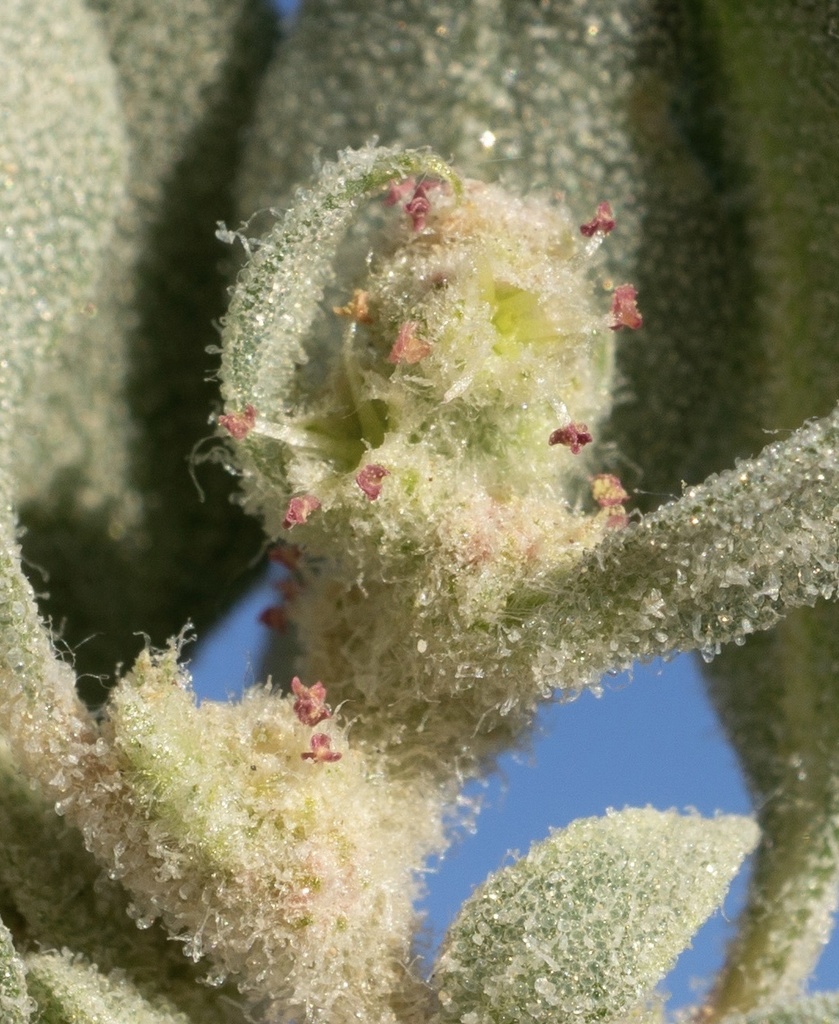
(c) Matt Berger, some rights reserved (CC BY), uploaded by Matt Berger · licence
Family: Chenopodiaceae · Type: Annual · Native
Conservation status: CNPS 1B.1
Atriplex argentea var. longitrichoma (Pahrump orach) is a native California annual in the Chenopodiaceae family, recognized by narrow elevation range and geographic restriction help distinguish this rare taxon.
Pahrump orach is a rare (CNPS 1B.1) California native annual found in the Mojave Desert in saline soils at elevations of 700 to 850 meters. Flowering from April to June, this plant produces small, inconspicuous flowers in delicate clusters. Growing with erect stems 10 to 30 centimeters tall and decumbent to ascending branches covered in fine scales, it has a distinctive branching structure. Its leaves are generally sessile with elliptic to ovate blades 10 to 35 millimeters long, tapering at the base and presenting a subtle, silvery-green appearance. The plant is adapted to harsh, salty environments with a compact growth form that helps it survive in challenging desert conditions.
Identification and appearance
Key characters: 24 sympatric species; narrow elevation range and geographic restriction help distinguish this rare taxon
Habitat and range
Habitat: Saline soils
Elevation: 700-850 m
Outside California: southwestern Nevada
Bloom period
Atriplex argentea var. longitrichoma blooms Apr-Jun.
Conservation status
CNPS 1B.1
How to tell it apart
vs Artemisia: Atriplex leaves have bead-like scales; Artemisia leaves are finely divided and aromatic when crushed.; vs Ambrosia: Atriplex has simple scaly leaves; Ambrosia has deeply lobed or divided leaves with coarse hairs.; vs Extriplex: Atriplex has 3-5 calyx lobes on male flowers and two seed colors; Extriplex has exactly 4 lobes and uniform dark seeds.; vs Chenopodium: Atriplex has bead-like bladder hairs and paired fruit bracts; Chenopodium has mealy powder and calyx-enclosed fruits.; vs Eriogonum: Atriplex has scaly leaves and paired fruit bracts; Eriogonum has smooth leaves and papery flower tubes.
Frequently asked questions
Is Atriplex argentea var. longitrichoma native to California?
Yes. Atriplex argentea var. longitrichoma is native to California (recorded as native).
When does Atriplex argentea var. longitrichoma bloom?
Atriplex argentea var. longitrichoma blooms Apr-Jun.
What plant family does Atriplex argentea var. longitrichoma belong to?
Atriplex argentea var. longitrichoma is in the Chenopodiaceae family, genus Atriplex.
Is Atriplex argentea var. longitrichoma rare or endangered?
Atriplex argentea var. longitrichoma carries California Rare Plant Rank 1B.1, state rank S2.
What habitat does Atriplex argentea var. longitrichoma grow in?
Atriplex argentea var. longitrichoma grows in Saline soils.
Related species
Other California species in the same genus, family, or bioregion.
Sources: Jepson eFlora · CalPhotos · CDFW CNDDB
Last updated 2026-09-30
Data from The California Species Project — 14,000+ California species with verified data from CNPS, CDFW, USFWS, Cal-IPC, and more.