Atriplex confertifolia
Shadscale
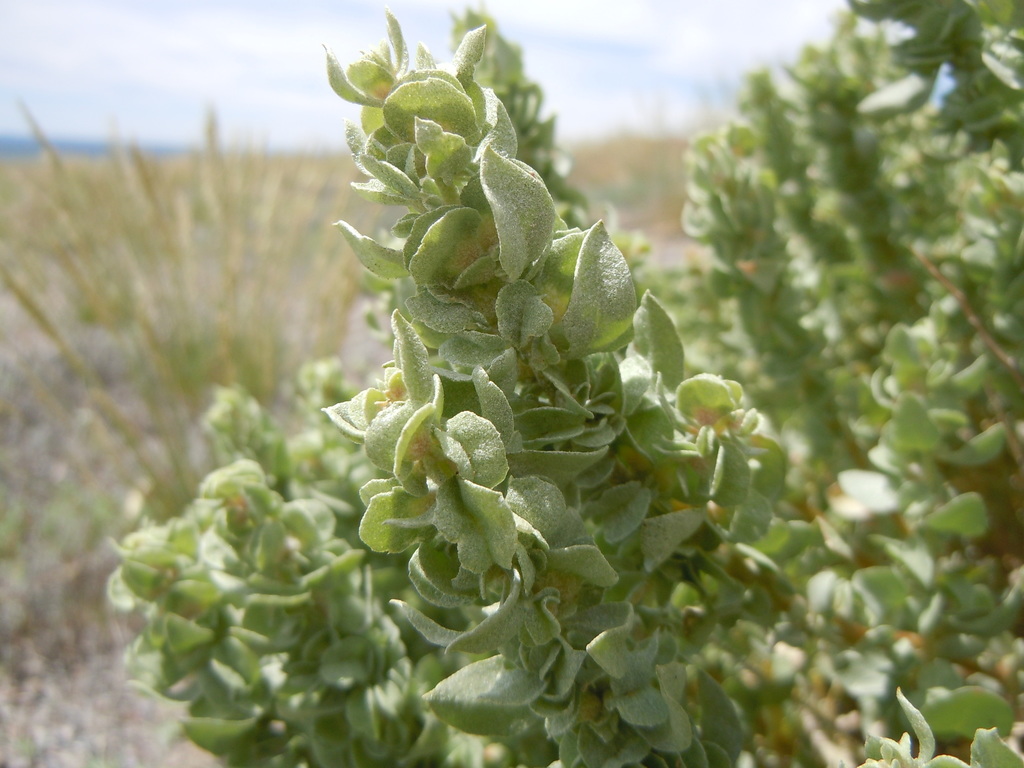
(c) Matt Lavin, some rights reserved (CC BY-SA) · licence
Family: Chenopodiaceae · Type: Shrub · Native
Atriplex confertifolia (Shadscale) is a native California shrub in the Chenopodiaceae family, recognized by distinctive rounded spiny shrub habit and free fruit bracts.
Shadscale is a California native shrub found in the eastern Sierra Nevada, Great Basin, southern coastal ranges, and Mojave Desert in alkaline flats, gravelly slopes, and pinyon/juniper woodland at elevations up to 2,400 meters. Flowering from April to July, this plant produces small, inconspicuous flowers nestled among dense, gray-scaled leaves. Growing as a compact, rounded shrub less than one meter tall with many stiff, spreading branches that become spine-like with age, it develops a distinctively structured form. Its leaves are elliptic to wide-ovate, 8 to 24 millimeters long, with a firm texture and a dense covering of gray scales that give the plant a distinctive silvery-gray appearance. The fruit consists of small, rounded bracts surrounding a tiny seed, well-adapted to its arid and alkaline habitats.
Identification and appearance
Key characters: 30 sympatric species; distinctive rounded spiny shrub habit and free fruit bracts are diagnostic
Habitat and range
Habitat: Alkaline flats, gravelly slopes in scrub, pinyon/juniper woodland
Elevation: < 2400 m
California counties: San Bernardino, Inyo, Kern, Riverside, Los Angeles, Modoc, Lassen, Mono, Imperial, San Luis Obispo, Humboldt, Fresno, Monterey, San Joaquin, Solano, Stanislaus, Tulare, Merced, San Diego, Marin
Outside California: to Oregon, north-central United States, northern Mexico
Bloom period
Atriplex confertifolia blooms Apr-Jul.
How to tell it apart
vs Artemisia: Atriplex leaves have bead-like scales; Artemisia leaves are finely divided and aromatic when crushed.; vs Ambrosia: Atriplex has simple scaly leaves; Ambrosia has deeply lobed or divided leaves with coarse hairs.; vs Extriplex: Atriplex has 3-5 calyx lobes on male flowers and two seed colors; Extriplex has exactly 4 lobes and uniform dark seeds.; vs Chenopodium: Atriplex has bead-like bladder hairs and paired fruit bracts; Chenopodium has mealy powder and calyx-enclosed fruits.; vs Eriogonum: Atriplex has scaly leaves and paired fruit bracts; Eriogonum has smooth leaves and papery flower tubes.
Frequently asked questions
Is Atriplex confertifolia native to California?
Yes. Atriplex confertifolia is native to California (recorded as native).
When does Atriplex confertifolia bloom?
Atriplex confertifolia blooms Apr-Jul.
Where in California does Atriplex confertifolia grow?
Atriplex confertifolia occurs in San Bernardino, Inyo, Kern, Riverside, Los Angeles, Modoc, Lassen, Mono and other counties, at elevations of < 2400 m.
What plant family does Atriplex confertifolia belong to?
Atriplex confertifolia is in the Chenopodiaceae family, genus Atriplex.
What habitat does Atriplex confertifolia grow in?
Atriplex confertifolia grows in Alkaline flats, gravelly slopes in scrub, pinyon/juniper woodland.
Related species
Other California species in the same genus, family, or bioregion.
Sources: Jepson eFlora · Index of California Plant Names · CalPhotos
Last updated 2026-10-07
Data from The California Species Project — 14,000+ California species with verified data from CNPS, CDFW, USFWS, Cal-IPC, and more.