Atriplex tularensis
Bakersfield smallscale
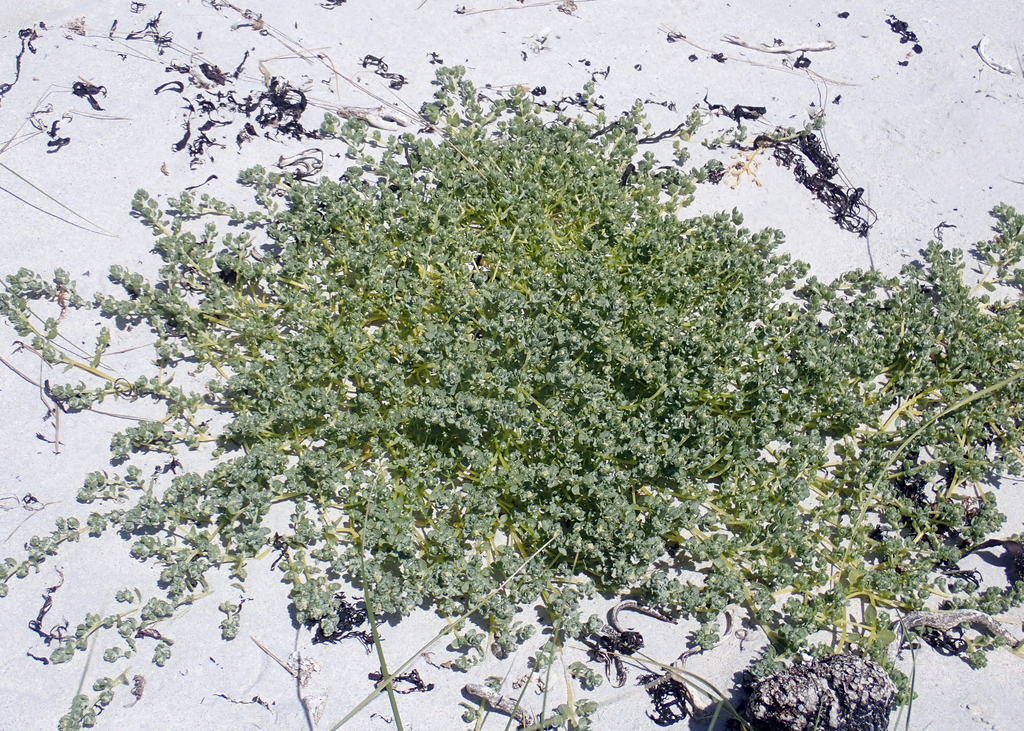
no rights reserved, uploaded by Peter de Lange · CC0
Family: Chenopodiaceae · Type: Herb · Native
Conservation status: CNPS 1A
Atriplex tularensis (Bakersfield smallscale) is a native California herb in the Chenopodiaceae family, recognized by geographic restriction to Kern Lake bed and rigid brittle stems diagnostic.
Bakersfield smallscale is a rare (CNPS 1A) California native annual found in the southern San Joaquin Valley in the Kern Lake Bed area of southwestern Kern County on alkaline soils and dry lake shores at elevations of 90 to 200 meters. Flowering from June to October, this plant produces small flowers with distinctive white-scaly stems that have reddish tips. Growing erect to 8 decimeters tall with rigid, brittle branches that overlap and create a distinctive architectural structure, it develops an open, sparse form. Its leaves range from 6 to 20 millimeters long, varying from lanceolate to ovate with rounded bases, with proximal leaves growing opposite and distal leaves alternating. The fruits develop compact bracts 2.5 to 3.5 millimeters long, with ovate to diamond-shaped edges and acute tips, containing small red-brown seeds approximately 1 millimeter in size.
Identification and appearance
Key characters: 22 sympatric species; geographic restriction to Kern Lake bed and rigid brittle stems diagnostic
Habitat and range
Habitat: Alkaline soils, shores of dry lake
Elevation: 90-200 m
Bloom period
Atriplex tularensis blooms Jun-Oct.
Conservation status
CNPS 1A
How to tell it apart
vs Artemisia: Atriplex leaves have bead-like scales; Artemisia leaves are finely divided and aromatic when crushed.; vs Ambrosia: Atriplex has simple scaly leaves; Ambrosia has deeply lobed or divided leaves with coarse hairs.; vs Extriplex: Atriplex has 3-5 calyx lobes on male flowers and two seed colors; Extriplex has exactly 4 lobes and uniform dark seeds.; vs Chenopodium: Atriplex has bead-like bladder hairs and paired fruit bracts; Chenopodium has mealy powder and calyx-enclosed fruits.; vs Eriogonum: Atriplex has scaly leaves and paired fruit bracts; Eriogonum has smooth leaves and papery flower tubes.
Frequently asked questions
Is Atriplex tularensis native to California?
Yes. Atriplex tularensis is native to California (recorded as native).
When does Atriplex tularensis bloom?
Atriplex tularensis blooms Jun-Oct.
What plant family does Atriplex tularensis belong to?
Atriplex tularensis is in the Chenopodiaceae family, genus Atriplex.
Is Atriplex tularensis rare or endangered?
Atriplex tularensis carries California Rare Plant Rank 1A, state rank SX.
What habitat does Atriplex tularensis grow in?
Atriplex tularensis grows in Alkaline soils, shores of dry lake.
Related species
Other California species in the same genus, family, or bioregion.
Sources: Jepson eFlora · CalPhotos · CDFW CNDDB
Last updated 2026-10-07
Data from The California Species Project — 14,000+ California species with verified data from CNPS, CDFW, USFWS, Cal-IPC, and more.