Avena barbata
Slender wild oat, Slender Wild Oat
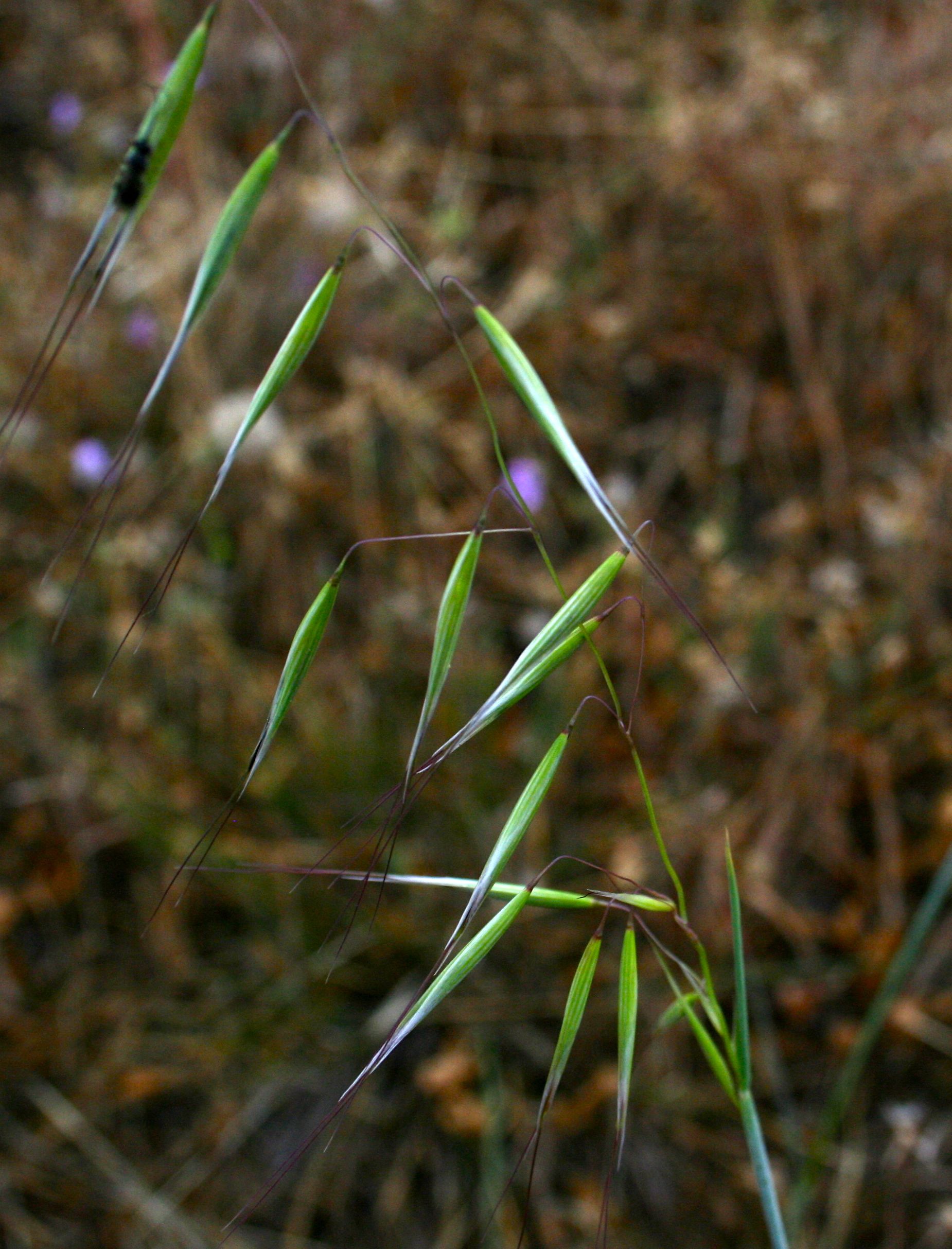
Photo by Chez Brungraber
Family: Poaceae · Type: Grass · Not Native
Conservation status: Cal-IPC Yes
Avena barbata (Slender wild oat) is a non-native California grass in the Poaceae family, recognized by spikelet size and lemma hairiness.
Slender wild oat is a naturalized annual grass found in California Floristic Province, Modoc Plateau, and Mojave Desert regions in disturbed sites at elevations of 40 to 1,200 meters. Flowering from March to June, this plant produces pale green to tan spikelets with delicate, twisted awns up to 45 millimeters long. Growing with erect stems 60 to 150 centimeters tall that become increasingly upright as the plant matures, it has a distinctive branching structure. Its leaf blades are 6 to 30 centimeters long, 2 to 6 millimeters wide, and range from smooth to slightly rough-textured. The spikelets break apart above the glumes, with each floret featuring a bearded base and bristly lemma teeth.
Identification and appearance
Key characters: 3 sympatric species; key features are spikelet size and lemma hairiness
Habitat and range
Habitat: Disturbed sites
Elevation: 40-1200 m
California counties: Humboldt, Los Angeles, San Luis Obispo, Fresno, San Diego, Kern, Orange, San Bernardino, Riverside, Alameda, Butte, Imperial, Mariposa, Sacramento, San Mateo, Santa Barbara, Santa Clara, Sonoma, Tehama, Tulare, Tuolumne, Ventura, Yolo, Contra Costa, Merced, Monterey, San Benito, Santa Cruz, Sutter, San Joaquin, Stanislaus, Shasta, Nevada, Napa, Mendocino, Madera, El Dorado, Del Norte, Colusa, Calaveras, Amador, Marin, San Francisco, Lake, Solano, Placer, Plumas, Glenn, Yuba, Kings, Trinity
Outside California: to Washington, Montana, Arizona, native to southern Europe, northern Africa to India
Bloom period
Avena barbata blooms Mar-Jun.
Conservation status
Cal-IPC Yes
How to tell it apart
vs Bromus: Avena has large dangling spikelets (15-50mm); Bromus has smaller, more upright or nodding spikelets under 20mm.; vs Danthonia: Avena has huge pendulous spikelets over 15mm; Danthonia has compact spikelets under 15mm.; vs Ehrharta: Avena has large dangling spikelets with twisted awns; Ehrharta has small awned spikelets and distinctive hardened lower florets.; vs Nassella: Avena has broad, dangling spikelets; Nassella has narrow, needle-like rolled florets with persistent awns.; vs Festuca: Avena has huge dangling spikelets (15-50mm); Festuca has small spikelets under 12mm in upright clusters.
Frequently asked questions
Is Avena barbata native to California?
No. Avena barbata is not native to California (recorded as not native).
When does Avena barbata bloom?
Avena barbata blooms Mar-Jun.
Where in California does Avena barbata grow?
Avena barbata occurs in Humboldt, Los Angeles, San Luis Obispo, Fresno, San Diego, Kern, Orange, San Bernardino and other counties, at elevations of 40-1200 m.
What plant family does Avena barbata belong to?
Avena barbata is in the Poaceae family, genus Avena.
Is Avena barbata invasive in California?
Avena barbata is listed by Cal-IPC with an invasiveness rating of Yes.
Related species
Other California species in the same genus, family, or bioregion.
Sources: Jepson eFlora · Index of California Plant Names · CalPhotos
Last updated 2026-10-07
Data from The California Species Project — 14,000+ California species with verified data from CNPS, CDFW, USFWS, Cal-IPC, and more.