Avena sativa
Cultivated oat, Cultivated Oat
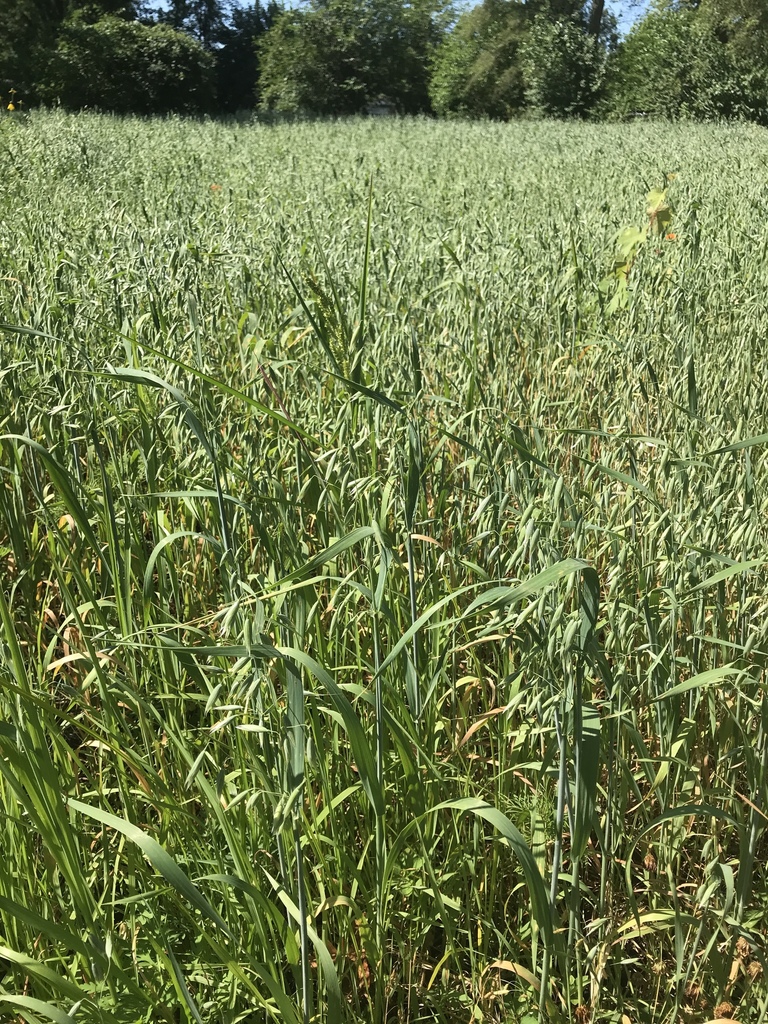
no rights reserved, uploaded by Greg Ulreich · CC0
Family: Poaceae · Type: Grass · Not Native
Avena sativa (Cultivated oat) is a non-native California grass in the Poaceae family, recognized by non-breaking spikelets and glabrous callus.
Cultivated oat is a naturalized annual found in the California Floristic Province in disturbed sites at elevations below 2,200 meters. Flowering from March to May, this plant produces tan to golden spikelets with delicate awns in loose, spreading clusters. Growing with tall stems 40 to 180 centimeters high, it has an upright, robust growth habit typical of grain crops. Its leaves are long and slender, with blades 8 to 45 centimeters in length and 3 to 16 millimeters wide, featuring a slightly rough texture. The spikelets are complex, with glumes 15 to 50 millimeters long and multiple florets that remain attached even after maturity.
Identification and appearance
Key characters: 3 sympatric species; key features are non-breaking spikelets and glabrous callus
Habitat and range
Habitat: Disturbed sites
Elevation: < 2200 m
California counties: Inyo, Kern, Lassen, Los Angeles, Mendocino, Orange, San Bernardino, San Diego, San Luis Obispo, Santa Barbara, Santa Clara, Monterey, Riverside, Ventura, Sutter, Sacramento, Solano, Nevada, Merced, Mariposa, Fresno, Madera, Contra Costa, Calaveras, Tuolumne, Trinity, Sonoma, San Mateo, Marin, San Francisco, Tulare, Butte, Tehama, Siskiyou, Humboldt, Del Norte, Shasta, Yolo, Glenn, Sierra, Imperial, Stanislaus, Napa, Placer
Outside California: to Alaska, eastern Canada, most of United States, origin in Near East
Bloom period
Avena sativa blooms Mar-May.
How to tell it apart
vs Bromus: Avena has large dangling spikelets (15-50mm); Bromus has smaller, more upright or nodding spikelets under 20mm.; vs Danthonia: Avena has huge pendulous spikelets over 15mm; Danthonia has compact spikelets under 15mm.; vs Ehrharta: Avena has large dangling spikelets with twisted awns; Ehrharta has small awned spikelets and distinctive hardened lower florets.; vs Nassella: Avena has broad, dangling spikelets; Nassella has narrow, needle-like rolled florets with persistent awns.; vs Festuca: Avena has huge dangling spikelets (15-50mm); Festuca has small spikelets under 12mm in upright clusters.
Frequently asked questions
Is Avena sativa native to California?
No. Avena sativa is not native to California (recorded as not native).
When does Avena sativa bloom?
Avena sativa blooms Mar-May.
Where in California does Avena sativa grow?
Avena sativa occurs in Inyo, Kern, Lassen, Los Angeles, Mendocino, Orange, San Bernardino, San Diego and other counties, at elevations of < 2200 m.
What plant family does Avena sativa belong to?
Avena sativa is in the Poaceae family, genus Avena.
What habitat does Avena sativa grow in?
Avena sativa grows in Disturbed sites.
Related species
Other California species in the same genus, family, or bioregion.
Sources: Jepson eFlora · Index of California Plant Names · CalPhotos
Last updated 2026-10-07
Data from The California Species Project — 14,000+ California species with verified data from CNPS, CDFW, USFWS, Cal-IPC, and more.