Avena sterilis
Animated oat
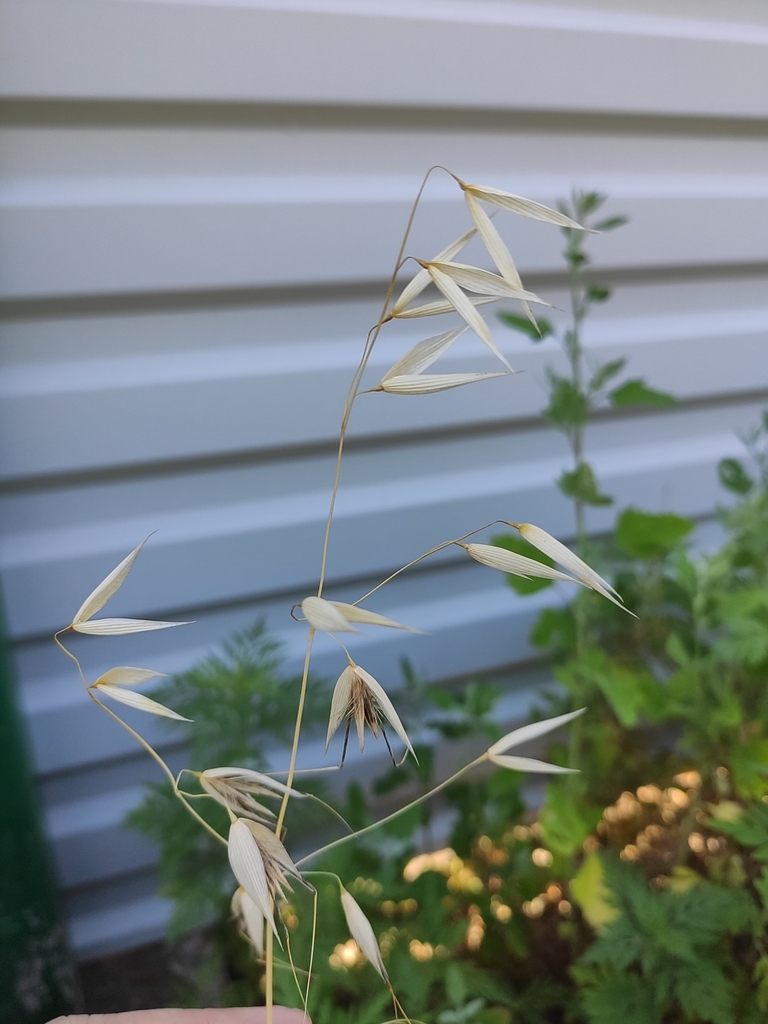
(c) KAnatoliy, some rights reserved (CC BY) · licence
Family: Poaceae · Type: Grass · Not Native
Avena sterilis (Animated oat) is a non-native California grass in the Poaceae family, recognized by but limited geographic range; key features are large spikelets and very long awns.
Animated oat is a naturalized annual found in coastal California regions including Alameda, Contra Costa, and San Diego counties in disturbed sites at elevations of 30 to 120 meters. Flowering from March to June, this plant produces pale yellow to tan spikelets with distinctive bearded flowering parts that create an intricate, animated appearance. Growing with slender stems 30 to 120 centimeters tall that become upright at maturity, it develops long, narrow leaves 8 to 60 centimeters in length with sparsely hairy margins. Its complex flowering structures feature lemmas with forked tips and dramatically twisted awns that can reach 9 centimeters long, creating a distinctive and dramatic seed dispersal mechanism. The fruit is characterized by 2 to 5 florets that detach together as a unified unit when mature.
Identification and appearance
Key characters: 3 sympatric species but limited geographic range; key features are large spikelets and very long awns
Habitat and range
Habitat: Disturbed sites
Elevation: 30-120 m
California counties: San Diego, Marin, Contra Costa, Alameda, Santa Clara, Yolo
Outside California: Canada, Pennsylvania, New Jersey, native Mediterranean to Afghanistan
Bloom period
Avena sterilis blooms Mar-Jun.
How to tell it apart
vs Bromus: Avena has large dangling spikelets (15-50mm); Bromus has smaller, more upright or nodding spikelets under 20mm.; vs Danthonia: Avena has huge pendulous spikelets over 15mm; Danthonia has compact spikelets under 15mm.; vs Ehrharta: Avena has large dangling spikelets with twisted awns; Ehrharta has small awned spikelets and distinctive hardened lower florets.; vs Nassella: Avena has broad, dangling spikelets; Nassella has narrow, needle-like rolled florets with persistent awns.; vs Festuca: Avena has huge dangling spikelets (15-50mm); Festuca has small spikelets under 12mm in upright clusters.
Frequently asked questions
Is Avena sterilis native to California?
No. Avena sterilis is not native to California (recorded as not native).
When does Avena sterilis bloom?
Avena sterilis blooms Mar-Jun.
Where in California does Avena sterilis grow?
Avena sterilis occurs in San Diego, Marin, Contra Costa, Alameda, Santa Clara, Yolo, at elevations of 30-120 m.
What plant family does Avena sterilis belong to?
Avena sterilis is in the Poaceae family, genus Avena.
What habitat does Avena sterilis grow in?
Avena sterilis grows in Disturbed sites.
Related species
Other California species in the same genus, family, or bioregion.
Sources: Jepson eFlora · Index of California Plant Names · CalPhotos
Last updated 2026-10-07
Data from The California Species Project — 14,000+ California species with verified data from CNPS, CDFW, USFWS, Cal-IPC, and more.