Baccharis salicifolia subsp. salicifolia
Mule fat, Mule Fat
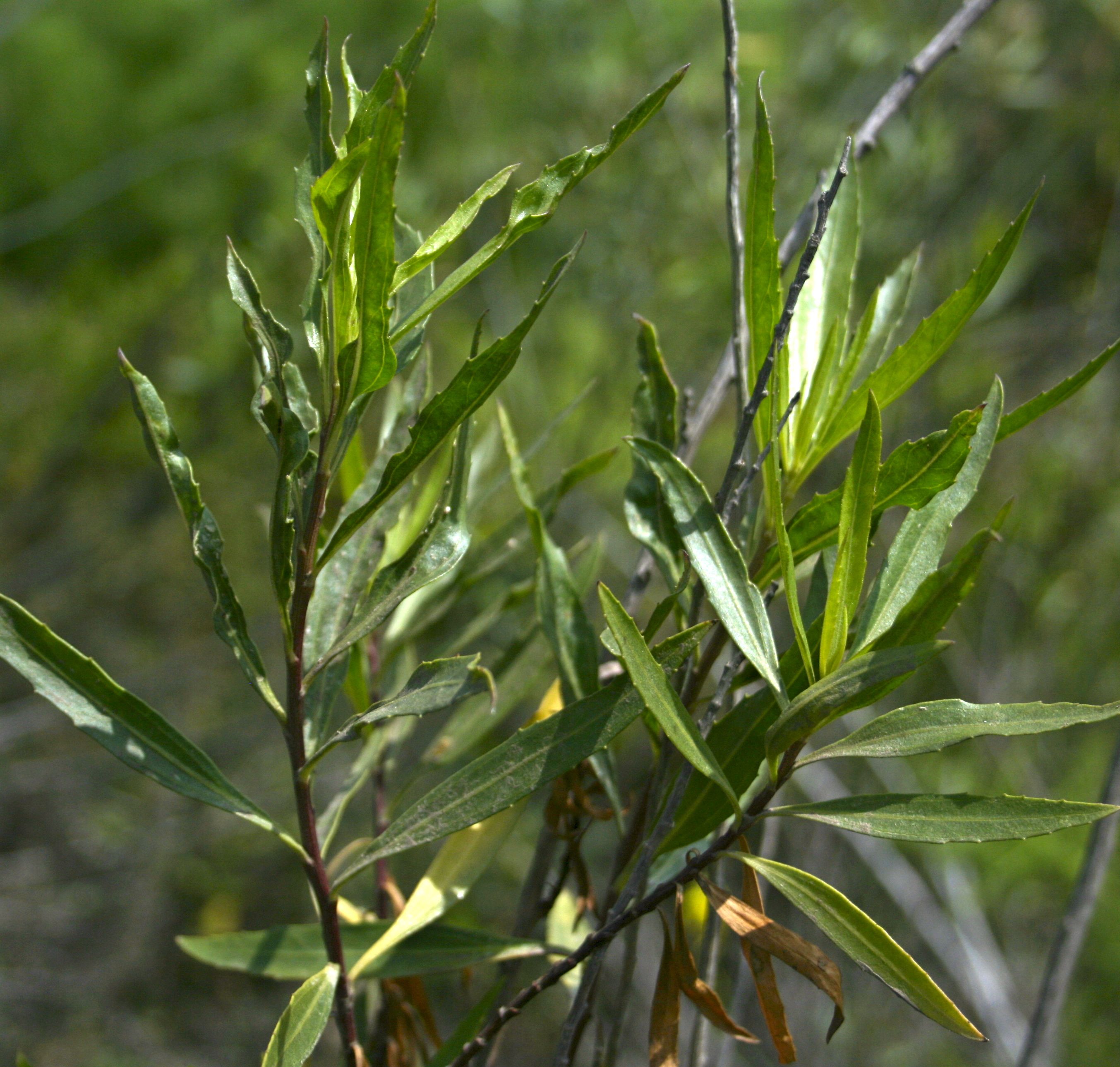
Photo by Chez Brungraber
Family: Asteraceae · Type: Shrub · Native
Baccharis salicifolia subsp. salicifolia (Mule fat) is a native California shrub in the Asteraceae family, recognized by largest shrub <4m with broadest leaves <150mm long and 3-20mm wide.
Mule fat is a California native shrub found in northwestern California, the Cascade Range foothills, Sierra Nevada, southern Sierra Nevada, Tehachapi, Central Valley, central western California, southwestern California, and desert regions in riparian woodlands, canyon bottoms, and disturbed sites at elevations from 30 meters below sea level to 2,400 meters. Flowering all year, this plant produces white flowers in terminal flat-topped or pyramidal clusters, with heads featuring green or reddish-tinged involucres. Growing 1 to 4 meters tall with few spreading or ascending branches, it forms dense thickets with glabrous to minutely hairy stems. Its lance-elliptic leaves are sessile or weakly petioled, typically 3 to 20 millimeters wide, with resin gland-dotted surfaces that give the plant a sticky texture. In summer and fall, the shrub produces clusters of small flower heads with staminate flowers ranging from 17 to 48 per cluster.
Identification and appearance
Key characters: 11 sympatric species; largest shrub <4m with broadest leaves <150mm long and 3-20mm wide
Habitat and range
Habitat: Riparian woodland, canyon bottoms, disturbed sites, often forming thickets
Elevation: -30-2400 m
California counties: San Diego, Riverside, Los Angeles, Kern, Ventura, San Bernardino, Tulare, Sutter, Santa Barbara, Napa, San Benito, Alameda, San Luis Obispo, Inyo, San Joaquin, Imperial, Lake, Orange, Fresno, Solano, Santa Clara, Stanislaus, Tuolumne, Butte, Modoc, Monterey, Merced, Sonoma, Contra Costa, Marin, Tehama, Glenn, Yolo, Mendocino, Kings, Yuba, Colusa
Outside California: to Colorado, Texas, Mexico, South America
Bloom period
Baccharis salicifolia subsp. salicifolia blooms All year.
How to tell it apart
vs Ericameria: Baccharis has sticky leaves and white fluffy seeds; Ericameria has narrow leaves and bright yellow ray flowers.; vs Salix: Baccharis has sticky resinous leaves and flower heads; Salix has fuzzy catkins and alternate leaves without resin.; vs Quercus: Baccharis has sticky leaves and fluffy seeds; Quercus has lobed or entire leaves and produces acorns.; vs Ceanothus: Baccharis has small clustered flower heads; Ceanothus has dense clusters of showy blue or white 5-petaled flowers.; vs Lepidospartum: Baccharis has sticky leafy branches; Lepidospartum has scale-like leaves on broom-like green stems.
Frequently asked questions
Is Baccharis salicifolia subsp. salicifolia native to California?
Yes. Baccharis salicifolia subsp. salicifolia is native to California (recorded as native).
When does Baccharis salicifolia subsp. salicifolia bloom?
Baccharis salicifolia subsp. salicifolia blooms All year.
Where in California does Baccharis salicifolia subsp. salicifolia grow?
Baccharis salicifolia subsp. salicifolia occurs in San Diego, Riverside, Los Angeles, Kern, Ventura, San Bernardino, Tulare, Sutter and other counties, at elevations of -30-2400 m.
What plant family does Baccharis salicifolia subsp. salicifolia belong to?
Baccharis salicifolia subsp. salicifolia is in the Asteraceae family, genus Baccharis.
What habitat does Baccharis salicifolia subsp. salicifolia grow in?
Baccharis salicifolia subsp. salicifolia grows in Riparian woodland, canyon bottoms, disturbed sites, often forming thickets.
Related species
Other California species in the same genus, family, or bioregion.
Sources: Jepson eFlora · Index of California Plant Names · CalPhotos
Last updated 2026-10-08
Data from The California Species Project — 14,000+ California species with verified data from CNPS, CDFW, USFWS, Cal-IPC, and more.