Bacopa rotundifolia
Disk waterhyssop
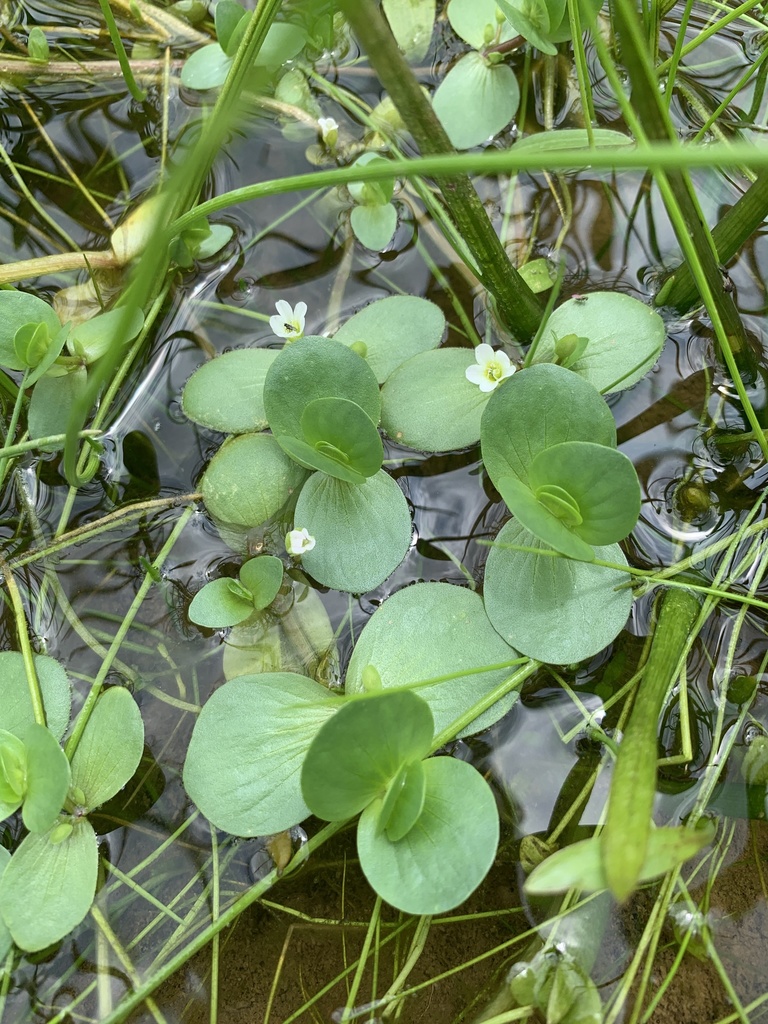
(c) Daniel J. Layton, some rights reserved (CC BY) · licence
Family: Plantaginaceae · Type: Herb · Not Native
Bacopa rotundifolia (Disk waterhyssop) is a non-native California herb in the Plantaginaceae family, recognized by . Key features: round leaves, short stout pedicels, anthers not exserted.
Disk waterhyssop is a naturalized perennial found in the Great Valley and Modoc Plateau, specifically in Fall River Valley, Shasta County, growing in muddy places, shallow water, and wet soil at elevations below 100 meters. Flowering from May to August, this plant produces white flowers with yellow throats, approximately 5 to 8 millimeters long. Growing with succulent stems that root easily in wet environments, the plant reaches a low-spreading habit. Its leaves are nearly round, 12 to 36 millimeters long, with more than six distinct palmate veins creating a distinctive pattern. The plant has tiny anthers and outer sepals that are ovate to round, measuring 3.1 to 5.3 millimeters in length.
Identification and appearance
Key characters: 2 sympatric species. Key features: round leaves, short stout pedicels, anthers not exserted
Habitat and range
Habitat: Muddy places, in wet soil or rooted and floating in shallow water
Elevation: < 100 m (< 1100 m in MP)
California counties: Stanislaus, Fresno, Butte, Sutter, Shasta, Glenn, Merced, Yolo, Sacramento, Yuba
Outside California: to Idaho, eastern United States, Arizona, Mexico, native to central United States
Bloom period
Bacopa rotundifolia blooms May-Aug.
How to tell it apart
vs Myoporum: Bacopa is tiny creeping aquatic; Myoporum is woody shrub with spotted flowers.; vs Chaenostoma: Bacopa has rounded succulent leaves; Chaenostoma has narrow linear leaves.; vs Callitriche: Bacopa has visible petaled flowers; Callitriche has no petals, just tiny green flowers.; vs Cabomba: Bacopa has simple oval leaves; Cabomba has finely divided fan-like submerged leaves.; vs Portulaca: Bacopa grows in wet mud; Portulaca grows in dry ground with thick cylindrical leaves.
Frequently asked questions
Is Bacopa rotundifolia native to California?
No. Bacopa rotundifolia is not native to California (recorded as not native).
When does Bacopa rotundifolia bloom?
Bacopa rotundifolia blooms May-Aug.
Where in California does Bacopa rotundifolia grow?
Bacopa rotundifolia occurs in Stanislaus, Fresno, Butte, Sutter, Shasta, Glenn, Merced, Yolo and other counties, at elevations of < 100 m (< 1100 m in MP).
What plant family does Bacopa rotundifolia belong to?
Bacopa rotundifolia is in the Plantaginaceae family, genus Bacopa.
What habitat does Bacopa rotundifolia grow in?
Bacopa rotundifolia grows in Muddy places, in wet soil or rooted and floating in shallow water.
Related species
Other California species in the same genus, family, or bioregion.
- Bacopa sp. — Water-hyssop
- Bacopa eisenii — Gila river water hyssop
- Bacopa monnieri — Herb of grace
- Bacopa repens — Creeping water hyssop
- Callitriche fassettii — Fassett's water starwort
- Callitriche heterophylla — Varied leaved water starwort
- Callitriche heterophylla var. bolanderi — Bolander's water starwort
Sources: Jepson eFlora · Index of California Plant Names · CalPhotos
Last updated 2026-10-07
Data from The California Species Project — 14,000+ California species with verified data from CNPS, CDFW, USFWS, Cal-IPC, and more.