Bahiopsis parishii
Parish's goldeneye, Parish's Goldeneye
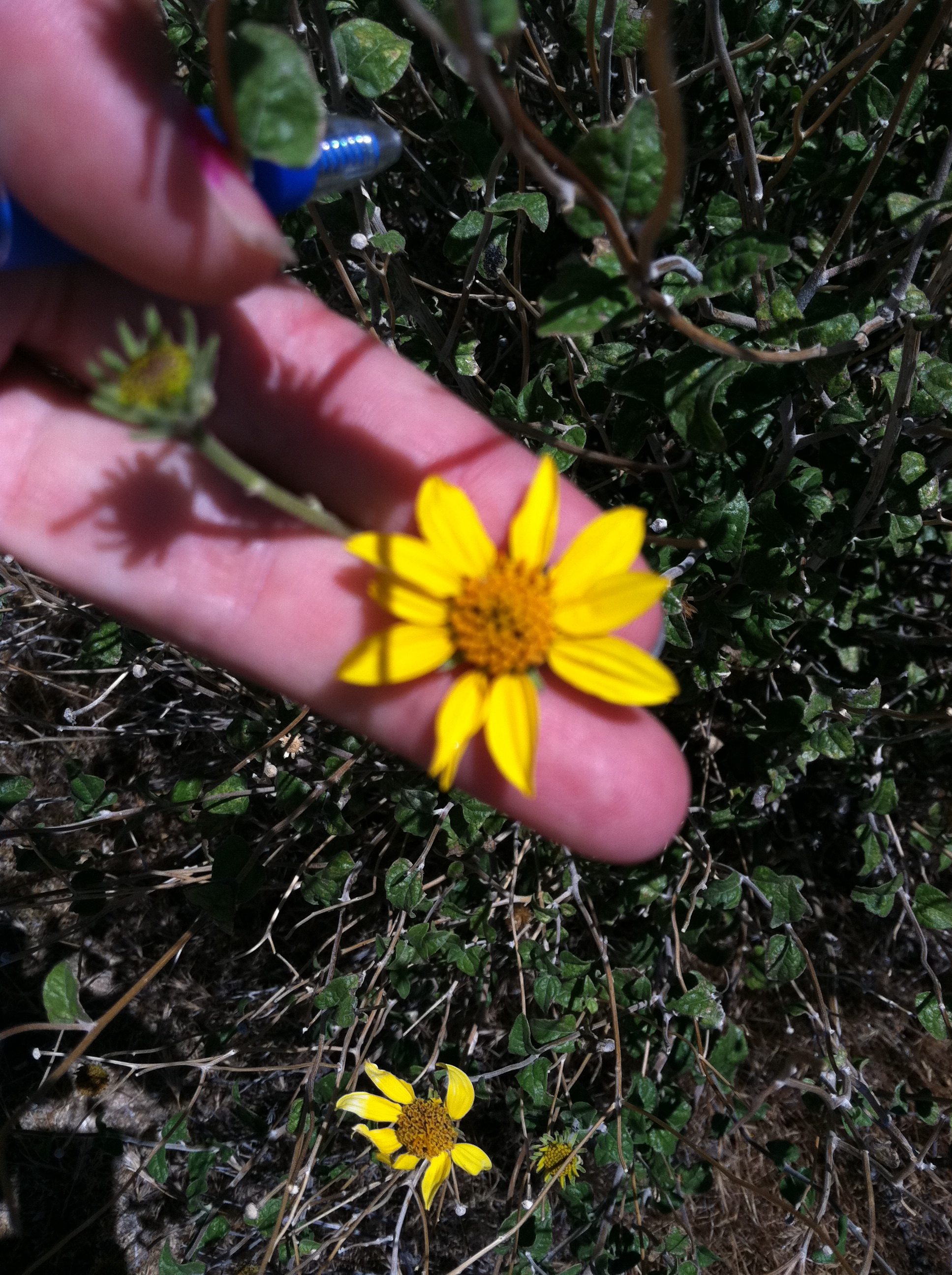
Photo by Chez Brungraber
Family: Asteraceae · Type: Shrub · Native
Bahiopsis parishii (Parish's goldeneye) is a native California shrub in the Asteraceae family, recognized by triangular leaves and long peduncles.
Parish's goldeneye is a California native shrub found in eastern Peninsular Range and Desert bioregions in washes and dry, rocky slopes at elevations below 1,500 meters. Flowering from February to June and September to October, this plant produces yellow ray flowers with distinctive disk centers in heads 10 to 13 millimeters wide. Growing as a compact shrub up to 2 meters in diameter with much-branched stems 60 to 130 centimeters tall, it is covered in short, rough hairs throughout. Its leaves are triangular-ovate, 10 to 35 millimeters long, with proximal leaves opposite and distal leaves alternate, featuring entire or occasionally few-toothed margins. The fruit is 2.7 to 3.8 millimeters long with pappus scales 2 to 3 millimeters in length.
Identification and appearance
Key characters: 2 sympatric species; key features are triangular leaves and long peduncles
Habitat and range
Habitat: Common. Washes, dry, rocky slopes
Elevation: < 1500 m
California counties: San Bernardino, Imperial, Riverside, San Diego, Los Angeles
Outside California: Nevada, Arizona, northwestern Mexico
Bloom period
Bahiopsis parishii blooms Feb-Jun, Sep--Oct.
How to tell it apart
vs Encelia: Bahiopsis has large showy yellow ray petals; Encelia rays are absent or reduced and inconspicuous.; vs Hulsea: Bahiopsis is a woody desert shrub; Hulsea is herbaceous with glandular-sticky aromatic foliage.; vs Helianthus: Bahiopsis has woody persistent stems; Helianthus has soft herbaceous stems that die back.; vs Tagetes: Bahiopsis has rounded leaf bases; Tagetes has deeply divided feathery leaves with strong scent.; vs Brickellia: Bahiopsis has large yellow ray petals; Brickellia flowers are small disk-only with no rays.
Frequently asked questions
Is Bahiopsis parishii native to California?
Yes. Bahiopsis parishii is native to California (recorded as native).
When does Bahiopsis parishii bloom?
Bahiopsis parishii blooms Feb-Jun, Sep--Oct.
Where in California does Bahiopsis parishii grow?
Bahiopsis parishii occurs in San Bernardino, Imperial, Riverside, San Diego, Los Angeles, at elevations of < 1500 m.
What plant family does Bahiopsis parishii belong to?
Bahiopsis parishii is in the Asteraceae family, genus Bahiopsis.
What habitat does Bahiopsis parishii grow in?
Bahiopsis parishii grows in Common. Washes, dry, rocky slopes.
Related species
Other California species in the same genus, family, or bioregion.
Sources: Jepson eFlora · Index of California Plant Names · CalPhotos
Last updated 2026-10-07
Data from The California Species Project — 14,000+ California species with verified data from CNPS, CDFW, USFWS, Cal-IPC, and more.