Balsamorhiza sericea
Silky balsamroot
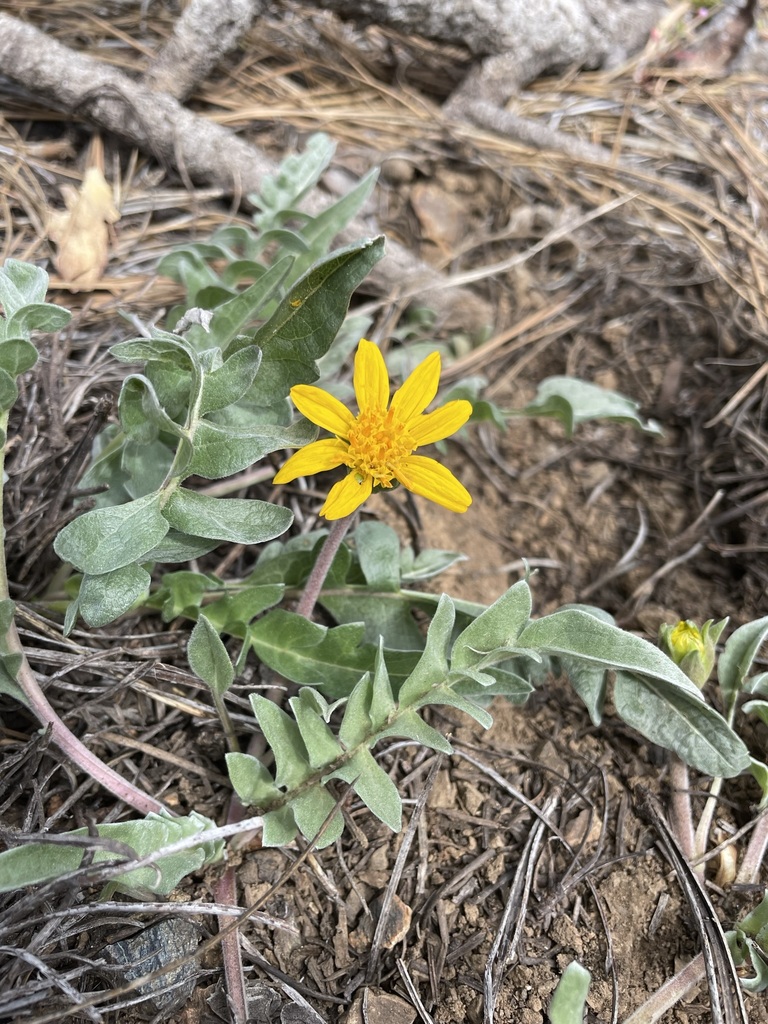
(c) Matt Berger, some rights reserved (CC BY) · licence
Family: Asteraceae · Type: Herb · Native
Conservation status: CNPS 1B.3
Balsamorhiza sericea (Silky balsamroot) is a native California herb in the Asteraceae family, recognized by distinctive widely ovate phyllaries and silvery canescent leaves on serpentine.
Silky balsamroot is a rare (CNPS 1B.3) California native perennial found in the eastern Klamath Ranges in Siskiyou and Trinity counties, growing on serpentine outcrops and rocky slopes at elevations of 400 to 1,800 meters. Flowering from May to June, this plant produces yellow sunflower-like ray flowers 1.5 to 3 centimeters long with prominent disk centers. Growing with stems 10 to 40 centimeters tall, it forms a distinctive basal cluster with silvery-gray foliage. Its basal leaves are 10 to 30 centimeters long, lanceolate to elliptic, with finely divided lobes covered in a soft, silvery canescent pubescence that gives the plant its distinctive silky appearance. The plant produces ray flowers with broadly ovate phyllaries that have wide, flat tips, creating a delicate yet robust botanical display.
Identification and appearance
Key characters: 2 sympatric species; distinctive widely ovate phyllaries and silvery canescent leaves on serpentine
Habitat and range
Habitat: Serpentine outcrops, rocky slopes
Elevation: 400-1800 m
Outside California: southwestern Oregon
Bloom period
Balsamorhiza sericea blooms May-Jun.
Conservation status
CNPS 1B.3
How to tell it apart
vs Wyethia: Balsamorhiza leaves cluster at ground level; Wyethia has several leaves scattered up the stem.; vs Agnorhiza: Balsamorhiza has entirely basal leaves; Agnorhiza has leaves along the stem.; vs Crepis: Balsamorhiza has large sunflower-like yellow flowers; Crepis has dandelion-like flowers with only ray petals.; vs Arnica: Balsamorhiza leaves are at the base only; Arnica has opposite pairs of leaves on the stem.; vs Pallenis: Balsamorhiza stems are nearly leafless; Pallenis has many leaves densely packed up the stem.
Frequently asked questions
Is Balsamorhiza sericea native to California?
Yes. Balsamorhiza sericea is native to California (recorded as native).
When does Balsamorhiza sericea bloom?
Balsamorhiza sericea blooms May-Jun.
What plant family does Balsamorhiza sericea belong to?
Balsamorhiza sericea is in the Asteraceae family, genus Balsamorhiza.
Is Balsamorhiza sericea rare or endangered?
Balsamorhiza sericea carries California Rare Plant Rank 1B.3, state rank S3.
What habitat does Balsamorhiza sericea grow in?
Balsamorhiza sericea grows in Serpentine outcrops, rocky slopes.
Related species
Other California species in the same genus, family, or bioregion.
Sources: Jepson eFlora · CNPS Rare Plant Inventory · Index of California Plant Names · CalPhotos · CDFW CNDDB
Last updated 2026-10-07
Data from The California Species Project — 14,000+ California species with verified data from CNPS, CDFW, USFWS, Cal-IPC, and more.