Barbarea orthoceras
American rocket
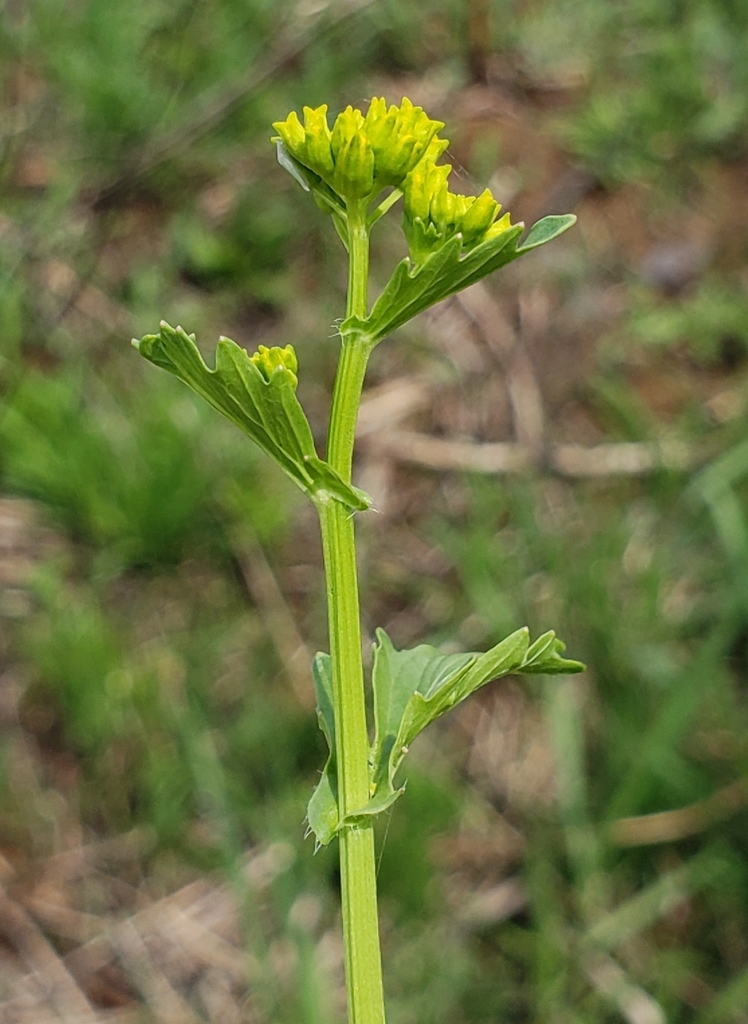
(c) aarongunnar, some rights reserved (CC BY) · licence
Family: Brassicaceae · Type: Herb · Native
Barbarea orthoceras (American rocket) is a native California herb in the Brassicaceae family, recognized by pod length, leaf lobe count, and native status.
American rocket is a California native perennial found in the California Floristic Province (excluding the Great Valley), Modoc Plateau, northern Eastern Sierra Nevada, and White and Inyo Mountains in damp meadows, wet rocks, streambanks, moist woodland, grassland, scree, and ledges at elevations up to 3,400 meters. Flowering from March to July, this plant produces bright yellow flowers 5 to 7 millimeters long with delicate sepals. Growing with branched stems 10 to 60 centimeters tall, it develops an upright, somewhat open structure. Its distinctive basal leaves are pinnately lobed, with 2 to 4 pairs of lateral lobes and a large terminal lobe that is ovate and sometimes irregularly toothed. The plant produces erect to ascending fruits 3 to 4 centimeters long, each containing 24 to 36 small ovate or oblong seeds.
Identification and appearance
Key characters: 2 sympatric species; distinguished by pod length, leaf lobe count, and native status
Habitat and range
Habitat: Damp meadows, wet rocks, streambanks, moist woodland, grassland, scree, ledges
Elevation: < 3400 m
California counties: Humboldt, Placer, Fresno, Lake, Los Angeles, Mono, Nevada, Orange, Riverside, San Bernardino, San Diego, San Luis Obispo, San Mateo, Sierra, Siskiyou, Tulare, Ventura, Santa Clara, Tehama, Tuolumne, El Dorado, Madera, Mendocino, Santa Cruz, Trinity, Sonoma, Butte, Kern, Mariposa, Modoc, Monterey, San Francisco, Glenn, Inyo, Calaveras, Plumas, Marin, Lassen, Contra Costa, Merced, Napa, Alameda, Santa Barbara, Shasta, Yolo, Alpine, San Benito, Yuba, Amador, Solano, Del Norte, Imperial, Sacramento
Outside California: Alaska, Canada, eastern North America, also central and eastern Asia
Bloom period
Barbarea orthoceras blooms Mar-Jul.
How to tell it apart
vs Sisymbrium: Upper stems are distinctly angular-ridged versus rounded stems.; vs Brassica: Stem leaves clasp with lobed bases versus non-clasping leaves in Brassica.; vs Mutarda: Found in wet streambank habitats versus drier upland sites.; vs Rorippa: Seeds arranged in one row per pod versus two rows in Rorippa.; vs Erysimum: Stem leaves clasp at base with lobes versus non-clasping entire leaves.
Frequently asked questions
Is Barbarea orthoceras native to California?
Yes. Barbarea orthoceras is native to California (recorded as native).
When does Barbarea orthoceras bloom?
Barbarea orthoceras blooms Mar-Jul.
Where in California does Barbarea orthoceras grow?
Barbarea orthoceras occurs in Humboldt, Placer, Fresno, Lake, Los Angeles, Mono, Nevada, Orange and other counties, at elevations of < 3400 m.
What plant family does Barbarea orthoceras belong to?
Barbarea orthoceras is in the Brassicaceae family, genus Barbarea.
What habitat does Barbarea orthoceras grow in?
Barbarea orthoceras grows in Damp meadows, wet rocks, streambanks, moist woodland, grassland, scree, ledges.
Related species
Other California species in the same genus, family, or bioregion.
Sources: Jepson eFlora · Index of California Plant Names · CalPhotos
Last updated 2026-10-07
Data from The California Species Project — 14,000+ California species with verified data from CNPS, CDFW, USFWS, Cal-IPC, and more.