Beckmannia syzigachne
American slough grass
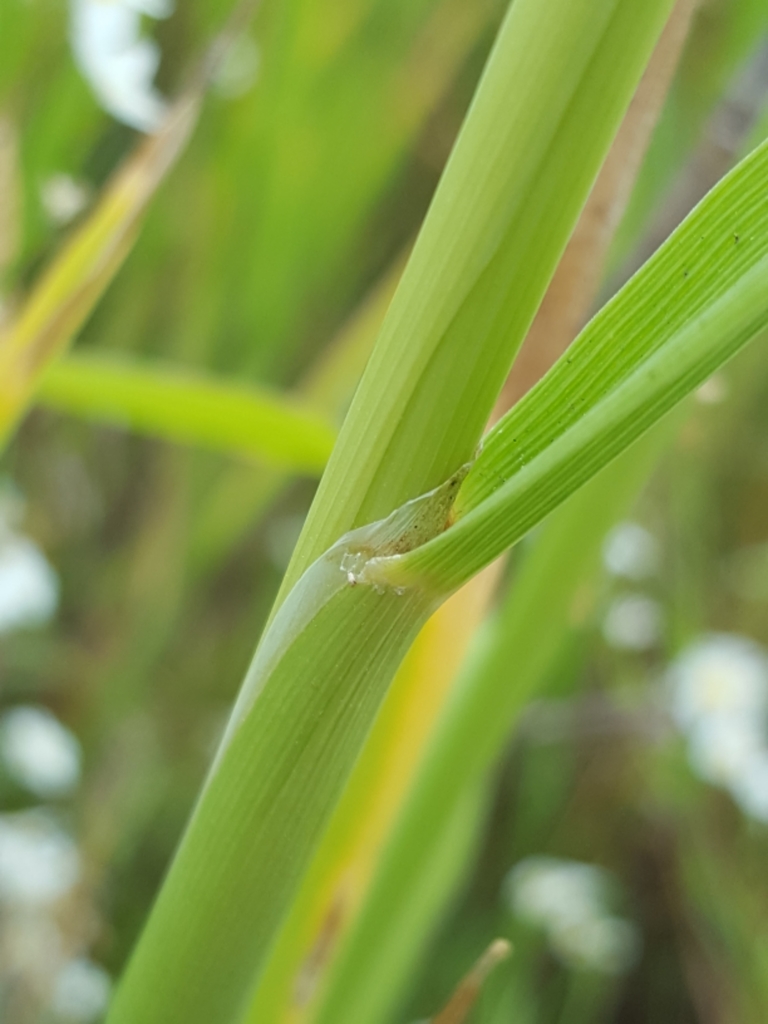
(c) Alex Abair, some rights reserved (CC BY), uploaded by Alex Abair · licence
Family: Poaceae · Type: Grass · Native
Beckmannia syzigachne (American slough grass) is a native California grass in the Poaceae family, recognized by Only Beckmannia species in California, distinguished by distinctive flattened, boat-shaped spikelets.
American slough grass is a native annual found in northwestern California, the Cascade Range, northern Sierra Nevada, Sacramento Valley, northern Coast Ranges, San Francisco Bay Area, Modoc Plateau, and northern eastern Sierra Nevada in margins of ponds, streams, and marshes at elevations below 2,000 meters. Flowering from May to July, this plant produces pale green to light brown flowers in narrow, dense inflorescences about 7 to 30 centimeters long. Growing with tufted stems 20 to 120 centimeters tall, it forms compact clusters in wet habitats. Its leaf blades are flat, 6 to 21 centimeters long and 4 to 10 millimeters wide, with a pubescent ligule 4 to 11 millimeters long and slightly rough texture. The plant produces small spikelets 2 to 3 millimeters long with prominently keeled glumes and lance-shaped lemmas without awns.
Identification and appearance
Key characters: Only Beckmannia species in California, distinguished by distinctive flattened, boat-shaped spikelets
Habitat and range
Habitat: Margins of ponds, streams, marshes
Elevation: < 2000 m
California counties: Humboldt, Lake, Lassen, Marin, Mendocino, Modoc, Mono, Plumas, Shasta, Siskiyou, Sonoma, Trinity, El Dorado, Ventura, San Mateo, Nevada, Napa, Sierra, San Francisco, Sacramento, Santa Cruz
Outside California: most of North America, except southeastern United States
Bloom period
Beckmannia syzigachne blooms May-Jul.
How to tell it apart
vs Alopecurus: Foxtail forms a soft, dense, cylindrical spike-like panicle with awned florets; Beckmannia has distinct one-sided branches lined with flat, nearly circular, awnless spikelets.; vs Phalaris: Phalaris has a compact ovoid or cylindric head of shiny keeled spikelets; Beckmannia arranges its coin-shaped spikelets in rows along separate appressed branchlets.; vs Echinochloa: Barnyard grass has crowded, often bristly or awned spikelets on one-sided branches; Beckmannia spikelets are awnless, laterally flattened, and shingled like little discs.; vs Polypogon: Polypogon has a soft, bristly, awned spike-like panicle; Beckmannia is awnless with rounded, laterally compressed spikelets.; vs Glyceria: Glyceria has open panicles of elongate, several-flowered spikelets; Beckmannia has one-floret, circular spikelets on stiffly appressed branches.
Frequently asked questions
Is Beckmannia syzigachne native to California?
Yes. Beckmannia syzigachne is native to California (recorded as native).
When does Beckmannia syzigachne bloom?
Beckmannia syzigachne blooms May-Jul.
Where in California does Beckmannia syzigachne grow?
Beckmannia syzigachne occurs in Humboldt, Lake, Lassen, Marin, Mendocino, Modoc, Mono, Plumas and other counties, at elevations of < 2000 m.
What plant family does Beckmannia syzigachne belong to?
Beckmannia syzigachne is in the Poaceae family, genus Beckmannia.
What habitat does Beckmannia syzigachne grow in?
Beckmannia syzigachne grows in Margins of ponds, streams, marshes.
Related species
Other California species in the same genus, family, or bioregion.
Sources: Jepson eFlora · Index of California Plant Names · CalPhotos
Last updated 2026-10-07
Data from The California Species Project — 14,000+ California species with verified data from CNPS, CDFW, USFWS, Cal-IPC, and more.