Berberis pinnata subsp. pinnata
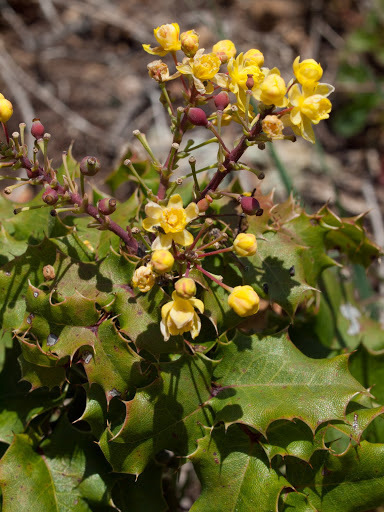
Photo: parent species Berberis pinnata · (c) 114397479669890378989, some rights reserved (CC BY) · licence
Family: Berberidaceae · Type: Shrub · Native
Berberis pinnata subsp. pinnata is a native California shrub in the Berberidaceae family, recognized by Mainland barberry; 7-11 wavy-margined spiny leaflets, spines >1 mm (vs island subsp. insularis).
Oregon grape is a California native shrub found in northwestern, central western, western Transverse Ranges, southern Gabilan Range, and Peninsular Ranges in rocky slopes, conifer forest, oak woodland, and chaparral at elevations up to 1,900 meters. Flowering from February to May, this plant produces yellow flowers in clusters up to 7.5 centimeters long. Growing with erect upper stems generally less than 2 meters tall, it forms a dense, compact shrub. Its compound leaves have wavy leaflet margins with spines over 1 millimeter long, creating a distinctive, slightly prickly texture. The shrub's entire or slightly serrated leaves provide an attractive, intricate foliage structure characteristic of its species.
Identification and appearance
Key characters: Mainland barberry; 7-11 wavy-margined spiny leaflets, spines >1 mm (vs island subsp. insularis)
Habitat and range
Habitat: Rocky slopes, conifer forest, oak woodland, chaparral
Elevation: < 1900 m
California counties: Humboldt, San Diego, Orange, San Benito, Monterey, San Mateo, Napa, Marin, Contra Costa, Del Norte, Los Angeles, Alameda, Santa Barbara, Ventura, San Luis Obispo, San Bernardino, Santa Clara, Santa Cruz
Outside California: to British Columbia, Baja California
Bloom period
Berberis pinnata subsp. pinnata blooms Feb-May.
How to tell it apart
vs Quercus: Berberis has compound leaves or simple leaves with regular spiny teeth; Quercus has simple lobed leaves with irregular lobes.; vs Ilex: Berberis has compound leaves or alternate simple leaves; Ilex has only simple leaves that are spirally arranged.; vs Pyracantha: Berberis has yellow flowers and compound or simple spiny-edged leaves; Pyracantha has white flowers and simple leaves with thorns on stems.; vs Rosa: Berberis has yellow flowers with 6 petals; Rosa has pink-white flowers with 5 petals and compound leaves with paired leaflets.; vs Rhaphiolepis: Berberis has yellow flowers and spiny-toothed leaves; Rhaphiolepis has white-pink flowers and simple leaves with smooth or finely toothed edges.
Frequently asked questions
Is Berberis pinnata subsp. pinnata native to California?
Yes. Berberis pinnata subsp. pinnata is native to California (recorded as native).
When does Berberis pinnata subsp. pinnata bloom?
Berberis pinnata subsp. pinnata blooms Feb-May.
Where in California does Berberis pinnata subsp. pinnata grow?
Berberis pinnata subsp. pinnata occurs in Humboldt, San Diego, Orange, San Benito, Monterey, San Mateo, Napa, Marin and other counties, at elevations of < 1900 m.
What plant family does Berberis pinnata subsp. pinnata belong to?
Berberis pinnata subsp. pinnata is in the Berberidaceae family, genus Berberis.
What habitat does Berberis pinnata subsp. pinnata grow in?
Berberis pinnata subsp. pinnata grows in Rocky slopes, conifer forest, oak woodland, chaparral.
Related species
Other California species in the same genus, family, or bioregion.
- Berberis sp. — Oregon-grape
- Berberis vulgaris — Common barberry
- Berberis aquifolium — Mountain grape
- Berberis aquifolium var. aquifolium — Oregon grape
- Berberis aquifolium var. dictyota — Jepson's oregon grape
- Berberis aquifolium var. repens — Creeping oregon grape
- Vancouveria chrysantha — Siskiyou inside-out-flower
- Vancouveria hexandra — Deciduous vancouvaria
Sources: Jepson eFlora · Index of California Plant Names · CalPhotos
Last updated 2026-10-07
Data from The California Species Project — 14,000+ California species with verified data from CNPS, CDFW, USFWS, Cal-IPC, and more.