Beta vulgaris subsp. maritima
Sea beet, Sea Beet
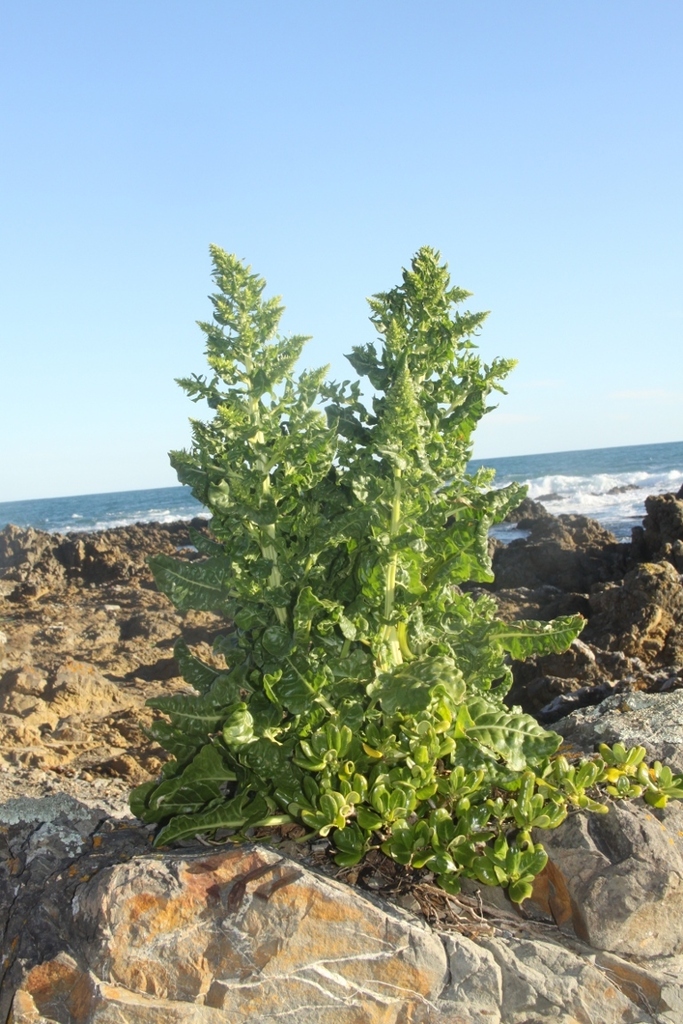
(c) Tony Wills, some rights reserved (CC BY-SA), uploaded by Tony Wills · licence
Family: Chenopodiaceae · Type: Perennial · Not Native
Beta vulgaris subsp. maritima (Sea beet) is a non-native California perennial in the Chenopodiaceae family, recognized by Only Beta species naturalized in California, distinguished by clustered corky fruits and coastal habitat.
Sea beet is a naturalized perennial found in coastal California regions including the Central Coast, San Francisco Bay Area, Southern California, Channel Islands, western Transverse Ranges, and Peninsular Ranges in moist sandy places and disturbed areas at elevations below 300 meters. Flowering from February to September, this plant produces small greenish-white flowers in compact clusters. Growing with simple stems up to 80 centimeters tall, it develops fibrous roots that occasionally become slightly swollen. Its leaves are oblanceolate, with petioles approximately the same length as the blade, typically less than 10 centimeters long. The fruit develops in clusters of 5 to 11 small round structures, each 3 to 5 millimeters in diameter.
Identification and appearance
Key characters: Only Beta species naturalized in California, distinguished by clustered corky fruits and coastal habitat
Habitat and range
Habitat: Moist sandy places, disturbed areas
Elevation: < 300 m
California counties: Riverside, Los Angeles, San Diego, Imperial, San Luis Obispo, San Mateo, Santa Barbara, Napa, Contra Costa
Outside California: New Jersey, southern Europe
Bloom period
Beta vulgaris subsp. maritima blooms Feb-Sep.
How to tell it apart
vs Rumex: Beta has clustered flowers in spikes; Rumex has whorled flowers along stems.; vs Blitum: Beta leaves are broadly oval; Blitum has triangular to arrowhead-shaped leaves.; vs Eriogonum: Beta has small greenish flowers in spikes; Eriogonum has showy clustered flowers with involucres.; vs Brassica: Beta has tiny 5-parted flowers; Brassica has obvious 4-petaled yellow flowers.; vs Rheum: Beta has small clustered flowers; Rheum has large basal leaves with tall flowering stalks.
Frequently asked questions
Is Beta vulgaris subsp. maritima native to California?
No. Beta vulgaris subsp. maritima is not native to California (recorded as not native).
When does Beta vulgaris subsp. maritima bloom?
Beta vulgaris subsp. maritima blooms Feb-Sep.
Where in California does Beta vulgaris subsp. maritima grow?
Beta vulgaris subsp. maritima occurs in Riverside, Los Angeles, San Diego, Imperial, San Luis Obispo, San Mateo, Santa Barbara, Napa and other counties, at elevations of < 300 m.
What plant family does Beta vulgaris subsp. maritima belong to?
Beta vulgaris subsp. maritima is in the Chenopodiaceae family, genus Beta.
What habitat does Beta vulgaris subsp. maritima grow in?
Beta vulgaris subsp. maritima grows in Moist sandy places, disturbed areas.
Related species
Other California species in the same genus, family, or bioregion.
Sources: Jepson eFlora · Index of California Plant Names · CalPhotos
Last updated 2026-09-30
Data from The California Species Project — 14,000+ California species with verified data from CNPS, CDFW, USFWS, Cal-IPC, and more.