Bistorta bistortoides
Western bistort, Western Bistort
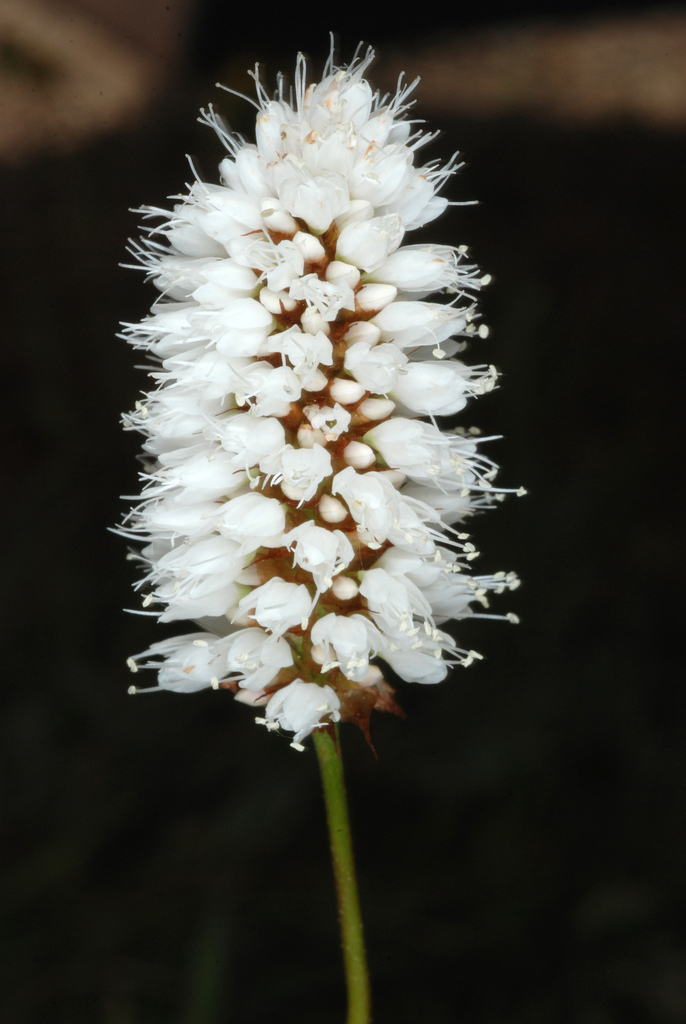
(c) Douglas Goldman, some rights reserved (CC BY-SA), uploaded by Douglas Goldman · licence
Family: Polygonaceae · Type: Herb · Native
Bistorta bistortoides (Western bistort) is a native California herb in the Polygonaceae family, recognized by Only Bistorta species in California, distinguished by contorted rhizomes and dense cylindrical flower spikes.
Western bistort is a California native perennial found in the northern Coast Ranges and northern eastern Sierra Nevada in wet meadows, streambanks, and alpine slopes at elevations of 1,500 to 3,000 meters. Flowering from July to September, this plant produces white to pale pink flowers in dense spike-like clusters 10 to 40 millimeters long. Growing with erect stems 20 to 70 centimeters tall, it emerges from contorted rhizomes with primarily basal leaves. Its leaves are elliptic to lance-oblong, 4 to 30 centimeters long, with entire margins and a tapered base, typically glaucous with minimal surface hairs. The fruit is a small, shiny, light-brown to olive-brown obovoid seed 3 to 4 millimeters long.
Identification and appearance
Key characters: Only Bistorta species in California, distinguished by contorted rhizomes and dense cylindrical flower spikes
Habitat and range
Habitat: Wet meadows, streambanks, alpine slopes
Elevation: 1500-3000 m
California counties: Tulare, Alpine, Mono, San Bernardino, Sonoma, Modoc, Fresno, Amador, Calaveras, Del Norte, Glenn, Inyo, Lake, Nevada, Riverside, Stanislaus, Trinity, Butte, El Dorado, Humboldt, Kern, Lassen, Madera, Marin, Mariposa, Mendocino, Placer, Plumas, Shasta, Sierra, Siskiyou, Tehama, Tuolumne
Outside California: to Alaska, eastern North America
Bloom period
Bistorta bistortoides blooms Jul-Sep.
How to tell it apart
vs Triantha: Bistorta has cylindrical fuzzy spikes; Triantha has more open sticky flower clusters.; vs Valeriana: Bistorta has dense bottlebrush spikes and simple leaves; Valeriana has branched clusters and divided leaves.; vs Plantago: Bistorta has white fuzzy bottlebrush spikes; Plantago has thin greenish spikes with tiny flowers.; vs Oxyria: Bistorta has dense flower spikes and plump seeds; Oxyria has loose flower clusters and winged fruits.; vs Persicaria: Bistorta has bottlebrush spikes on unbranched stems; Persicaria has branched stems and papery stem sheaths.
Frequently asked questions
Is Bistorta bistortoides native to California?
Yes. Bistorta bistortoides is native to California (recorded as native).
When does Bistorta bistortoides bloom?
Bistorta bistortoides blooms Jul-Sep.
Where in California does Bistorta bistortoides grow?
Bistorta bistortoides occurs in Tulare, Alpine, Mono, San Bernardino, Sonoma, Modoc, Fresno, Amador and other counties, at elevations of 1500-3000 m.
What plant family does Bistorta bistortoides belong to?
Bistorta bistortoides is in the Polygonaceae family, genus Bistorta.
What habitat does Bistorta bistortoides grow in?
Bistorta bistortoides grows in Wet meadows, streambanks, alpine slopes.
Related species
Other California species in the same genus, family, or bioregion.
Sources: Jepson eFlora · Index of California Plant Names · CalPhotos
Last updated 2026-10-07
Data from The California Species Project — 14,000+ California species with verified data from CNPS, CDFW, USFWS, Cal-IPC, and more.