Blepharizonia plumosa
Big tarplant
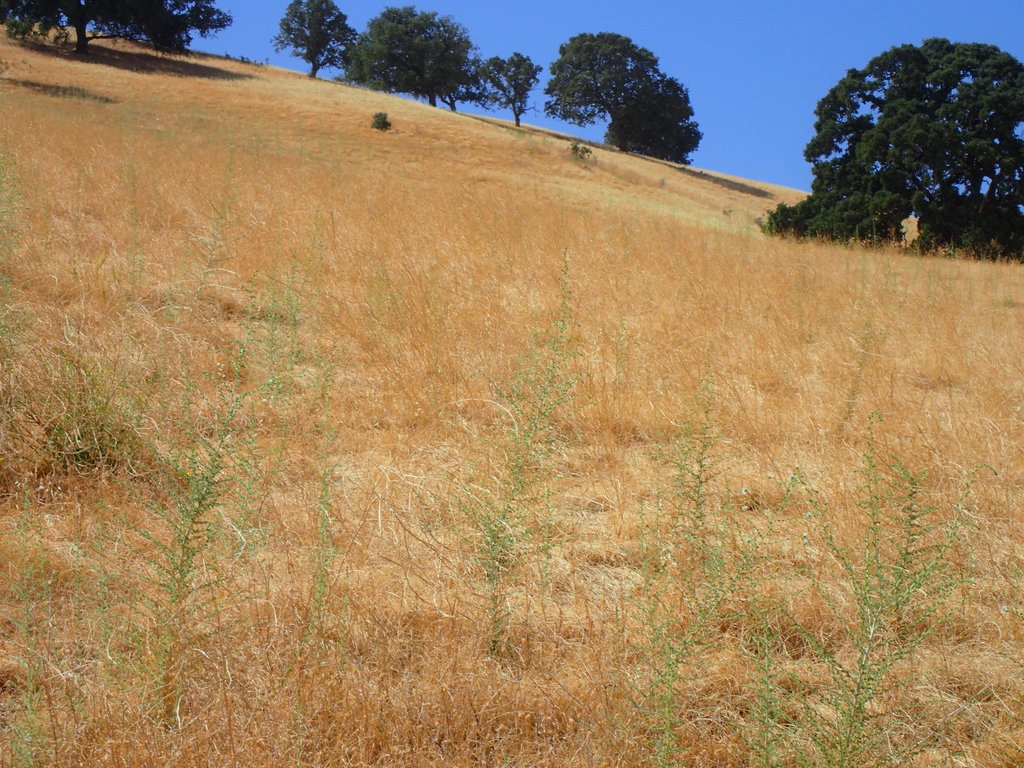
no rights reserved · CC0
Family: Asteraceae · Type: Herb · Native
Conservation status: CNPS 1B.1
Blepharizonia plumosa (Big tarplant) is a native California herb in the Asteraceae family, recognized by . CNPS 1B.1 rare plant. Distinguishable by canescent (woolly-gray) involucre vs coarse-hairy, and much more restricted range/elevation.
Big tarplant is a rare (CNPS 1B.1) California native annual found in northwestern San Joaquin Valley and eastern San Francisco Bay Area in dry grassland slopes at elevations below 500 meters. Flowering from July to November, this plant produces yellow flowers in distinctive involucres that are grayish-white and covered with tiny tack-shaped glands. Growing with upright stems 20 to 60 centimeters tall, it forms an open, branching habit typical of annual grassland species. Its leaves are deeply divided with narrow, feather-like segments that give the plant a delicate, soft appearance. The fruit is small and adapted to wind dispersal across its dry, open habitat.
Identification and appearance
Key characters: 1 sympatric species. CNPS 1B.1 rare plant. Distinguishable by canescent (woolly-gray) involucre vs coarse-hairy, and much more restricted range/elevation.
Habitat and range
Habitat: dry slopes in grassland
Elevation: < 500 m
Bloom period
Blepharizonia plumosa blooms Jul-Nov.
Conservation status
CNPS 1B.1
How to tell it apart
vs Hemizonia: Blepharizonia ray fruits are hairy; Hemizonia ray fruits are completely smooth.; vs Holocarpha: Blepharizonia lacks pit-gland-tipped bracts on flower stalks; Holocarpha has distinctive pit glands.; vs Deinandra: Blepharizonia has paleae only at disk edge; Deinandra (if annual) also edge-only but ray fruits differ.; vs Osmadenia: Blepharizonia is sticky-glandular; Osmadenia completely lacks sticky glands.; vs Calycadenia: Blepharizonia has shallowly lobed rays; Calycadenia has deeply split, fringed ray petals.
Frequently asked questions
Is Blepharizonia plumosa native to California?
Yes. Blepharizonia plumosa is native to California (recorded as native).
When does Blepharizonia plumosa bloom?
Blepharizonia plumosa blooms Jul-Nov.
What plant family does Blepharizonia plumosa belong to?
Blepharizonia plumosa is in the Asteraceae family, genus Blepharizonia.
Is Blepharizonia plumosa rare or endangered?
Blepharizonia plumosa carries California Rare Plant Rank 1B.1, state rank S1S2.
What habitat does Blepharizonia plumosa grow in?
Blepharizonia plumosa grows in dry slopes in grassland.
Related species
Other California species in the same genus, family, or bioregion.
Sources: Jepson eFlora · CNPS Rare Plant Inventory · Index of California Plant Names · CalPhotos · CDFW CNDDB
Last updated 2026-10-07
Data from The California Species Project — 14,000+ California species with verified data from CNPS, CDFW, USFWS, Cal-IPC, and more.