Bloomeria crocea var. crocea
Common goldenstar
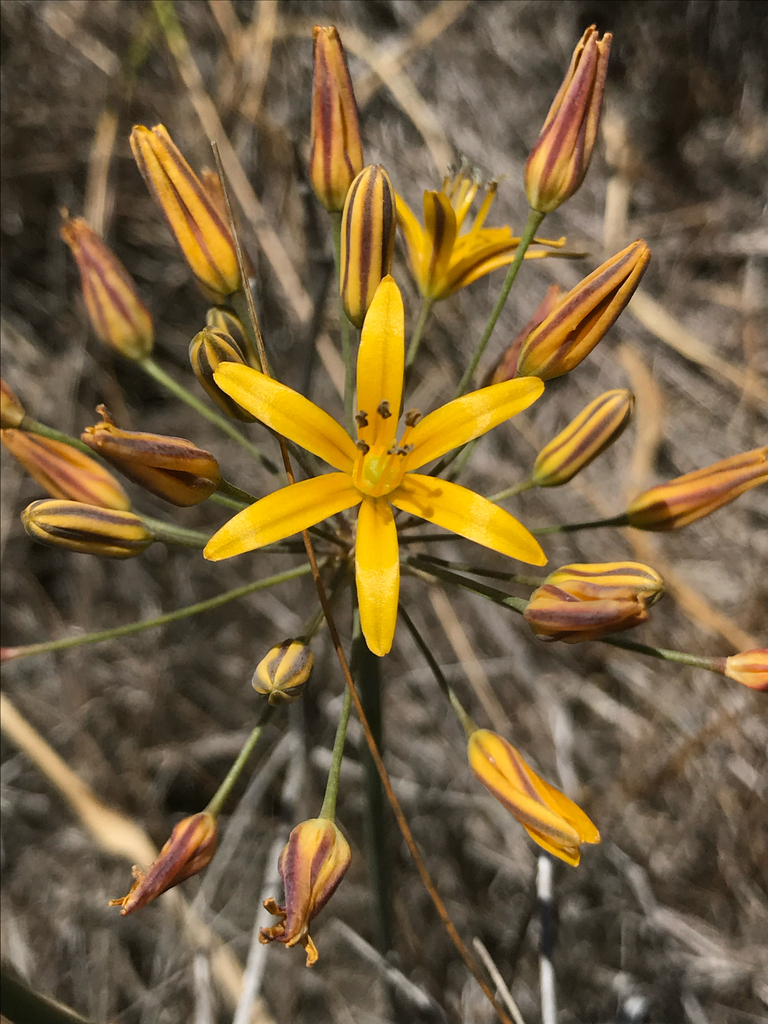
(c) Adam J. Searcy, some rights reserved (CC BY), uploaded by Adam J. Searcy · licence
Family: Themidaceae · Type: Herb · Native
Bloomeria crocea var. crocea (Common goldenstar) is a native California herb in the Themidaceae family, recognized by characteristic dark parallel lines on petals and small nectar cups.
Common goldenstar is a California native perennial found in coastal western and southwestern California regions in dry flats, hillsides, chaparral, coastal-sage scrub, valley grassland, and oak woodland at elevations below 1,700 meters. Flowering from April to June, this plant produces vibrant yellow-orange flowers with two distinctive dark parallel lines, creating a striking visual pattern. Growing with slender stems emerging from underground corms, it forms compact clusters in its native habitats. Its narrow, grass-like leaves emerge from the base, providing a delicate green backdrop to the brilliant flower clusters. The flower's nectar cup features tiny cusps less than 1 millimeter long, adding a subtle architectural detail to its elegant bloom.
Identification and appearance
Key characters: Co-occurs with 5 species; distinguished by characteristic dark parallel lines on petals and small nectar cups
Habitat and range
Habitat: dry flats, hillsides, chaparral, coastal-sage scrub, valley grassland, oak woodland
Elevation: < 1700 m
California counties: Los Angeles, Orange, San Bernardino, Riverside, San Diego, Ventura, Fresno, Santa Barbara, Kern, Monterey, San Benito, San Luis Obispo
Outside California: northern Baja California
Bloom period
Bloomeria crocea var. crocea blooms Apr-Jun.
How to tell it apart
vs Triteleia: Bloomeria has golden spreading stars; Triteleia has tubular flowers in purple, blue, white, or pale yellow.; vs Primula: Bloomeria grows from bulbs with grass-like leaves; Primula has basal rosettes of broad leaves.; vs Muilla: Bloomeria flowers are golden yellow; Muilla flowers are white.; vs Androstephium: Bloomeria has spreading star petals; Androstephium has tubular flowers.; vs Brodiaea: Bloomeria has golden spreading stars; Brodiaea has purple tubular flowers.
Frequently asked questions
Is Bloomeria crocea var. crocea native to California?
Yes. Bloomeria crocea var. crocea is native to California (recorded as native).
When does Bloomeria crocea var. crocea bloom?
Bloomeria crocea var. crocea blooms Apr-Jun.
Where in California does Bloomeria crocea var. crocea grow?
Bloomeria crocea var. crocea occurs in Los Angeles, Orange, San Bernardino, Riverside, San Diego, Ventura, Fresno, Santa Barbara and other counties, at elevations of < 1700 m.
What plant family does Bloomeria crocea var. crocea belong to?
Bloomeria crocea var. crocea is in the Themidaceae family, genus Bloomeria.
What habitat does Bloomeria crocea var. crocea grow in?
Bloomeria crocea var. crocea grows in dry flats, hillsides, chaparral, coastal-sage scrub, valley grassland, oak woodland.
Related species
Other California species in the same genus, family, or bioregion.
Sources: Jepson eFlora · Index of California Plant Names · CalPhotos
Last updated 2026-10-07
Data from The California Species Project — 14,000+ California species with verified data from CNPS, CDFW, USFWS, Cal-IPC, and more.