Bolboschoenus maritimus subsp. paludosus
Saltmarsh bulrush, alkali bulrush, Alkali Bulrush
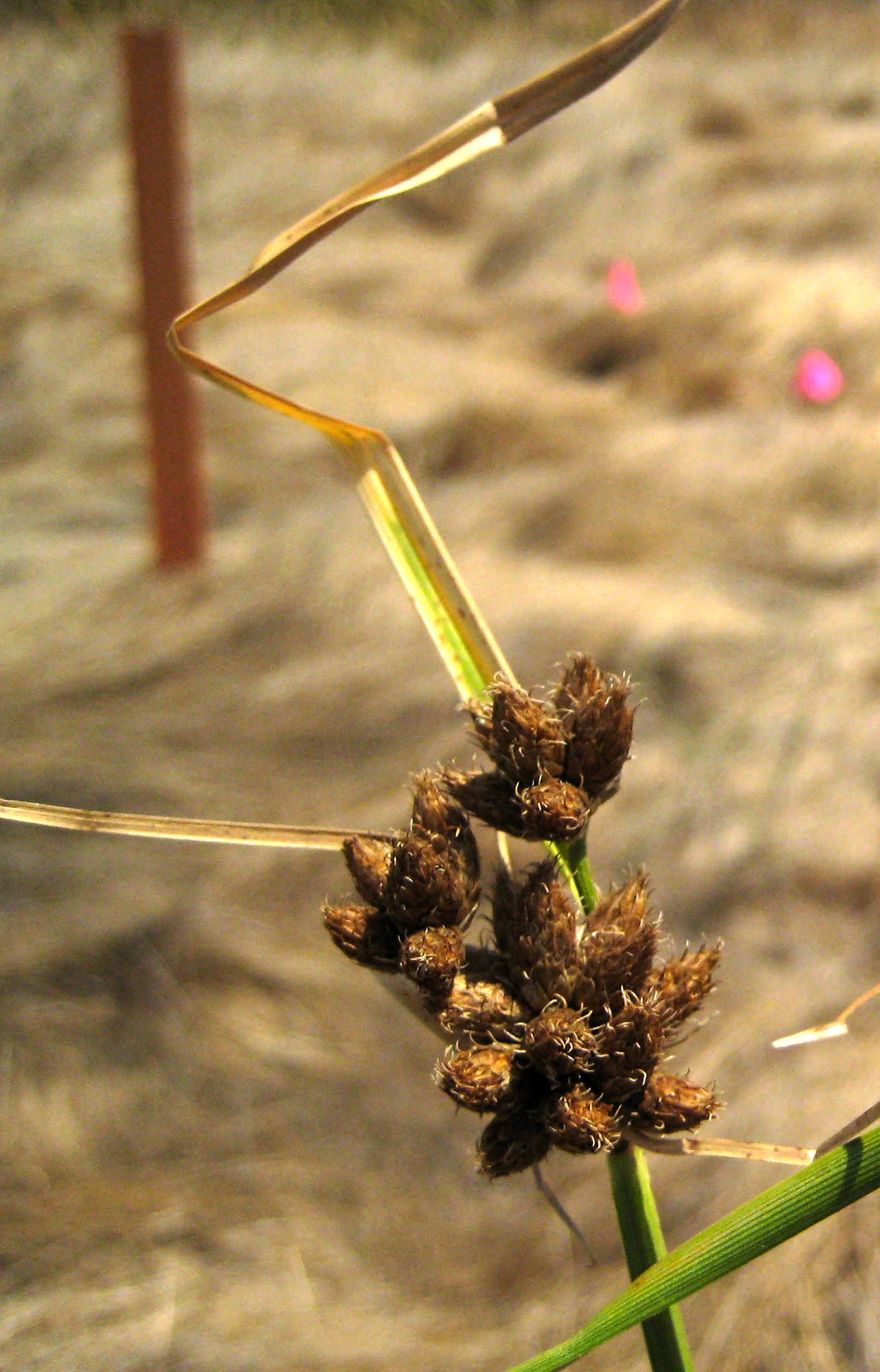
Photo by Chez Brungraber
Family: Cyperaceae · Type: Grass · Native
Bolboschoenus maritimus subsp. paludosus (Saltmarsh bulrush) is a native California grass in the Cyperaceae family, recognized by wide distribution, brackish-saline habitat, floating fruits, and mostly unbranched inflorescence.
Saltmarsh bulrush is a native perennial found throughout California (excluding the California and Sierra Nevada Ranges) in brackish to saline coastal and inland marshes at elevations up to 2,900 meters. Flowering during summer, this plant produces yellow-anthered flowers in compact clusters with spikelets 7 to 40 millimeters long. Growing up to 150 centimeters tall with stems 3 to 8 millimeters in diameter, it forms dense clumps in wet environments. Its leaves have distinctive triangular, membranous sheaths and blades 2 to 12 millimeters wide, with transparent, membranous flower bracts. The fruit is uniquely adapted to aquatic environments, developing as a small, two-sided structure that floats on water and is 2.3 to 4.1 millimeters long.
Identification and appearance
Key characters: 3 sympatric species; key features are wide distribution, brackish-saline habitat, floating fruits, and mostly unbranched inflorescence
Habitat and range
Habitat: Common in California. Brackish to saline coastal, inland marshes, shores
Elevation: < 2900 m
California counties: Ventura, Kern, Riverside, Los Angeles, Orange, Imperial, San Bernardino, Inyo, San Luis Obispo, Monterey, San Diego, Solano, Humboldt, Sonoma, Santa Barbara, Butte, San Mateo, Marin, Fresno, Merced, Glenn, Kings, Lassen, Contra Costa, Colusa, Siskiyou, Napa, Modoc, Del Norte, San Joaquin, Alameda, Mendocino, Yolo, Tehama, Placer, Stanislaus, Sutter, Tulare
Outside California: to Alaska, Nova Scotia, Texas, temperate South America, Eurasia, Africa, Hawaii
Bloom period
Bolboschoenus maritimus subsp. paludosus blooms Summer.
How to tell it apart
vs Schoenoplectus: Dig for tubers - Bolboschoenus has firm tubers, Schoenoplectus has only fibrous roots or rhizomes.; vs Carex: Bolboschoenus flowers are in rounded spikelets, Carex has separate male/female spikes or combined in same spike.; vs Scirpus: Bolboschoenus has firm underground tubers, Scirpus lacks tubers entirely.; vs Cyperus: Bolboschoenus has three-angled stems, Cyperus typically has flat leaf-like bracts radiating umbrella-like at top.; vs Sporobolus: Bolboschoenus stems are three-angled and solid, grass stems are round and hollow with nodes.
Frequently asked questions
Is Bolboschoenus maritimus subsp. paludosus native to California?
Yes. Bolboschoenus maritimus subsp. paludosus is native to California (recorded as native).
When does Bolboschoenus maritimus subsp. paludosus bloom?
Bolboschoenus maritimus subsp. paludosus blooms Summer.
Where in California does Bolboschoenus maritimus subsp. paludosus grow?
Bolboschoenus maritimus subsp. paludosus occurs in Ventura, Kern, Riverside, Los Angeles, Orange, Imperial, San Bernardino, Inyo and other counties, at elevations of < 2900 m.
What plant family does Bolboschoenus maritimus subsp. paludosus belong to?
Bolboschoenus maritimus subsp. paludosus is in the Cyperaceae family, genus Bolboschoenus.
What habitat does Bolboschoenus maritimus subsp. paludosus grow in?
Bolboschoenus maritimus subsp. paludosus grows in Common in California. Brackish to saline coastal, inland marshes, shores.
Related species
Other California species in the same genus, family, or bioregion.
Sources: Jepson eFlora · Index of California Plant Names · CalPhotos
Last updated 2026-10-07
Data from The California Species Project — 14,000+ California species with verified data from CNPS, CDFW, USFWS, Cal-IPC, and more.