Borago officinalis
Borage
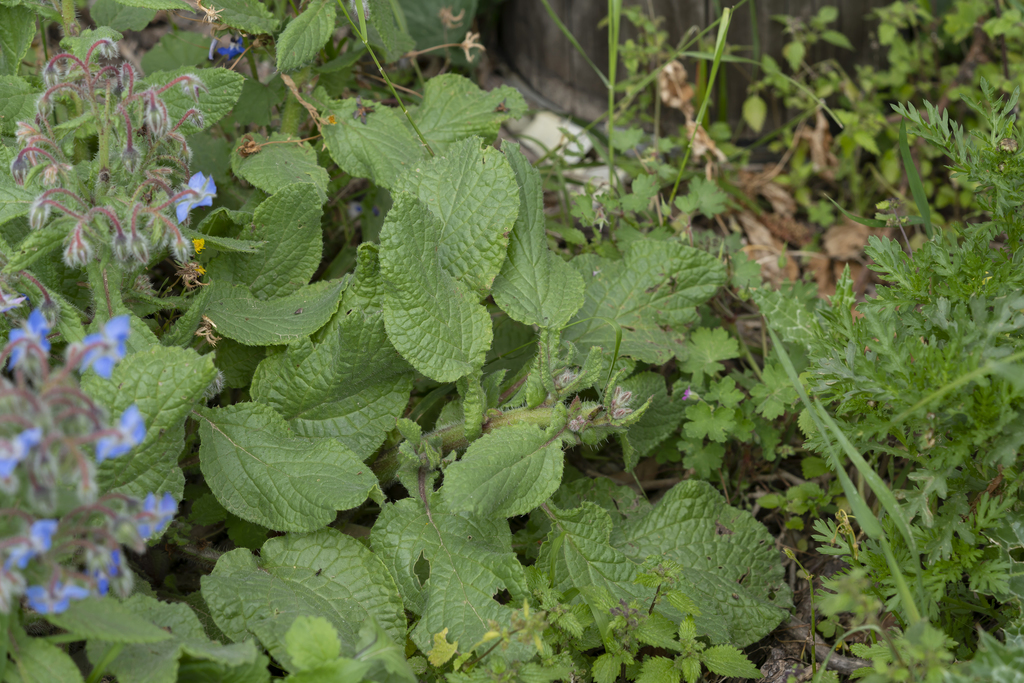
(c) Eleftherios Katsillis, some rights reserved (CC BY), uploaded by Eleftherios Katsillis · licence
Family: Boraginaceae · Type: Herb · Not Native
Borago officinalis (Borage) is a non-native California herb in the Boraginaceae family, recognized by Cultivated European herb occasionally escaping in coastal California.
Borage is a naturalized perennial found in the Central Coast, San Francisco Bay, and Southern California coastal areas in open, disturbed sites at elevations below 550 meters. Flowering from June to August, this plant produces bright blue flowers with a distinctive rotate corolla about 18 to 20 millimeters in diameter. Growing with branching stems 20 to 70 centimeters tall, it develops from a robust taproot. Its lower leaves are large and broad, measuring 8 to 20 centimeters long and 3 to 8 centimeters wide. The fruit consists of small nutlets approximately 5 to 7 millimeters long.
Identification and appearance
Key characters: Cultivated European herb occasionally escaping in coastal California
Habitat and range
Habitat: Open, disturbed sites
Elevation: < 550 m
California counties: Santa Cruz, Los Angeles, Marin, Solano, Santa Clara, Santa Barbara, Monterey, Contra Costa, Ventura, San Diego, Nevada, Sacramento, Tulare, Humboldt, Alameda, San Luis Obispo, San Mateo
Outside California: widespread United States, native to southern Europe
Bloom period
Borago officinalis blooms Jun-Aug.
How to tell it apart
vs Anchusa: Anchusa has a salverform to funnel corolla with a closed throat (scales) and included anthers; Borago has a flat, star-shaped blue corolla with a protruding cone of dark anthers.; vs Echium: Echium is a tall, shrubby plant with 2-lipped (asymmetric) funnel flowers and exserted stamens; Borago is a coarse, bristly herb with radial, star-shaped flowers.; vs Symphytum: Comfrey has nodding tubular-bell flowers and leaf bases that run down and wing the stem; Borago has flat blue star flowers and non-decurrent leaves.; vs Cynoglossum: Hound's-tongue has small funnel flowers and bur-like clinging nutlets; Borago has large (limb ~2 cm) blue star flowers with a central anther cone.; vs Myosotis: Forget-me-nots are small with tiny salverform flowers and a yellow eye; Borago has large, spreading blue stars with a dark protruding anther cone.
Frequently asked questions
Is Borago officinalis native to California?
No. Borago officinalis is not native to California (recorded as not native).
When does Borago officinalis bloom?
Borago officinalis blooms Jun-Aug.
Where in California does Borago officinalis grow?
Borago officinalis occurs in Santa Cruz, Los Angeles, Marin, Solano, Santa Clara, Santa Barbara, Monterey, Contra Costa and other counties, at elevations of < 550 m.
What plant family does Borago officinalis belong to?
Borago officinalis is in the Boraginaceae family, genus Borago.
What habitat does Borago officinalis grow in?
Borago officinalis grows in Open, disturbed sites.
Related species
Other California species in the same genus, family, or bioregion.
Sources: Jepson eFlora · Index of California Plant Names · CalPhotos
Last updated 2026-10-07
Data from The California Species Project — 14,000+ California species with verified data from CNPS, CDFW, USFWS, Cal-IPC, and more.