Botrychium hesperium
Western moonwort
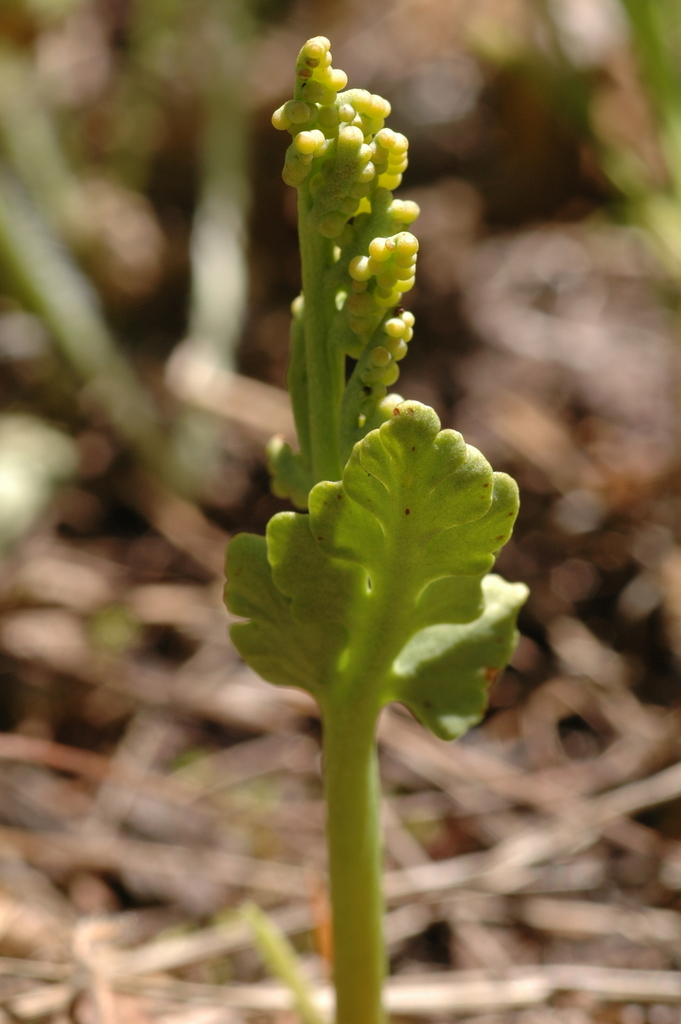
(c) Timothy McNitt, some rights reserved (CC BY), uploaded by Timothy McNitt · licence
Family: Ophioglossaceae · Type: Herb · Native
Botrychium hesperium (Western moonwort) is a native California herb in the Ophioglossaceae family, recognized by limited distribution data available.
Western moonwort is a California native perennial found in wet meadows at elevations up to 3,200 meters. Growing with a distinctive fern-like structure, this plant has a trophophore blade 2 to 5 centimeters long and 2 to 3 centimeters wide, with 3 to 6 pairs of ovate to elliptic pinnae. Its fronds emerge with a dull yellowish-green color, featuring pinnae that ascend with broadly attached margins and converge at approximately 120-degree angles. The plant's common stalk is roughly equal in length to its trophophore, with a sporophore stalk measuring about half to two-thirds of the trophophore's length. Its fertile portion is ovate to triangular, bearing evenly spaced sporangia across its ascending pinnae.
Identification and appearance
Key characters: Geographically isolated; limited distribution data available
Habitat and range
Habitat: Wet meadows
Elevation: 3200 m
Outside California: western North America
How to tell it apart
vs Sceptridium: Check the leaf bud - Botrychium is completely smooth, Sceptridium is hairy.; vs Ophioglossum: Botrychium has divided compound leaves; Ophioglossum has a single simple oval blade.; vs Botrypus: Feel the leaf bud - Botrychium is smooth and hairless, Botrypus is distinctly hairy.
Frequently asked questions
Is Botrychium hesperium native to California?
Yes. Botrychium hesperium is native to California (recorded as native).
What plant family does Botrychium hesperium belong to?
Botrychium hesperium is in the Ophioglossaceae family, genus Botrychium.
What habitat does Botrychium hesperium grow in?
Botrychium hesperium grows in Wet meadows.
Related species
Other California species in the same genus, family, or bioregion.
Sources: Jepson eFlora · CalPhotos
Last updated 2026-10-07
Data from The California Species Project — 14,000+ California species with verified data from CNPS, CDFW, USFWS, Cal-IPC, and more.