Bouteloua gracilis
Blue grama
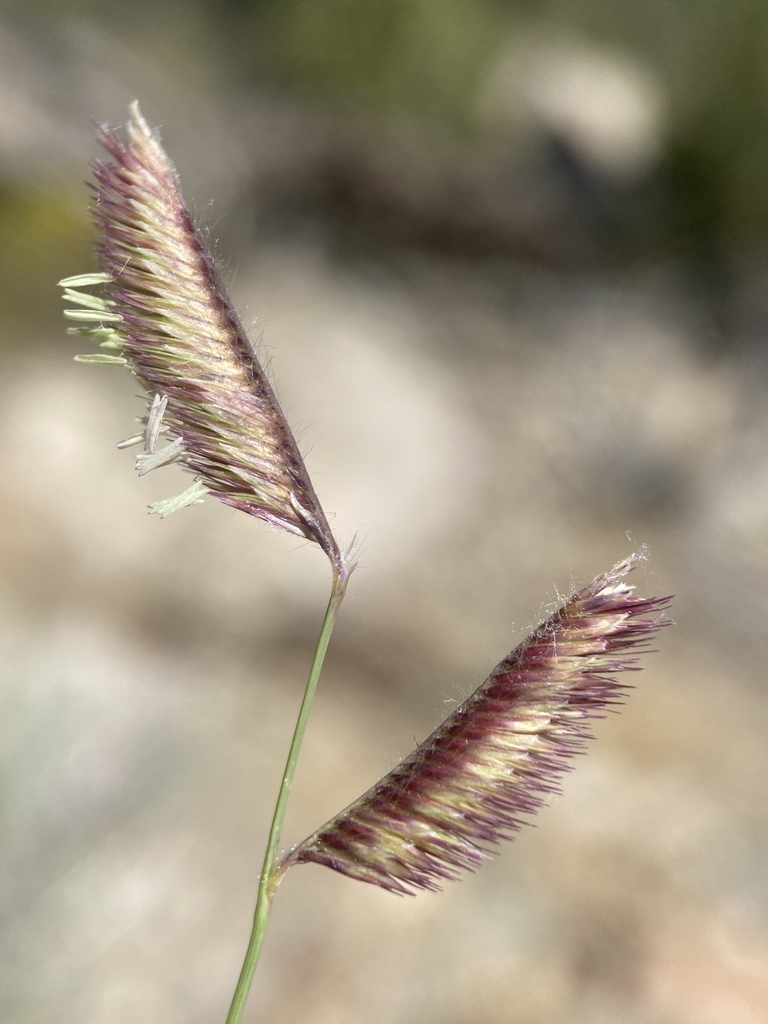
(c) Matt Berger, some rights reserved (CC BY), uploaded by Matt Berger · licence
Family: Poaceae · Type: Grass · Native
Bouteloua gracilis (Blue grama) is a native California grass in the Poaceae family, recognized by few branches and distinctive glume hairs.
Blue grama is a native perennial grass found in the eastern Mojave Desert Mountains, including Mid Hills, Clark Mountain Range, Ivanpah, and New York Mountains, on sandy to rocky slopes and in scrub, woodland, and pine forest habitats at elevations below 2,700 meters. Flowering from May to October, this grass produces small, delicate spikelets with spreading branches that create a distinctive comb-like appearance. Growing with ascending to erect stems 10 to 60 centimeters tall, it forms short rhizomes and develops compact clusters of narrow leaves less than 15 centimeters long and 2 millimeters wide. Its spikelets feature unique hairy-tufted bases and characteristic 2 to 3 florets with unequal awns emerging from the leaf clusters. The grass's remarkable ability to spread through short rhizomes and its adaptability to diverse desert and woodland environments make it a resilient and widespread species across its range.
Identification and appearance
Key characters: 2 sympatric species; key features are few branches and distinctive glume hairs
Habitat and range
Habitat: Sandy to rocky slopes, flats, drainages, scrub, woodland, pine forest
Elevation: < 2700 m
California counties: San Bernardino, Merced, San Diego, Santa Barbara, Riverside, Kern, Sacramento
Outside California: to southern Canada, eastern United States, southern Mexico, Argentina
Bloom period
Bouteloua gracilis blooms May-Oct.
How to tell it apart
vs Cenchrus: Bouteloua has one-sided comb-like spikes; Cenchrus has spiny burs around the spikelets.; vs Melica: Bouteloua has spikelets on one side only; Melica has spikelets all around the branches.; vs Avena: Bouteloua has tiny comb-like spikes; Avena has large, dangling spikelets in open clusters.; vs Ehrharta: Bouteloua has 3-veined lemmas; Ehrharta has hardened sterile lemmas below the fertile one.; vs Hordeum: Bouteloua has one-sided brush spikes; Hordeum has cylindrical spikes with bristly glumes all around.
Frequently asked questions
Is Bouteloua gracilis native to California?
Yes. Bouteloua gracilis is native to California (recorded as native).
When does Bouteloua gracilis bloom?
Bouteloua gracilis blooms May-Oct.
Where in California does Bouteloua gracilis grow?
Bouteloua gracilis occurs in San Bernardino, Merced, San Diego, Santa Barbara, Riverside, Kern, Sacramento, at elevations of < 2700 m.
What plant family does Bouteloua gracilis belong to?
Bouteloua gracilis is in the Poaceae family, genus Bouteloua.
What habitat does Bouteloua gracilis grow in?
Bouteloua gracilis grows in Sandy to rocky slopes, flats, drainages, scrub, woodland, pine forest.
Related species
Other California species in the same genus, family, or bioregion.
- Bouteloua sp. — Grama
- Bouteloua trifida — Three-awned grama
- Bouteloua aristidoides var. aristidoides — Needle grama
- Bouteloua barbata var. barbata — Sixweeks grama
- Bouteloua curtipendula — Side-oats grama
- Bouteloua eriopoda — Black grama
- Brachypodium distachyon — False brome
- Brachypodium pinnatum — Heath false brome
Sources: Jepson eFlora · Index of California Plant Names · CalPhotos
Last updated 2026-10-07
Data from The California Species Project — 14,000+ California species with verified data from CNPS, CDFW, USFWS, Cal-IPC, and more.