Brachypodium sylvaticum
Slender false brome
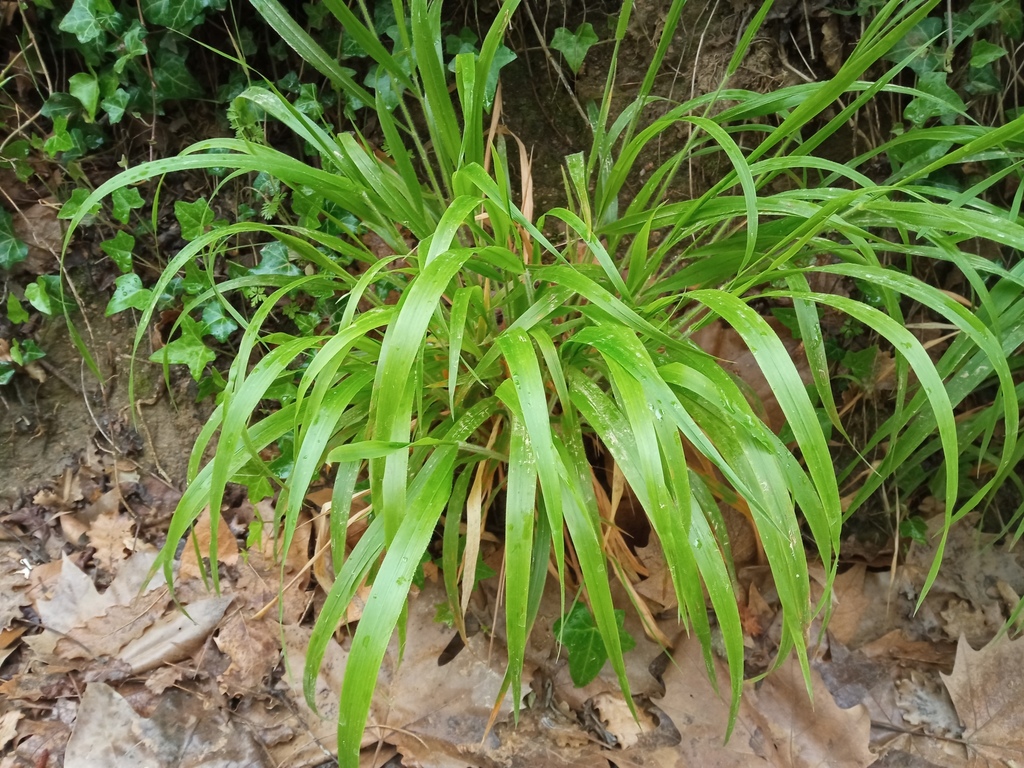
(c) Josep Gesti, some rights reserved (CC BY-SA), uploaded by Josep Gesti · licence
Family: Poaceae · Type: Grass · Not Native
Conservation status: Cal-IPC Yes
Brachypodium sylvaticum (Slender false brome) is a non-native California grass in the Poaceae family, recognized by . Cespitose growth form and long awns distinguish from other species.
Slender false brome is a naturalized perennial grass found in San Francisco Bay Area in forest, woodland, and upland prairies at elevations below 600 meters. Flowering from November to December, this grass produces pale green to tan spikelets in loose, distant clusters. Growing with erect stems 30 to 200 centimeters tall, it forms dense tufted clumps in woodland areas. Its flat leaves are 8 to 35 centimeters long and 4 to 15 millimeters wide, with soft, smooth leaf sheaths. The grass produces distinctive spikelets with elongated awns 7 to 15 millimeters long, which are typically as long or longer than the lemma.
Identification and appearance
Key characters: 2 sympatric species. Cespitose growth form and long awns distinguish from other species.
Habitat and range
Habitat: Forest, woodland, upland prairies
Elevation: < 600 m
California counties: San Mateo
Outside California: Oregon, Washington, British Columbia, Virginia, native to Europe and northern Africa
Bloom period
Brachypodium sylvaticum blooms Nov-Dec.
Conservation status
Cal-IPC Yes
How to tell it apart
vs Bromus: Brachypodium upper glume has 5-9 veins; Bromus typically has fewer.; vs Ehrharta: Brachypodium has fringed seed case edges; Ehrharta has smooth, hardened sterile lemmas below each fertile floret.; vs Hordeum: Brachypodium spikelets lack long awns and ear-like leaf bases; Hordeum has both.; vs Festuca: Brachypodium has strongly fringed inner bract edges; Festuca bracts are smooth.; vs Hilaria: Brachypodium has solitary spikelets at each node; Hilaria has 3-spikelet clusters.
Frequently asked questions
Is Brachypodium sylvaticum native to California?
No. Brachypodium sylvaticum is not native to California (recorded as not native).
When does Brachypodium sylvaticum bloom?
Brachypodium sylvaticum blooms Nov-Dec.
Where in California does Brachypodium sylvaticum grow?
Brachypodium sylvaticum occurs in San Mateo, at elevations of < 600 m.
What plant family does Brachypodium sylvaticum belong to?
Brachypodium sylvaticum is in the Poaceae family, genus Brachypodium.
Is Brachypodium sylvaticum invasive in California?
Brachypodium sylvaticum is listed by Cal-IPC with an invasiveness rating of Yes.
Related species
Other California species in the same genus, family, or bioregion.
Sources: Jepson eFlora · Index of California Plant Names · CalPhotos
Last updated 2026-10-07
Data from The California Species Project — 14,000+ California species with verified data from CNPS, CDFW, USFWS, Cal-IPC, and more.