Brasenia schreberi
Watershield
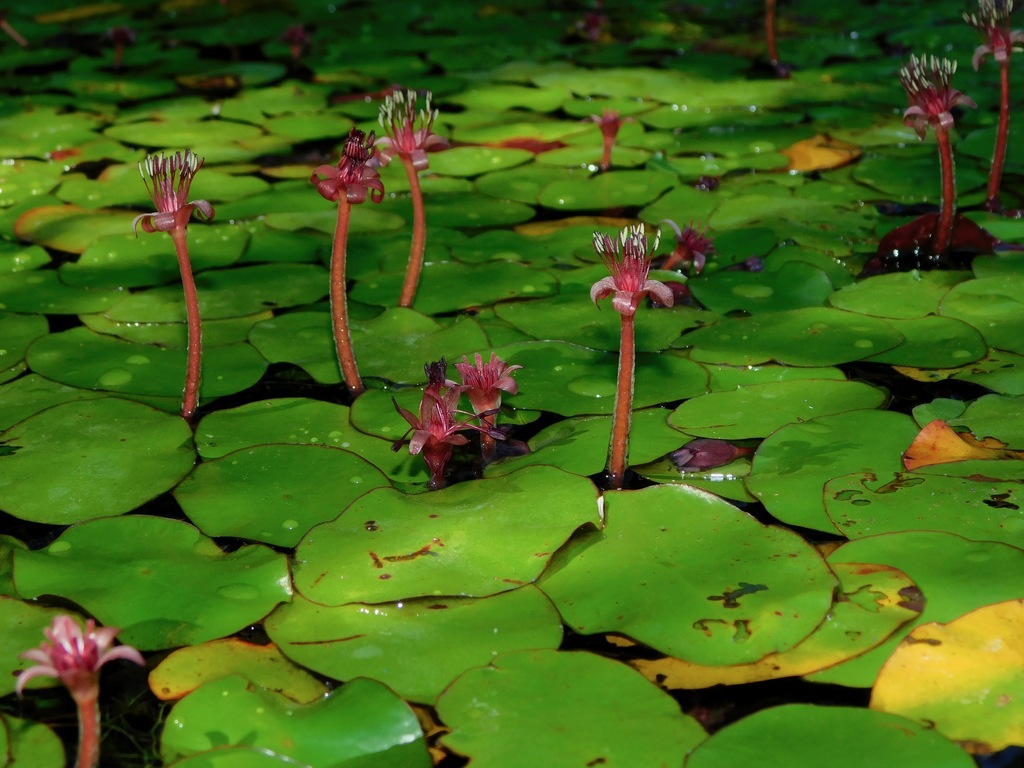
(c) Michael J. Papay, some rights reserved (CC BY), uploaded by Michael J. Papay · licence
Family: Cabombaceae · Type: Herb · Native
Conservation status: CNPS 2B.3
Brasenia schreberi (Watershield) is a native California herb in the Cabombaceae family, recognized by Ancient lineage with disjunct global distribution, relict populations in California.
Watershield is a California native perennial found in the Klamath Ranges, northern California Coast Ranges, Sierra Nevada, Sacramento Valley, and Modoc Plateau in ponds and slow streams at elevations below 2,200 meters. Flowering from April to October, this aquatic plant produces red-purple to purple-brown flowers about 10 to 20 millimeters long with linear-oblong petals. Growing with slender, branching red-brown stems 30 to 200 centimeters long, it is distinctive for its submersed parts covered in thick mucilage. Its centrally attached (peltate) leaves are elliptic to ovate, 3.5 to 12 centimeters long, with blades much smaller than their long petioles. Individual flowers emerge from leaf axils, with each plant bearing 4 to 18 carpels and producing small oblong, leathery fruits 6 to 8 millimeters long.
Identification and appearance
Key characters: Ancient lineage with disjunct global distribution, relict populations in California
Habitat and range
Habitat: Ponds, slow streams
Elevation: < 2200 m
California counties: Lake, Shasta, Tuolumne, Mendocino, Nevada, Plumas, Sierra, Sacramento, Siskiyou, Butte, Tehama, El Dorado, Tulare, Sutter, Lassen, Mariposa
Outside California: to Alaska, Montana, eastern North America, Central America, South America, Africa, eastern Asia, eastern Australia
Bloom period
Brasenia schreberi blooms Apr-Oct.
Conservation status
CNPS 2B.3
How to tell it apart
vs Nymphaea: Brasenia leaves attach at the center and have slimy undersides; waterlily leaves have a V-notch to the center and no slime.; vs Cabomba: Brasenia has simple oval floating leaves; Cabomba has feathery, finely-divided underwater leaves.; vs Peltandra: Brasenia has oval floating leaves with thick slime on all submerged parts; Peltandra has arrow-shaped leaves rising above water with no slime.; vs Nymphoides: Brasenia leaves attach at the center and feel slimy underneath; Nymphoides leaves have a V-notch and are never slimy.; vs Hydrocotyle: Brasenia leaves float flat on water with slimy undersides; Hydrocotyle leaves rise above water on stiff stalks with no slime.
Frequently asked questions
Is Brasenia schreberi native to California?
Yes. Brasenia schreberi is native to California (recorded as native).
When does Brasenia schreberi bloom?
Brasenia schreberi blooms Apr-Oct.
Where in California does Brasenia schreberi grow?
Brasenia schreberi occurs in Lake, Shasta, Tuolumne, Mendocino, Nevada, Plumas, Sierra, Sacramento and other counties, at elevations of < 2200 m.
What plant family does Brasenia schreberi belong to?
Brasenia schreberi is in the Cabombaceae family, genus Brasenia.
Is Brasenia schreberi rare or endangered?
Brasenia schreberi carries California Rare Plant Rank 2B.3, state rank S3.
Related species
Other California species in the same genus, family, or bioregion.
Sources: Jepson eFlora · CNPS Rare Plant Inventory · Index of California Plant Names · CalPhotos · CDFW CNDDB
Last updated 2026-10-07
Data from The California Species Project — 14,000+ California species with verified data from CNPS, CDFW, USFWS, Cal-IPC, and more.