Brassica oleracea
Cabbage
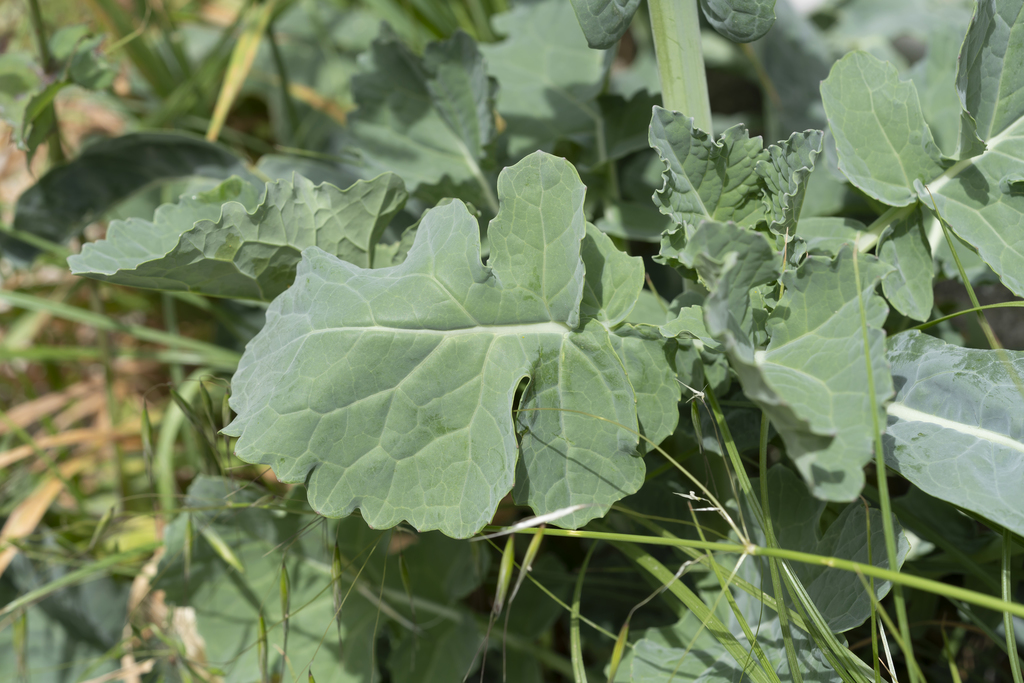
(c) Eleftherios Katsillis, some rights reserved (CC BY), uploaded by Eleftherios Katsillis · licence
Family: Brassicaceae · Type: Herb · Not Native
Brassica oleracea (Cabbage) is a non-native California herb in the Brassicaceae family, recognized by fleshy glaucous leaves, large pale flowers, and sea cliff habitat.
Cabbage is a naturalized perennial herb found in central and northern coastal California on southeast-facing sea cliffs at elevations below 400 meters. Flowering from May to August, this plant produces yellow or cream-white flowers 1.8 to 2.5 centimeters long with broad petals 8 to 12 millimeters wide. Growing with branched stems 50 to 100 centimeters tall, it develops fleshy, pinnately lobed basal leaves up to 75 centimeters long and smaller clasping cauline leaves. Its distinctive leaves range from deeply lobed at the base to sessile and partially clasping higher on the stem, with a smooth, glaucous appearance. The plant produces elongated fruits 5 to 8 centimeters long, with seeds approximately 1.7 to 2.5 millimeters wide.
Identification and appearance
Key characters: 2 sympatric species; key features are fleshy glaucous leaves, large pale flowers, and sea cliff habitat
Habitat and range
Habitat: Se-facing sea cliffs
Elevation: < 400 m
California counties: Monterey, San Mateo, Alameda, Los Angeles, San Francisco, Santa Barbara, Riverside, San Bernardino, Ventura, Sonoma, Marin, Contra Costa, San Luis Obispo, Del Norte, San Diego, Yolo, Mendocino
Outside California: to Washington, Montana, Texas, eastern North America, native to Europe
Bloom period
Brassica oleracea blooms May-Aug.
How to tell it apart
vs Hirschfeldia: Brassica pods angle outward with faint veining; Hirschfeldia pods press tight against the stem with prominent ribs.; vs Sisymbrium: Brassica has large showy flowers with petals 8-30mm; Sisymbrium has smaller, less conspicuous flowers.; vs Lactuca: Brassica has four-petaled yellow flowers and seed pods; Lactuca has ray flowers like a dandelion and milky sap.; vs Crambe: Brassica pods split open to release many seeds; Crambe produces single-seeded round fruits that don't split.
Frequently asked questions
Is Brassica oleracea native to California?
No. Brassica oleracea is not native to California (recorded as not native).
When does Brassica oleracea bloom?
Brassica oleracea blooms May-Aug.
Where in California does Brassica oleracea grow?
Brassica oleracea occurs in Monterey, San Mateo, Alameda, Los Angeles, San Francisco, Santa Barbara, Riverside, San Bernardino and other counties, at elevations of < 400 m.
What plant family does Brassica oleracea belong to?
Brassica oleracea is in the Brassicaceae family, genus Brassica.
What habitat does Brassica oleracea grow in?
Brassica oleracea grows in Se-facing sea cliffs.
Related species
Other California species in the same genus, family, or bioregion.
Sources: Jepson eFlora · Index of California Plant Names · CalPhotos
Last updated 2026-10-07
Data from The California Species Project — 14,000+ California species with verified data from CNPS, CDFW, USFWS, Cal-IPC, and more.