Brassica tournefortii
Sahara mustard
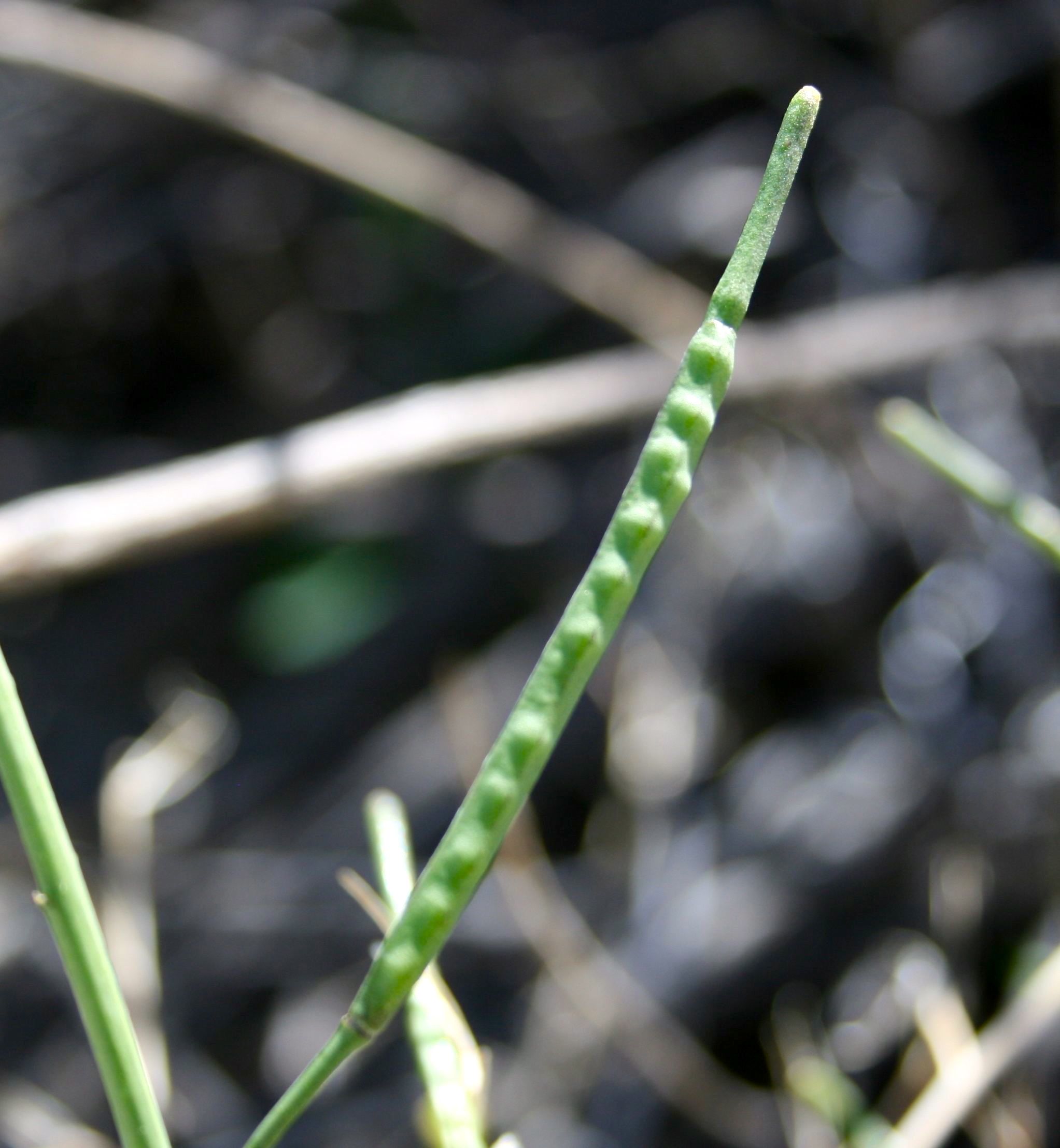
Photo by Chez Brungraber
Family: Brassicaceae · Type: Herb · Not Native
Conservation status: Cal-IPC Yes
Brassica tournefortii (Sahara mustard) is a non-native California herb in the Brassicaceae family, recognized by dense stiff hairs and deeply pinnately lobed basal leaves with many lateral lobe pairs.
Sahara mustard is a naturalized annual plant found in southwestern and desert bioregions in roadsides, washes, and open areas at elevations below 800 meters. Flowering from January to June, this plant produces yellow flowers 4 to 7 millimeters long with white or cream-colored petals. Growing with branched stems 30 to 70 centimeters tall, it develops a dense covering of stiff hairs across its stems and foliage. Its basal leaves form a persistent rosette with pinnately lobed edges, featuring 4 to 10 lateral lobe pairs that are serrate-dentate in appearance. The fruit develops as a slender, spreading to ascending pod 3 to 7 centimeters long, typically containing multiple small spherical seeds.
Identification and appearance
Key characters: 4 sympatric species; key features are dense stiff hairs and deeply pinnately lobed basal leaves with many lateral lobe pairs
Habitat and range
Habitat: Roadsides, washes, open areas
Elevation: < 800 m
California counties: San Diego, Kern, Riverside, San Bernardino, Imperial, Los Angeles, Monterey, Orange, San Luis Obispo, Kings, San Benito, Ventura, Inyo, Santa Barbara, Yolo, Sacramento
Outside California: to southern Nevada, Texas, native to Mediterranean, southwestern Asia
Bloom period
Brassica tournefortii blooms Jan-Jun.
Conservation status
Cal-IPC Yes
How to tell it apart
vs Hirschfeldia: Brassica pods angle outward with faint veining; Hirschfeldia pods press tight against the stem with prominent ribs.; vs Sisymbrium: Brassica has large showy flowers with petals 8-30mm; Sisymbrium has smaller, less conspicuous flowers.; vs Lactuca: Brassica has four-petaled yellow flowers and seed pods; Lactuca has ray flowers like a dandelion and milky sap.; vs Crambe: Brassica pods split open to release many seeds; Crambe produces single-seeded round fruits that don't split.
Frequently asked questions
Is Brassica tournefortii native to California?
No. Brassica tournefortii is not native to California (recorded as not native).
When does Brassica tournefortii bloom?
Brassica tournefortii blooms Jan-Jun.
Where in California does Brassica tournefortii grow?
Brassica tournefortii occurs in San Diego, Kern, Riverside, San Bernardino, Imperial, Los Angeles, Monterey, Orange and other counties, at elevations of < 800 m.
What plant family does Brassica tournefortii belong to?
Brassica tournefortii is in the Brassicaceae family, genus Brassica.
Is Brassica tournefortii invasive in California?
Brassica tournefortii is listed by Cal-IPC with an invasiveness rating of Yes.
Related species
Other California species in the same genus, family, or bioregion.
- Brassica fruticulosa — Mediterranean cabbage
- Brassica juncea — India mustard
- Brassica napus — Swede rape
- Brassica nigra — Black mustard
- Brassica oleracea — Cabbage
- Brassica rapa — Turnip
- Cakile edentula — American searocket
- Cakile maritima — European searocket
- Cakile sp. — Sea rocket
- Camelina microcarpa — False flax
Sources: Jepson eFlora · Index of California Plant Names · CalPhotos
Last updated 2026-10-07
Data from The California Species Project — 14,000+ California species with verified data from CNPS, CDFW, USFWS, Cal-IPC, and more.