Briza maxima
Rattlesnake grass, large quaking grass, Large Quaking Grass
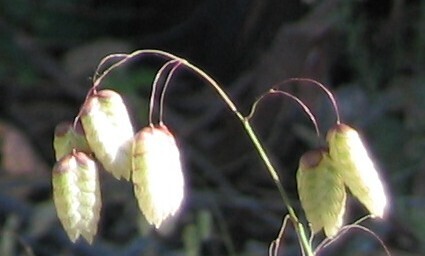
(c) zebedeugalinha, some rights reserved (CC BY) · licence
Family: Poaceae · Type: Grass · Not Native
Conservation status: Cal-IPC Yes
Briza maxima (Rattlesnake grass) is a non-native California grass in the Poaceae family, recognized by (B. minor). Clear distinction based on spikelet size, shape, orientation, and floret count.
Rattlesnake grass is a naturalized annual grass found in northwestern California, western California Ranges, northern Sierra Nevada, Sacramento Valley, central western California, southern California coastal areas, western Transverse Ranges, and Peninsular Ranges at elevations below 970 meters. Flowering from April to July, this plant produces delicate, pendulous spikelets in spreading to hanging clusters 2 to 10 centimeters long. Growing with slender stems 20 to 80 centimeters tall, it forms elegant, drooping grass heads that resemble small rattles. Its leaves have narrow blades 1 to 7 millimeters wide with short ligules 1 to 4 millimeters long, commonly found in shaded sites, roadsides, pastures, and coastal dune areas. Each distinctive spikelet contains 12 to 19 individual florets, creating a distinctive trembling appearance that gives the grass its snake-like nickname.
Identification and appearance
Key characters: 1 sympatric species (B. minor). Clear distinction based on spikelet size, shape, orientation, and floret count.
Habitat and range
Habitat: Shaded sites, roadsides, pastures, weedy on coastal dunes
Elevation: < 970 m
California counties: Humboldt, San Francisco, San Luis Obispo, Butte, Contra Costa, Los Angeles, Mendocino, Modoc, Monterey, Napa, Santa Cruz, Sonoma, Fresno, San Mateo, Yuba, Amador, Marin, Santa Barbara, Sacramento, Nevada, Calaveras, Trinity, Santa Clara, San Diego, Shasta, Tehama, Del Norte, Lake, Ventura, Siskiyou, Yolo, Solano, San Bernardino, Colusa, Placer
Outside California: to British Columbia, eastern United States, native to southern Europe
Bloom period
Briza maxima blooms Apr-Jul.
Conservation status
Cal-IPC Yes
How to tell it apart
vs Poa: Poa has narrow, keeled, several-flowered spikelets held rather stiffly; Briza has broad, ovate to heart-shaped, laterally flattened spikelets that dangle and tremble on hair-like pedicels.; vs Eragrostis: Eragrostis has small, linear-oblong, many-flowered spikelets; Briza spikelets are broad, papery, and shingle-like with overlapping rounded lemmas.; vs Melica: Melica also has swollen, papery spikelets, but they sit on a narrow, often one-sided raceme; Briza's hang from an open, spreading panicle and quake in the wind.; vs Bromus: Bromus has large, elongate, usually awned spikelets; Briza is awnless with rounded, closely overlapping florets.; vs Distichlis: Saltgrass has stiff, 2-ranked, tough spikelets on wiry rhizomatous stems; Briza is a soft annual with nodding, inflated, trembling spikelets.
Frequently asked questions
Is Briza maxima native to California?
No. Briza maxima is not native to California (recorded as not native).
When does Briza maxima bloom?
Briza maxima blooms Apr-Jul.
Where in California does Briza maxima grow?
Briza maxima occurs in Humboldt, San Francisco, San Luis Obispo, Butte, Contra Costa, Los Angeles, Mendocino, Modoc and other counties, at elevations of < 970 m.
What plant family does Briza maxima belong to?
Briza maxima is in the Poaceae family, genus Briza.
Is Briza maxima invasive in California?
Briza maxima is listed by Cal-IPC with an invasiveness rating of Yes.
Related species
Other California species in the same genus, family, or bioregion.
Sources: Jepson eFlora · Index of California Plant Names · CalPhotos
Last updated 2026-10-07
Data from The California Species Project — 14,000+ California species with verified data from CNPS, CDFW, USFWS, Cal-IPC, and more.