Briza minor
Annual quaking grass, small quaking grass, Small Quaking Grass
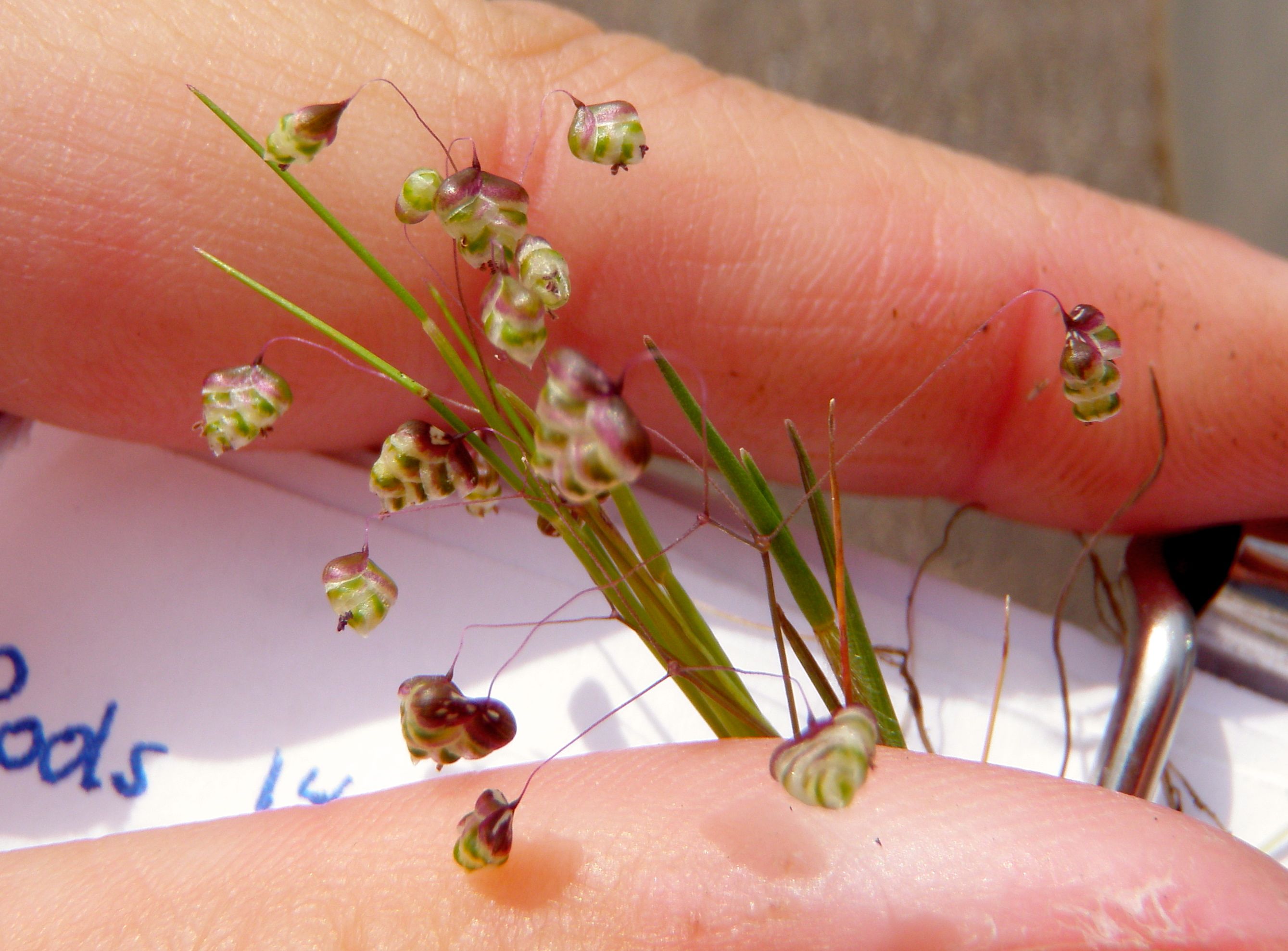
Photo by Chez Brungraber
Family: Poaceae · Type: Grass · Not Native
Briza minor (Annual quaking grass) is a non-native California grass in the Poaceae family, recognized by (B. maxima). Clear distinction based on spikelet size, shape, orientation, number per inflorescence, and floret count.
Annual quaking grass is a naturalized annual found in northwestern California, central high rocky forests, Sierra Nevada, Central Valley, central western California, southern California, western Transverse Ranges, Peninsular Ranges, and desert regions near Rancho Mirage in open, shaded, or moist sites at elevations of 20 to 600 meters. Flowering from April to July, this grass produces delicate, nodding spikelets in light green to pale tan inflorescences that tremble gracefully with slight movement. Growing with slender stems 8 to 50 centimeters tall, it forms loose, open clusters that sway easily in the wind. Its leaf blades are 3 to 10 millimeters wide with elongated ligules measuring 3 to 13 millimeters long. The inflorescence typically contains more than 15 small, triangular to oval spikelets with 4 to 6 delicate florets.
Identification and appearance
Key characters: 1 sympatric species (B. maxima). Clear distinction based on spikelet size, shape, orientation, number per inflorescence, and floret count.
Habitat and range
Habitat: Shaded or moist, open sites
Elevation: 20-600 m
California counties: Alameda, Butte, Fresno, Humboldt, Lake, Los Angeles, Madera, Marin, Mendocino, Monterey, Napa, Placer, San Diego, San Joaquin, San Mateo, Santa Clara, Santa Cruz, Shasta, Sonoma, Tulare, El Dorado, Tuolumne, Ventura, Yolo, Yuba, San Bernardino, San Luis Obispo, Orange, Sacramento, Calaveras, Amador, Solano, Santa Barbara, Nevada, Merced, Mariposa, San Francisco, Sutter, Contra Costa, Tehama, Glenn, Colusa, Stanislaus, Riverside, San Benito, Del Norte, Trinity, Sierra
Outside California: to British Columbia, eastern United States, native to southern and western Europe
Bloom period
Briza minor blooms Apr-Jul.
How to tell it apart
vs Poa: Poa has narrow, keeled, several-flowered spikelets held rather stiffly; Briza has broad, ovate to heart-shaped, laterally flattened spikelets that dangle and tremble on hair-like pedicels.; vs Eragrostis: Eragrostis has small, linear-oblong, many-flowered spikelets; Briza spikelets are broad, papery, and shingle-like with overlapping rounded lemmas.; vs Melica: Melica also has swollen, papery spikelets, but they sit on a narrow, often one-sided raceme; Briza's hang from an open, spreading panicle and quake in the wind.; vs Bromus: Bromus has large, elongate, usually awned spikelets; Briza is awnless with rounded, closely overlapping florets.; vs Distichlis: Saltgrass has stiff, 2-ranked, tough spikelets on wiry rhizomatous stems; Briza is a soft annual with nodding, inflated, trembling spikelets.
Frequently asked questions
Is Briza minor native to California?
No. Briza minor is not native to California (recorded as not native).
When does Briza minor bloom?
Briza minor blooms Apr-Jul.
Where in California does Briza minor grow?
Briza minor occurs in Alameda, Butte, Fresno, Humboldt, Lake, Los Angeles, Madera, Marin and other counties, at elevations of 20-600 m.
What plant family does Briza minor belong to?
Briza minor is in the Poaceae family, genus Briza.
What habitat does Briza minor grow in?
Briza minor grows in Shaded or moist, open sites.
Related species
Other California species in the same genus, family, or bioregion.
Sources: Jepson eFlora · Index of California Plant Names · CalPhotos
Last updated 2026-10-07
Data from The California Species Project — 14,000+ California species with verified data from CNPS, CDFW, USFWS, Cal-IPC, and more.