Brodiaea santarosae
Santa rosa basalt brodiaea, Santa Rosa Basalt Brodiaea
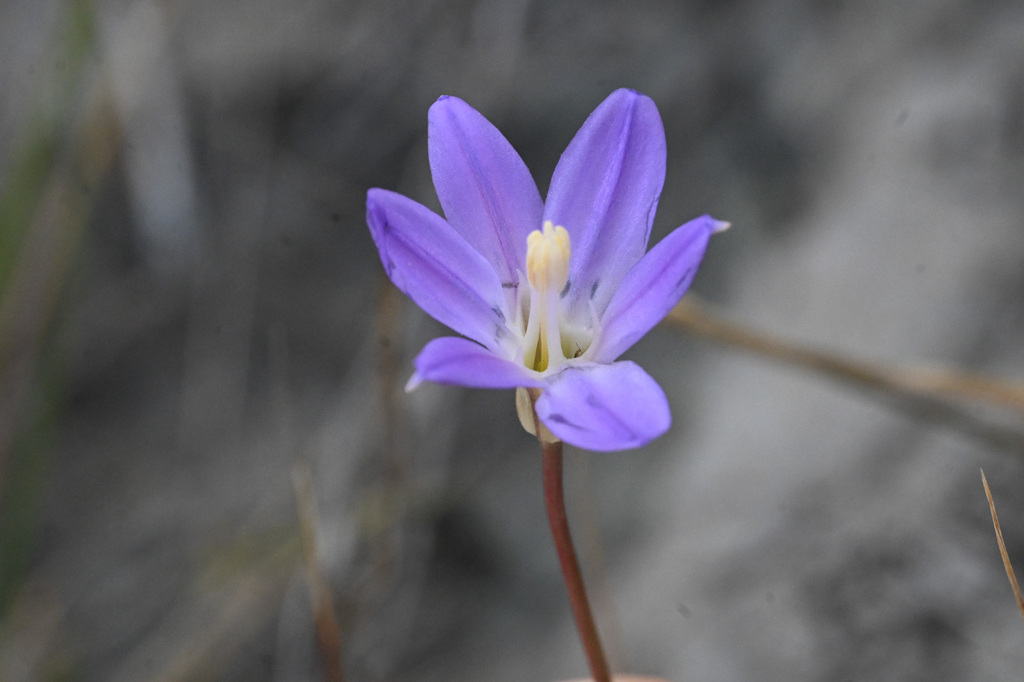
(c) Trevor Van Loon, some rights reserved (CC BY) · licence
Family: Themidaceae · Type: Herb · Native
Conservation status: CNPS 1B.2
Brodiaea santarosae (Santa rosa basalt brodiaea) is a native California herb in the Themidaceae family, recognized by variable staminodes within flowers.
Santa rosa basalt brodiaea is a rare (CNPS 1B.2) California native perennial found in the Santa Ana Mountains in grassland habitats on soils derived from Santa Rosa basalt at elevations of 580 to 1,045 meters. Flowering from May to June, this plant produces violet flowers with ascending perianth lobes 15 to 30 millimeters long, creating delicate clusters atop slender scapes. Growing with erect stems 9 to 36 centimeters tall, it emerges from underground corms in open grassland settings. Its flowers feature distinctive white to lavender staminodes and elegant violet perianth segments that rise gracefully above narrow linear leaves. The plant's intricate floral structure includes filaments 2 to 8 millimeters long supporting delicate anthers in a complex reproductive arrangement.
Identification and appearance
Key characters: 4 sympatric species; variable staminodes within flowers
Habitat and range
Habitat: Grassland, on soils derived from Santa Rosa basalt
Elevation: 580-1045 m
Bloom period
Brodiaea santarosae blooms May-Jun.
Conservation status
CNPS 1B.2
How to tell it apart
vs Triteleia: Count the stamens: Brodiaea has 3 fertile stamens, Triteleia has 6.; vs Dipterostemon: Brodiaea has straight flower stalks; Dipterostemon stalks curve or bend.; vs Dichelostemma: Brodiaea stalks stay straight and upright; Dichelostemma stalks curve, twist, or twine.; vs Sisyrinchium: Brodiaea flowers are tubular; Sisyrinchium flowers are flat and star-shaped.; vs Scilla: Brodiaea has tubular flowers with visible stamens inside; Scilla has bell-shaped flowers.
Frequently asked questions
Is Brodiaea santarosae native to California?
Yes. Brodiaea santarosae is native to California (recorded as native).
When does Brodiaea santarosae bloom?
Brodiaea santarosae blooms May-Jun.
What plant family does Brodiaea santarosae belong to?
Brodiaea santarosae is in the Themidaceae family, genus Brodiaea.
Is Brodiaea santarosae rare or endangered?
Brodiaea santarosae carries California Rare Plant Rank 1B.2, state rank S1.
What habitat does Brodiaea santarosae grow in?
Brodiaea santarosae grows in Grassland, on soils derived from Santa Rosa basalt.
Related species
Other California species in the same genus, family, or bioregion.
Sources: Jepson eFlora · CalPhotos · CDFW CNDDB
Last updated 2026-10-07
Data from The California Species Project — 14,000+ California species with verified data from CNPS, CDFW, USFWS, Cal-IPC, and more.