Bromus inermis
Smooth brome, hungarian brome, Hungarian Brome
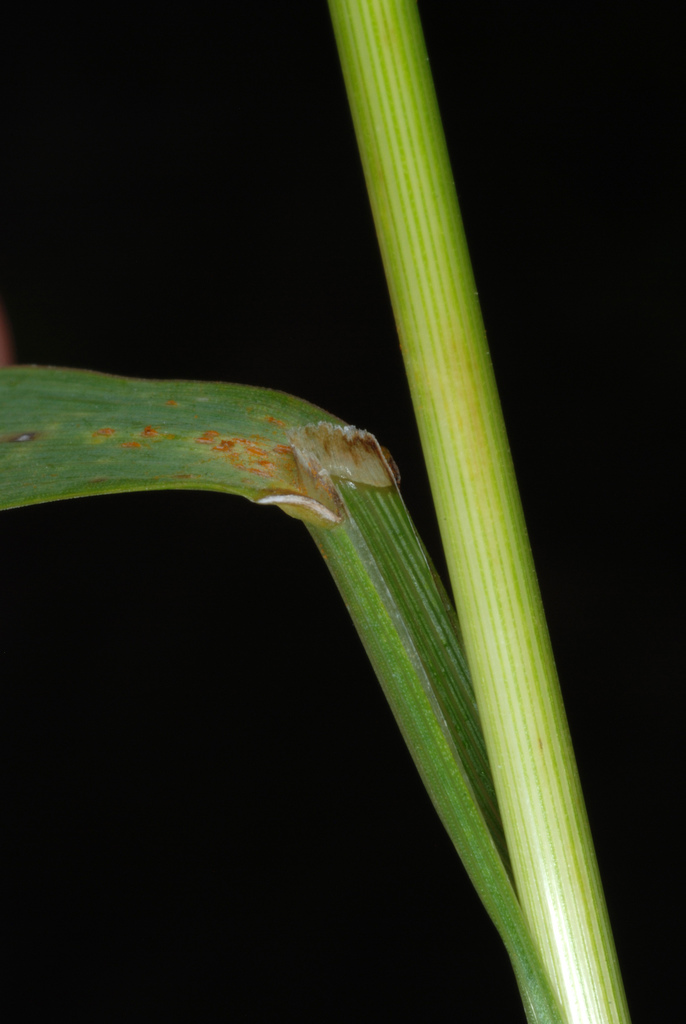
(c) Douglas Goldman, some rights reserved (CC BY-SA), uploaded by Douglas Goldman · licence
Family: Poaceae · Type: Grass · Not Native
Bromus inermis (Smooth brome) is a non-native California grass in the Poaceae family, recognized by rhizomatous habit and short/no awns diagnostic.
Smooth brome is a naturalized perennial grass found in coastal, northern California, high Cascade Range, Sierra Nevada, southern coastal, and Great Basin regions in disturbed sites and roadsides at elevations up to 2,700 meters. Flowering from March to August, this grass produces pale green to tan spikelets 20 to 33 millimeters long in open, spreading clusters. Growing 45 to 130 centimeters tall with extensive rhizomatous roots, it forms dense, spreading clumps in open areas. Its leaf blades are 5 to 15 millimeters wide, generally glabrous with a small ligule less than 3 millimeters long. The spikelets have glabrous glumes and lemmas that are rounded on the back, sometimes with marginal hairs and short awns up to 3 millimeters long.
Identification and appearance
Key characters: 33 sympatric species; rhizomatous habit and short/no awns diagnostic
Habitat and range
Habitat: Disturbed sites, roadsides
Elevation: < 2700 m
California counties: Butte, Mono, Riverside, San Bernardino, Tehama, Ventura, El Dorado, Los Angeles, Tuolumne, Kern, San Diego, Alpine, Placer, Modoc, Shasta, Tulare, Siskiyou, Santa Barbara, Nevada, Monterey, Mariposa, Lassen, Plumas, Sierra, Trinity, Humboldt, San Luis Obispo, Yolo, Alameda, Lake, Santa Clara
Outside California: Coahuila, Guatemala, to Alaska, eastern North America, native to Eurasia
Bloom period
Bromus inermis blooms Mar-Aug.
How to tell it apart
vs Nassella: Bromus has closed leaf sheaths and large spikelets; Nassella has open sheaths and needle-like awns.; vs Hordeum: Bromus has separate large spikelets; Hordeum has three spikelets grouped at each node.; vs Avena: Bromus lemmas have two teeth at tip; Avena lemmas have a twisted awn from the back.; vs Lolium: Bromus spikelets are stalked in clusters; Lolium spikelets sit edgewise against the stem.; vs Festuca: Bromus leaf sheaths are closed; Festuca sheaths split open halfway down.
Frequently asked questions
Is Bromus inermis native to California?
No. Bromus inermis is not native to California (recorded as not native).
When does Bromus inermis bloom?
Bromus inermis blooms Mar-Aug.
Where in California does Bromus inermis grow?
Bromus inermis occurs in Butte, Mono, Riverside, San Bernardino, Tehama, Ventura, El Dorado, Los Angeles and other counties, at elevations of < 2700 m.
What plant family does Bromus inermis belong to?
Bromus inermis is in the Poaceae family, genus Bromus.
What habitat does Bromus inermis grow in?
Bromus inermis grows in Disturbed sites, roadsides.
Related species
Other California species in the same genus, family, or bioregion.
Sources: Jepson eFlora · Index of California Plant Names · CalPhotos
Last updated 2026-10-07
Data from The California Species Project — 14,000+ California species with verified data from CNPS, CDFW, USFWS, Cal-IPC, and more.