Bromus laevipes
Chinook brome, woodland brome, Woodland Brome
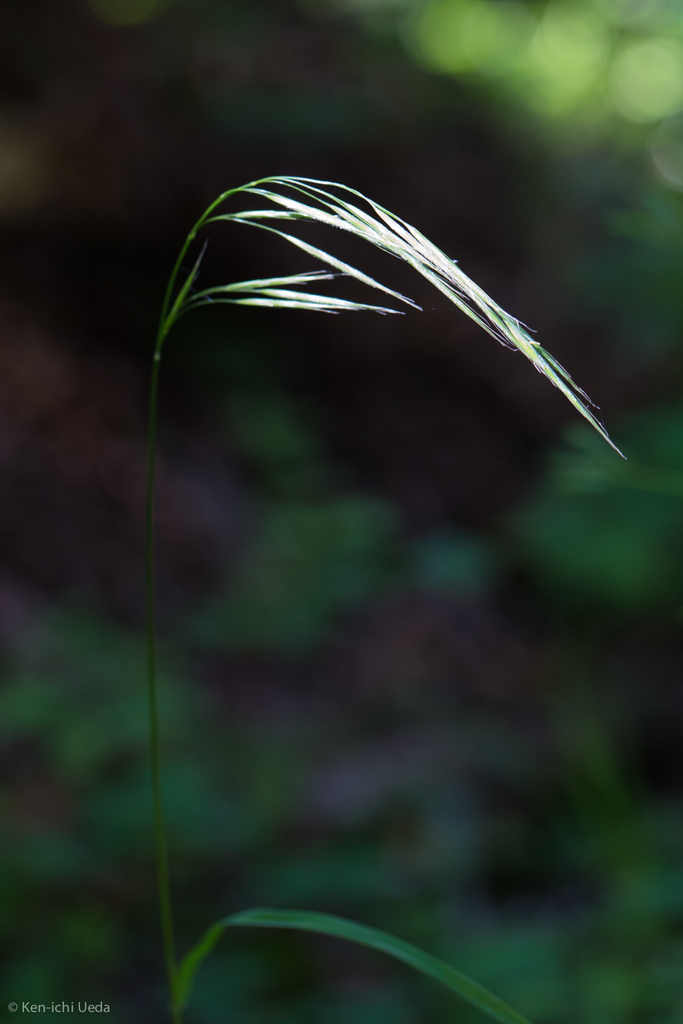
(c) Ken-ichi Ueda, some rights reserved (CC BY) · licence
Family: Poaceae · Type: Grass · Native
Bromus laevipes (Chinook brome) is a native California grass in the Poaceae family, recognized by glabrous habit and large anthers diagnostic.
Chinook brome is a California native perennial grass found in northwestern California, Cascade Range, Sierra Nevada, Sutter Buttes, central western California, southern California coastal areas, Channel Islands, western Transverse Ranges, and Peninsular Ranges in shrubland, conifer forest, and shaded streambank habitats at elevations below 2,500 meters. Flowering from May to July, this grass produces open branching flower clusters with nodding to spreading branches up to 27 centimeters long. Growing 50 to 160 centimeters tall with an upright habit, it develops slender green stems with a distinctive spreading inflorescence. Its leaves are glabrous with narrow blades 3 to 7 millimeters wide and ligules 2 to 4 millimeters long. The grass produces delicate spikelets 23 to 35 millimeters long with hairy lemmas and short awns 3 to 6.5 millimeters in length.
Identification and appearance
Key characters: 34 sympatric species; glabrous habit and large anthers diagnostic
Habitat and range
Habitat: shrubland, conifer forest, shaded streambanks, roadsides
Elevation: < 2500 m
California counties: Butte, Fresno, Humboldt, Lake, Madera, Marin, Mendocino, Monterey, Placer, San Luis Obispo, San Mateo, Santa Barbara, Solano, Sonoma, Tehama, Trinity, Contra Costa, Inyo, Los Angeles, Orange, San Bernardino, Santa Clara, Sierra, Tuolumne, Tulare, Riverside, Napa, Colusa, Santa Cruz, Calaveras, Amador, Siskiyou, Shasta, Plumas, Glenn, El Dorado, Alameda, Mariposa, Nevada, Sacramento, Yuba, Sutter, Yolo, Mono, Ventura, San Benito, Kern, Del Norte
Outside California: to Washington
Bloom period
Bromus laevipes blooms May-Jul.
How to tell it apart
vs Nassella: Bromus has closed leaf sheaths and large spikelets; Nassella has open sheaths and needle-like awns.; vs Hordeum: Bromus has separate large spikelets; Hordeum has three spikelets grouped at each node.; vs Avena: Bromus lemmas have two teeth at tip; Avena lemmas have a twisted awn from the back.; vs Lolium: Bromus spikelets are stalked in clusters; Lolium spikelets sit edgewise against the stem.; vs Festuca: Bromus leaf sheaths are closed; Festuca sheaths split open halfway down.
Frequently asked questions
Is Bromus laevipes native to California?
Yes. Bromus laevipes is native to California (recorded as native).
When does Bromus laevipes bloom?
Bromus laevipes blooms May-Jul.
Where in California does Bromus laevipes grow?
Bromus laevipes occurs in Butte, Fresno, Humboldt, Lake, Madera, Marin, Mendocino, Monterey and other counties, at elevations of < 2500 m.
What plant family does Bromus laevipes belong to?
Bromus laevipes is in the Poaceae family, genus Bromus.
What habitat does Bromus laevipes grow in?
Bromus laevipes grows in shrubland, conifer forest, shaded streambanks, roadsides.
Related species
Other California species in the same genus, family, or bioregion.
Sources: Jepson eFlora · Index of California Plant Names · CalPhotos
Last updated 2026-10-07
Data from The California Species Project — 14,000+ California species with verified data from CNPS, CDFW, USFWS, Cal-IPC, and more.