Bromus rubens
Red brome, Red Brome
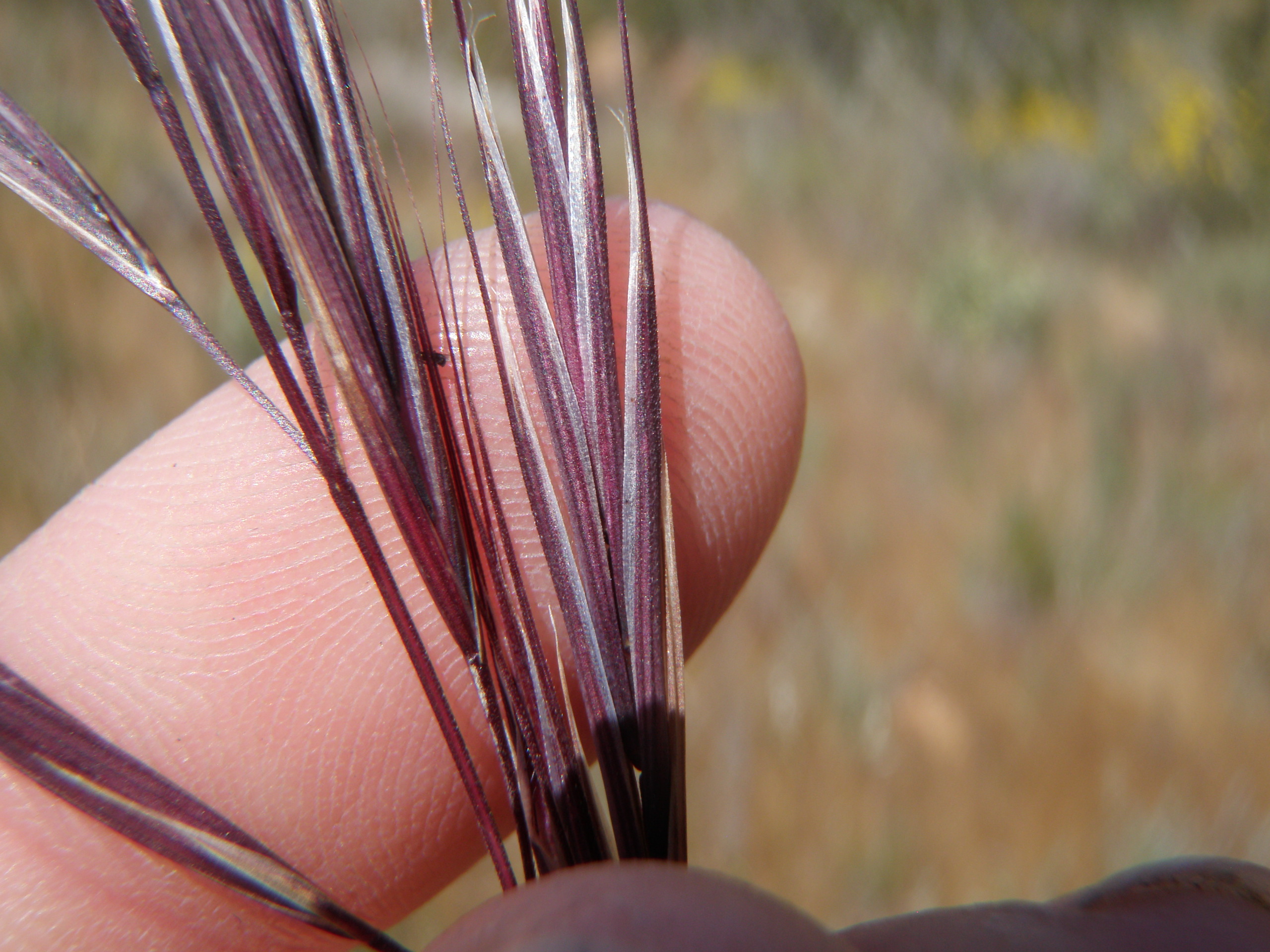
Photo by Chez Brungraber
Family: Poaceae · Type: Grass · Not Native
Conservation status: Cal-IPC Yes
Bromus rubens (Red brome) is a non-native California grass in the Poaceae family, recognized by dense obovoid inflorescence with overlapping florets diagnostic.
Red brome is a naturalized annual grass found in California in disturbed areas and roadsides at elevations below 3,050 meters. Flowering from February to June, this plant produces small, dense spikelets with light brown to reddish flowers 20 to 25 millimeters long. Growing with slender stems 10 to 45 centimeters tall, it has an upright to slightly spreading habit with multiple branching inflorescences. Its leaves are glabrous or slightly hairy, with blades 2 to 4 millimeters wide and ligules 1.8 to 4 millimeters long. The plant's distinctive awned lemmas have straight awns 8 to 21 millimeters long, giving the grass a delicate, feathery appearance.
Identification and appearance
Key characters: 34 sympatric species; dense obovoid inflorescence with overlapping florets diagnostic
Habitat and range
Habitat: Disturbed areas, roadsides
Elevation: < 3050 m
California counties: San Luis Obispo, San Bernardino, San Diego, Kern, Ventura, Los Angeles, Santa Barbara, Orange, Tulare, Inyo, Fresno, Napa, Sacramento, Colusa, Nevada, Merced, Yolo, Solano, Butte, Monterey, Placer, Glenn, Siskiyou, Tehama, Lassen, Stanislaus, Lake, Contra Costa, Riverside, Sierra, Sutter, Calaveras, Trinity, San Benito, Modoc, Amador, Plumas, Madera, Tuolumne, Marin, Humboldt, Santa Clara, Kings, Sonoma, Mendocino, Mariposa, San Francisco, Alameda, Santa Cruz, San Joaquin, Shasta, San Mateo, Imperial
Outside California: to southern Washington, southeastern United States, northwestern Mexico, native to Europe
Bloom period
Bromus rubens blooms Feb-Jun.
Conservation status
Cal-IPC Yes
How to tell it apart
vs Nassella: Bromus has closed leaf sheaths and large spikelets; Nassella has open sheaths and needle-like awns.; vs Hordeum: Bromus has separate large spikelets; Hordeum has three spikelets grouped at each node.; vs Avena: Bromus lemmas have two teeth at tip; Avena lemmas have a twisted awn from the back.; vs Lolium: Bromus spikelets are stalked in clusters; Lolium spikelets sit edgewise against the stem.; vs Festuca: Bromus leaf sheaths are closed; Festuca sheaths split open halfway down.
Frequently asked questions
Is Bromus rubens native to California?
No. Bromus rubens is not native to California (recorded as not native).
When does Bromus rubens bloom?
Bromus rubens blooms Feb-Jun.
Where in California does Bromus rubens grow?
Bromus rubens occurs in San Luis Obispo, San Bernardino, San Diego, Kern, Ventura, Los Angeles, Santa Barbara, Orange and other counties, at elevations of < 3050 m.
What plant family does Bromus rubens belong to?
Bromus rubens is in the Poaceae family, genus Bromus.
Is Bromus rubens invasive in California?
Bromus rubens is listed by Cal-IPC with an invasiveness rating of Yes.
Related species
Other California species in the same genus, family, or bioregion.
Sources: Jepson eFlora · Index of California Plant Names · CalPhotos
Last updated 2026-10-07
Data from The California Species Project — 14,000+ California species with verified data from CNPS, CDFW, USFWS, Cal-IPC, and more.