Bromus vulgaris
Columbia brome
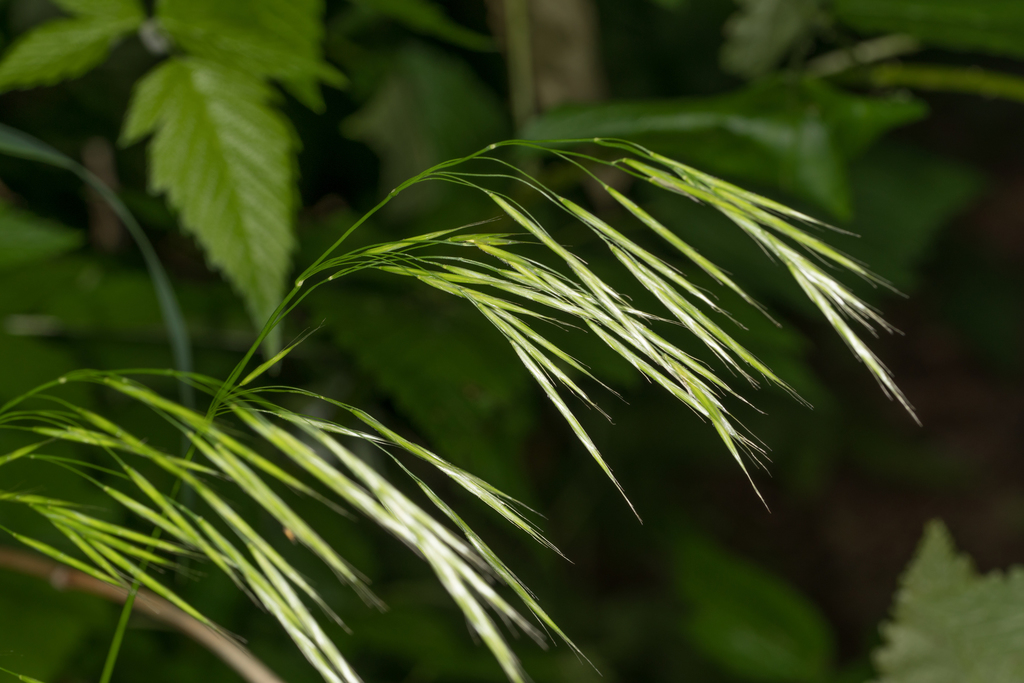
no rights reserved, uploaded by Jesse Rorabaugh · CC0
Family: Poaceae · Type: Grass · Native
Bromus vulgaris (Columbia brome) is a native California grass in the Poaceae family, recognized by long ligule and shaded woodland habitat preference.
Columbia brome is a native perennial grass found in northwestern California, the Cascade Range, northern and central Sierra Nevada, and central western California in shady to open rocky woodland, ravines, and meadows at elevations below 1,900 meters. Flowering from May to August, this grass produces open, branching flower clusters 8 to 22 centimeters long with ascending to nodding branches. Growing 45 to 110 centimeters tall with multiple nodes between 3 to 7 points along its stem, it develops distinctive grass blades 13 to 25 centimeters long that are generally hairy on the upper surface. Its leaf ligules measure 2 to 6 millimeters long, and each spikelet features lemmas with soft marginal hairs and awns 6 to 11 millimeters in length. The grass develops slender, somewhat open flower clusters that are more than 2 centimeters wide, with individual spikelets ranging from 15 to 30 millimeters long.
Identification and appearance
Key characters: 28 sympatric species; long ligule and shaded woodland habitat preference
Habitat and range
Habitat: Shady to open rocky woodland, ravines, meadows
Elevation: < 1900 m
California counties: Butte, Del Norte, El Dorado, Humboldt, Lake, Marin, Nevada, Plumas, San Luis Obispo, Santa Clara, Santa Cruz, San Bernardino, San Mateo, Siskiyou, Mendocino, Mariposa, Sonoma, Trinity, Sierra, Shasta, Lassen, Glenn, Monterey, Napa, Madera, Tehama, Tuolumne, Sacramento, Placer
Outside California: to British Columbia, Montana, Wyoming
Bloom period
Bromus vulgaris blooms May-Aug.
How to tell it apart
vs Nassella: Bromus has closed leaf sheaths and large spikelets; Nassella has open sheaths and needle-like awns.; vs Hordeum: Bromus has separate large spikelets; Hordeum has three spikelets grouped at each node.; vs Avena: Bromus lemmas have two teeth at tip; Avena lemmas have a twisted awn from the back.; vs Lolium: Bromus spikelets are stalked in clusters; Lolium spikelets sit edgewise against the stem.; vs Festuca: Bromus leaf sheaths are closed; Festuca sheaths split open halfway down.
Frequently asked questions
Is Bromus vulgaris native to California?
Yes. Bromus vulgaris is native to California (recorded as native).
When does Bromus vulgaris bloom?
Bromus vulgaris blooms May-Aug.
Where in California does Bromus vulgaris grow?
Bromus vulgaris occurs in Butte, Del Norte, El Dorado, Humboldt, Lake, Marin, Nevada, Plumas and other counties, at elevations of < 1900 m.
What plant family does Bromus vulgaris belong to?
Bromus vulgaris is in the Poaceae family, genus Bromus.
What habitat does Bromus vulgaris grow in?
Bromus vulgaris grows in Shady to open rocky woodland, ravines, meadows.
Related species
Other California species in the same genus, family, or bioregion.
- Bromus arenarius — Australian chess
- Bromus arizonicus — Arizona brome
- Bromus arvensis — Field brome
- Bromus berteroanus — Chilean chess
- Bromus briziformis — Rattlesnake chess
- Bromus caroli-henrici — Weedy brome
- Calamagrostis bolanderi — Bolander's reed grass
- Calamagrostis breweri — Short hair reed grass
- Calamagrostis canadensis — Bluejoint reedgrass
- Calamagrostis canadensis var. canadensis — Bluejoint reed grass
Sources: Jepson eFlora · Index of California Plant Names · CalPhotos
Last updated 2026-10-07
Data from The California Species Project — 14,000+ California species with verified data from CNPS, CDFW, USFWS, Cal-IPC, and more.