Bulbostylis capillaris
Thread-leaved beakseed, Thread-Leaved Beakseed
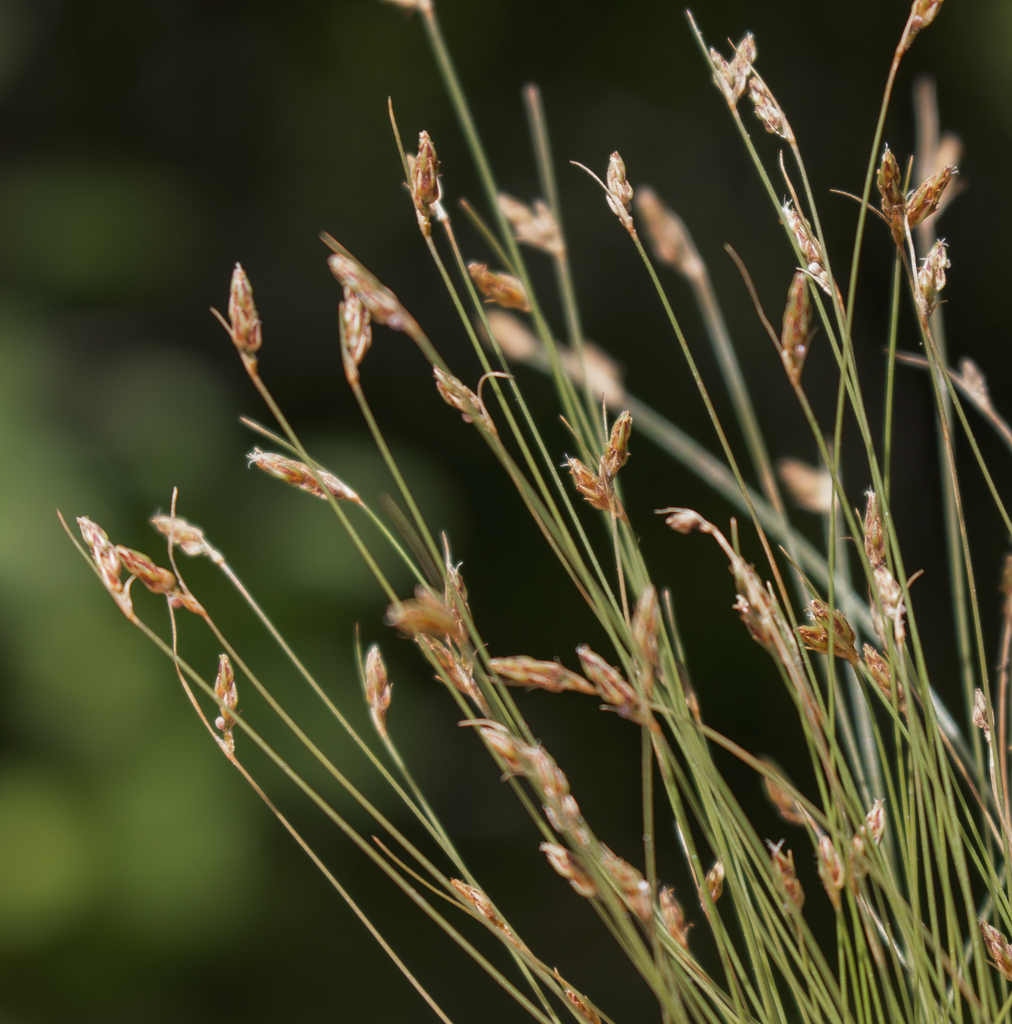
(c) aarongunnar, some rights reserved (CC BY), uploaded by aarongunnar · licence
Family: Cyperaceae · Type: Grass · Native
Conservation status: CNPS 4.2
Bulbostylis capillaris (Thread-leaved beakseed) is a native California grass in the Cyperaceae family, recognized by Widespread tropical/subtropical species at its northern range limit in California.
Thread-leaved beakseed is a California native perennial found in the northern Sierra Nevada Foothills, northern Sierra Nevada, and Sierra Nevada Highlands in open damp or dry sandy-gravelly soil at elevations of 300 to 2,200 meters. Flowering from June to July, this plant produces small, delicate flowers in compact spikelets. Growing with fine, thread-like stems typically taller than its leaves, it forms slender and minimally branched clusters. Its leaves are exceptionally narrow, with blade width less than 0.5 millimeters, creating a wispy, hair-like appearance. The fruit is pale brown with transverse wavy ridges and sharp angles, crowned by a rounded tubercle.
Identification and appearance
Key characters: Widespread tropical/subtropical species at its northern range limit in California
Habitat and range
Habitat: Open damp/dry sandy-gravelly soil
Elevation: 300-2200 m
California counties: Mariposa, Shasta, Tuolumne, Butte, Nevada, Sierra, Placer, Plumas, Tehama, Siskiyou, Alpine, Yolo, El Dorado
Outside California: to eastern North America, Caribbean, Central America, South America, Asia, Pacific Islands
Bloom period
Bulbostylis capillaris blooms Jun-Jul.
Conservation status
CNPS 4.2
How to tell it apart
vs Fimbristylis: Bulbostylis has long soft fringe hairs; Fimbristylis has short stiff sandpaper-like hairs.; vs Bolboschoenus: Bulbostylis has hairy sheath collars and grows in dry areas; Bolboschoenus has smooth sheaths and grows in wetlands.; vs Scirpus: Bulbostylis has conspicuous hairy collars at sheath tips; Scirpus has smooth sheaths.; vs Calliscirpus: Bulbostylis has long hairy fringe; Calliscirpus has smooth sheaths.; vs Eriophorum: Bulbostylis has hairy sheaths; Eriophorum has cotton-like bristles on the fruits themselves.
Frequently asked questions
Is Bulbostylis capillaris native to California?
Yes. Bulbostylis capillaris is native to California (recorded as native).
When does Bulbostylis capillaris bloom?
Bulbostylis capillaris blooms Jun-Jul.
Where in California does Bulbostylis capillaris grow?
Bulbostylis capillaris occurs in Mariposa, Shasta, Tuolumne, Butte, Nevada, Sierra, Placer, Plumas and other counties, at elevations of 300-2200 m.
What plant family does Bulbostylis capillaris belong to?
Bulbostylis capillaris is in the Cyperaceae family, genus Bulbostylis.
Is Bulbostylis capillaris rare or endangered?
Bulbostylis capillaris carries California Rare Plant Rank 4.2, state rank S3.
Related species
Other California species in the same genus, family, or bioregion.
Sources: Jepson eFlora · CNPS Rare Plant Inventory · Index of California Plant Names · CalPhotos · CDFW CNDDB
Last updated 2026-10-07
Data from The California Species Project — 14,000+ California species with verified data from CNPS, CDFW, USFWS, Cal-IPC, and more.