Caesalpinia gilliesii
Bird-of-paradise
(c) mel letterman, some rights reserved (CC BY) · licence
Family: Fabaceae · Type: Shrub / Tree · Not Native
Caesalpinia gilliesii (Bird-of-paradise) is a non-native California shrub / tree in the Fabaceae family.
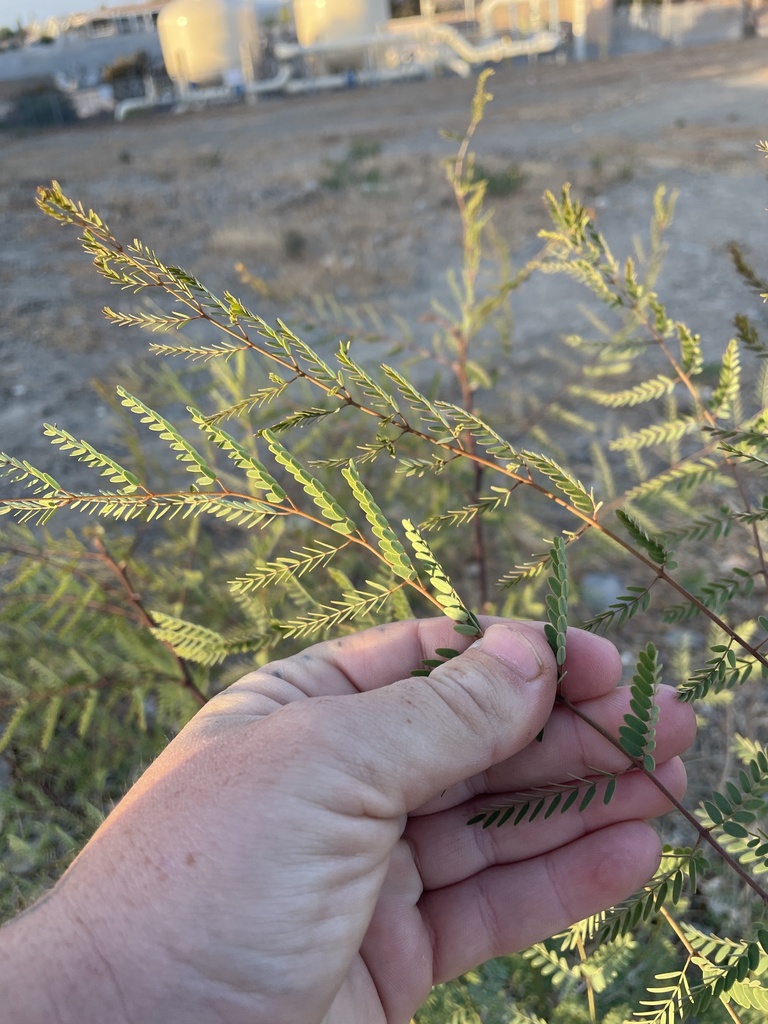
Bird-of-paradise is a naturalized perennial found in southern California, San Gabriel Mountains, Peninsular Ranges, and Mojave Desert in disturbed areas at elevations below 1,000 meters. Flowering from May to August, this plant produces vibrant yellow flowers with orange marks on long stamens up to 10 centimeters long. Growing up to 4 meters tall with glandular-hairy stems, it forms an evergreen shrub with delicate, feathery compound leaves. Its leaves feature 16 to 30 primary leaflets and 14 to 22 secondary leaflets, each less than 8 millimeters long, creating a soft, intricate foliage texture. The fruit develops as a flat, slightly curved pod 6 to 12 centimeters long, containing 6 to 10 brown ovate seeds.
Identification and appearance
Key characters: 1 sympatric species (C. spinosa). Key differentiators: size, armature, stamen length, fruit dehiscence
Habitat and range
Habitat: Uncommon. Disturbed areas
Elevation: < 1000 m
California counties: San Bernardino, Kern, Riverside, San Luis Obispo, Tehama, Los Angeles, Ventura, San Diego, Tulare, San Joaquin, Alameda, Contra Costa, Yolo, Santa Clara, Solano
Outside California: native to Argentina, Uruguay, widely cultivated in arid temperate, tropics
Bloom period
Caesalpinia gilliesii blooms May-Aug.
How to tell it apart
vs Erythrostemon: Caesalpinia and Erythrostemon are closely related and often lumped; check current taxonomy.; vs Delonix: Caesalpinia is typically a shrub under 4m; Delonix (royal poinciana) is a large spreading tree.; vs Cercis: Caesalpinia has twice-compound leaves and orange-red flowers; Cercis has simple heart-shaped leaves and magenta flowers.; vs Senna: Caesalpinia has scattered prickles and orange-red flowers; Senna is unarmed with yellow flowers.; vs Gleditsia: Caesalpinia has scattered curved prickles; Gleditsia has massive branched thorns on trunk.
Frequently asked questions
Is Caesalpinia gilliesii native to California?
No. Caesalpinia gilliesii is not native to California (recorded as not native).
When does Caesalpinia gilliesii bloom?
Caesalpinia gilliesii blooms May-Aug.
Where in California does Caesalpinia gilliesii grow?
Caesalpinia gilliesii occurs in San Bernardino, Kern, Riverside, San Luis Obispo, Tehama, Los Angeles, Ventura, San Diego and other counties, at elevations of < 1000 m.
What plant family does Caesalpinia gilliesii belong to?
Caesalpinia gilliesii is in the Fabaceae family, genus Caesalpinia.
What habitat does Caesalpinia gilliesii grow in?
Caesalpinia gilliesii grows in Uncommon. Disturbed areas.
Related species
Other California species in the same genus, family, or bioregion.
Sources: Jepson eFlora · Index of California Plant Names · CalPhotos
Last updated 2026-10-07
Data from The California Species Project — 14,000+ California species with verified data from CNPS, CDFW, USFWS, Cal-IPC, and more.