Cakile maritima
European searocket
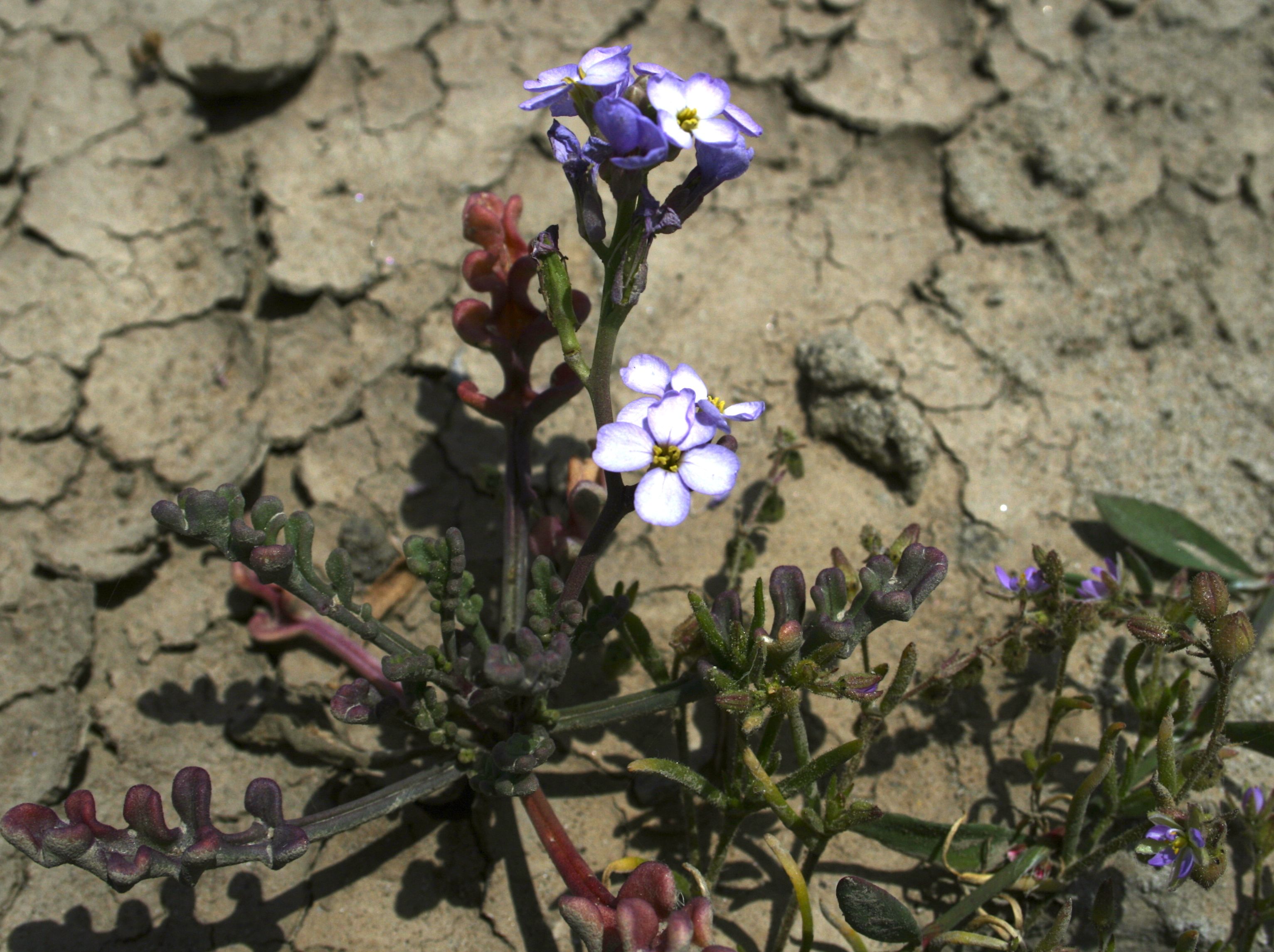
Photo by Chez Brungraber
Family: Brassicaceae · Type: Herb · Not Native
Conservation status: Cal-IPC Yes
Cakile maritima (European searocket) is a non-native California herb in the Brassicaceae family, recognized by . Key difference is conic 4-sided fruit tip vs flat tip.
European searocket is a naturalized plant found along California's coastal bioregions including North Coast, Central Coast, Southern Coast, and Channel Islands on beach dunes at elevations below 100 meters. Flowering from May to November, this plant produces white to lavender flowers with petals 8 to 14 millimeters long. Growing with stems that are prostrate or mound-forming to erect and reaching up to 80 centimeters tall, it has a distinctive spreading growth habit. Its leaves are broadly ovate to lanceolate, attached to stems with visible petioles, creating a textured green backdrop for the delicate flowers. The fruit is 1.2 to 2.7 centimeters long with a terminal segment that is generally four-sided and tapered to an acute or blunt tip.
Identification and appearance
Key characters: 1 sympatric species. Key difference is conic 4-sided fruit tip vs flat tip.
Habitat and range
Habitat: Beach dunes
Elevation: < 100 m
California counties: Ventura, Del Norte, Monterey, Orange, San Diego, San Mateo, Sonoma, San Luis Obispo, Los Angeles, San Francisco, Santa Barbara, Humboldt, Mendocino, Alameda, Marin, Contra Costa, Santa Cruz
Outside California: to British Columbia, eastern North America, Mexico, native to Europe
Bloom period
Cakile maritima blooms May-Nov.
Conservation status
Cal-IPC Yes
How to tell it apart
vs Raphanus: Cakile is completely hairless with corky pods on beaches, Raphanus has hairy stems and non-corky pods.; vs Ambrosia: Cakile has four-petaled mustard flowers and smooth succulent leaves, Ambrosia has tiny composite flowers and divided leaves.; vs Cardamine: Cakile grows on coastal beaches with thick succulent leaves, Cardamine grows inland with thin non-succulent leaves.; vs Coleonema: Cakile has four-petaled flowers and grows on beaches, Coleonema has five-petaled flowers and needle-like leaves.; vs Spergularia: Cakile has four-petaled mustard flowers in racemes, Spergularia has five-petaled pink flowers in clusters.
Frequently asked questions
Is Cakile maritima native to California?
No. Cakile maritima is not native to California (recorded as not native).
When does Cakile maritima bloom?
Cakile maritima blooms May-Nov.
Where in California does Cakile maritima grow?
Cakile maritima occurs in Ventura, Del Norte, Monterey, Orange, San Diego, San Mateo, Sonoma, San Luis Obispo and other counties, at elevations of < 100 m.
What plant family does Cakile maritima belong to?
Cakile maritima is in the Brassicaceae family, genus Cakile.
Is Cakile maritima invasive in California?
Cakile maritima is listed by Cal-IPC with an invasiveness rating of Yes.
Related species
Other California species in the same genus, family, or bioregion.
Sources: Jepson eFlora · Index of California Plant Names · CalPhotos
Last updated 2026-10-07
Data from The California Species Project — 14,000+ California species with verified data from CNPS, CDFW, USFWS, Cal-IPC, and more.