Calamagrostis rubescens
Pine reed grass, Pine Reed Grass
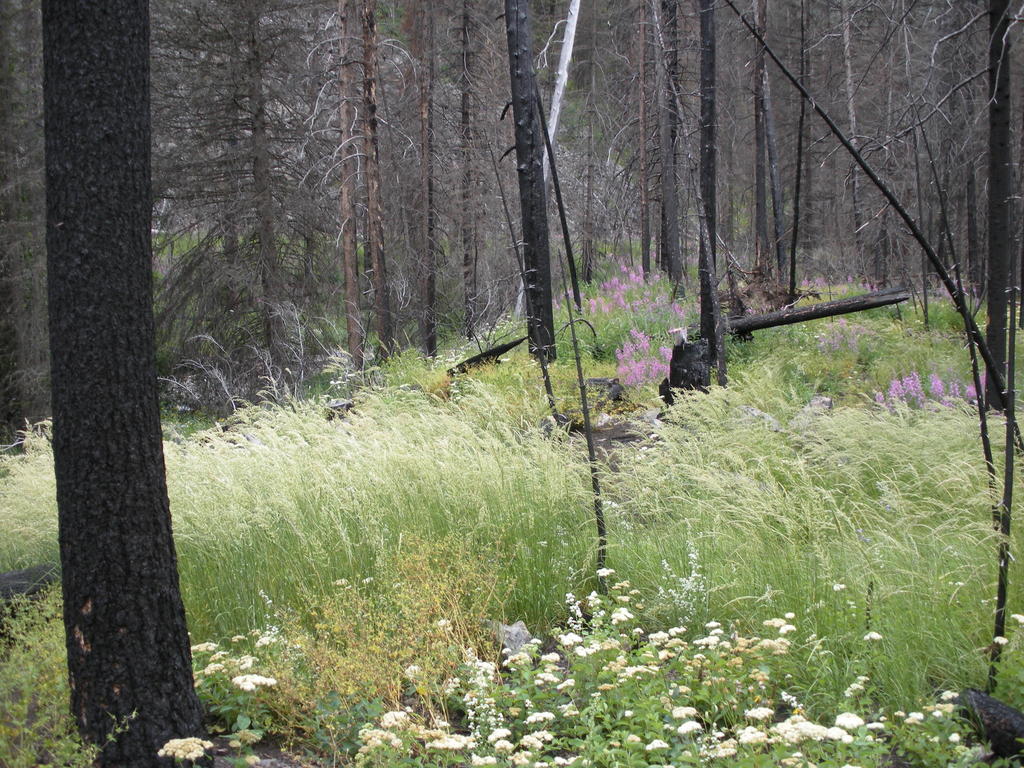
(c) Matt Lavin, some rights reserved (CC BY-SA) · licence
Family: Poaceae · Type: Grass · Native
Calamagrostis rubescens (Pine reed grass) is a native California grass in the Poaceae family, recognized by long slender rhizomes and short awns in wooded coastal habitats.
Pine reed grass is a California native perennial found in northern coastal, north coastal redwood, central western, and northern Channel Islands (Santa Cruz Island) regions in wooded slopes, montane forest, chaparral, and meadows at elevations below 900 meters. Flowering from June to September, this grass produces delicate pale green to tan flower clusters in dense to slightly open inflorescences 6 to 15 centimeters long. Growing with loosely clustered stems 60 to 100 centimeters tall, it develops slender rhizomes 10 to 20 centimeters long and has 2 to 3 stem nodes. Its leaf blades are 2 to 5 millimeters wide, flat, with smooth lower surfaces and scabrous upper surfaces that are occasionally short-hairy. The grass produces awned lemmas 3 to 4 millimeters long with twisted awns 2 to 4 millimeters in length, often barely extending beyond the glume tips.
Identification and appearance
Key characters: 7 sympatric species; key features are long slender rhizomes and short awns in wooded coastal habitats
Habitat and range
Habitat: Wooded slopes, montane forest, chaparral, meadows
Elevation: < 900 m
California counties: Marin, Mendocino, Monterey, San Luis Obispo, Santa Barbara, Santa Cruz, Contra Costa, Sonoma, Napa, Santa Clara, San Mateo, Plumas, Lake, Humboldt, Del Norte, Siskiyou, El Dorado, Placer
Outside California: to southwestern Canada, Rocky Mountains
Bloom period
Calamagrostis rubescens blooms Jun-Sep.
How to tell it apart
vs Leymus: Leymus has spike-like inflorescences; Calamagrostis has open, branching panicles.; vs Koeleria: Koeleria has dense spike-like panicles; Calamagrostis panicles are loose and open.; vs Holcus: Holcus has velvety-hairy spikelets; Calamagrostis has silky basal hairs only.; vs Muhlenbergia: Calamagrostis spikelets are 2-4mm with awns; Muhlenbergia often larger without prominent awns.; vs Spinifex: Spinifex forms spiny seed heads on beaches; Calamagrostis has soft panicles in mountains.
Frequently asked questions
Is Calamagrostis rubescens native to California?
Yes. Calamagrostis rubescens is native to California (recorded as native).
When does Calamagrostis rubescens bloom?
Calamagrostis rubescens blooms Jun-Sep.
Where in California does Calamagrostis rubescens grow?
Calamagrostis rubescens occurs in Marin, Mendocino, Monterey, San Luis Obispo, Santa Barbara, Santa Cruz, Contra Costa, Sonoma and other counties, at elevations of < 900 m.
What plant family does Calamagrostis rubescens belong to?
Calamagrostis rubescens is in the Poaceae family, genus Calamagrostis.
What habitat does Calamagrostis rubescens grow in?
Calamagrostis rubescens grows in Wooded slopes, montane forest, chaparral, meadows.
Related species
Other California species in the same genus, family, or bioregion.
Sources: Jepson eFlora · Index of California Plant Names · CalPhotos
Last updated 2026-10-07
Data from The California Species Project — 14,000+ California species with verified data from CNPS, CDFW, USFWS, Cal-IPC, and more.