Calamagrostis stricta subsp. inexpansa
Thurber's reed grass
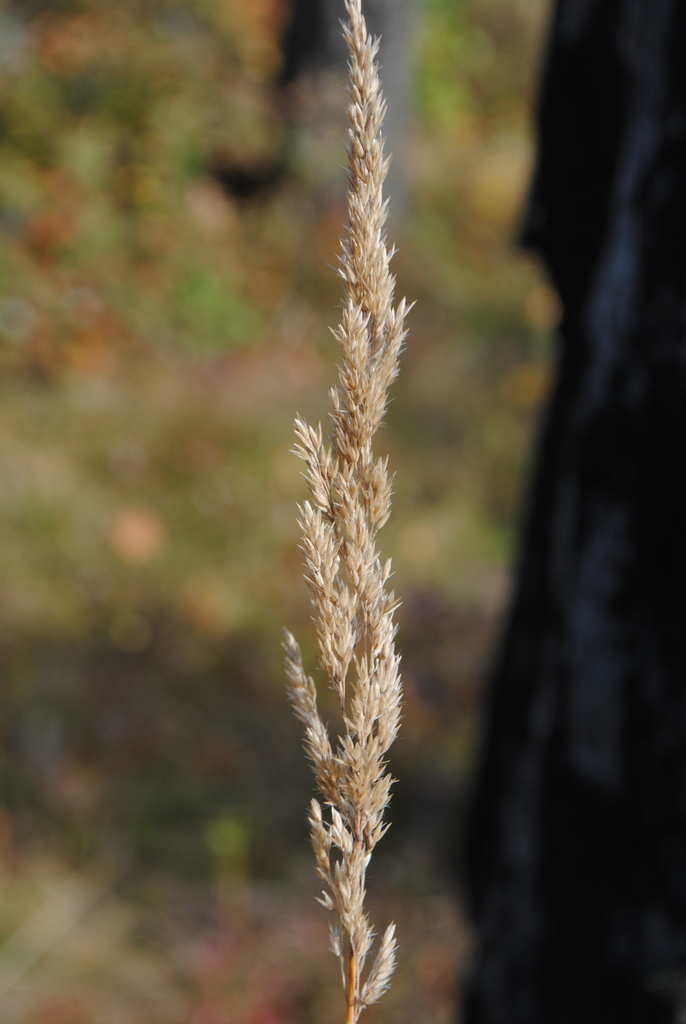
Photo: parent species Calamagrostis stricta · (c) Zihao Wang, some rights reserved (CC BY) · licence
Family: Poaceae · Type: Grass · Native
Conservation status: CNPS 2B.1
Calamagrostis stricta subsp. inexpansa (Thurber's reed grass) is a native California grass in the Poaceae family, recognized by flat glaucous strongly scabrous leaves vs. rolled leaves in subsp. stricta.
Thurber's reed grass is a California native perennial found in northwestern California, the Cascade Range, northern and central Sierra Nevada, and central Coast Range in slopes, meadows, and coastal marshes at elevations below 3,400 meters. Flowering from June to August, this grass produces pale green to grayish inflorescences with delicate branches 6 to 20 centimeters long. Growing with erect stems 40 to 120 centimeters tall, the plant has distinctively flat leaves that are strongly rough-textured and often have a bluish-gray upper surface. Its leaf blades are strongly scabrous with ligules 2 to 5.5 millimeters long, creating a distinctive texture when touched. The grass produces small spikelets with thick glumes 3 to 6 millimeters long and occasionally features an asymmetrical, stiff awn on its lemma.
Identification and appearance
Key characters: 12 sympatric species; key features are flat glaucous strongly scabrous leaves vs. rolled leaves in subsp. stricta
Habitat and range
Habitat: Slopes, meadows, coastal marshes
Elevation: < 3400 m
California counties: Fresno, Inyo, Mendocino, Mono, Plumas, Tulare, Tuolumne, Modoc, Sierra, Lassen, Del Norte, Marin, El Dorado, Madera, Sonoma, Humboldt, Shasta, Mariposa, Alpine, Monterey
Outside California: to Alaska, northeastern North America, northeastern Asia
Bloom period
Calamagrostis stricta subsp. inexpansa blooms Jun-Aug.
Conservation status
CNPS 2B.1
How to tell it apart
vs Leymus: Leymus has spike-like inflorescences; Calamagrostis has open, branching panicles.; vs Koeleria: Koeleria has dense spike-like panicles; Calamagrostis panicles are loose and open.; vs Holcus: Holcus has velvety-hairy spikelets; Calamagrostis has silky basal hairs only.; vs Muhlenbergia: Calamagrostis spikelets are 2-4mm with awns; Muhlenbergia often larger without prominent awns.; vs Spinifex: Spinifex forms spiny seed heads on beaches; Calamagrostis has soft panicles in mountains.
Frequently asked questions
Is Calamagrostis stricta subsp. inexpansa native to California?
Yes. Calamagrostis stricta subsp. inexpansa is native to California (recorded as native).
When does Calamagrostis stricta subsp. inexpansa bloom?
Calamagrostis stricta subsp. inexpansa blooms Jun-Aug.
Where in California does Calamagrostis stricta subsp. inexpansa grow?
Calamagrostis stricta subsp. inexpansa occurs in Fresno, Inyo, Mendocino, Mono, Plumas, Tulare, Tuolumne, Modoc and other counties, at elevations of < 3400 m.
What plant family does Calamagrostis stricta subsp. inexpansa belong to?
Calamagrostis stricta subsp. inexpansa is in the Poaceae family, genus Calamagrostis.
Is Calamagrostis stricta subsp. inexpansa rare or endangered?
Calamagrostis stricta subsp. inexpansa carries California Rare Plant Rank 2B.1, state rank S2.
Related species
Other California species in the same genus, family, or bioregion.
- Calamagrostis stricta subsp. stricta
- Calamagrostis arenaria subsp. arenaria — European beachgrass, maram grass
- Calamagrostis bolanderi — Bolander's reed grass
- Calamagrostis breviligulata
- Calamagrostis breviligulata subsp. breviligulata — American beachgrass
- Calamagrostis breweri — Short hair reed grass
- Catabrosa aquatica subsp. aquatica — water whorlgrass
- Cenchrus echinatus — Southern sandbur
- Cenchrus longispinus — Mat sandbur
Sources: Jepson eFlora · CNPS Rare Plant Inventory · Index of California Plant Names · CalPhotos · CDFW CNDDB
Last updated 2026-10-07
Data from The California Species Project — 14,000+ California species with verified data from CNPS, CDFW, USFWS, Cal-IPC, and more.