Calia secundiflora
Texas mountain laurel, Texas Mountain Laurel
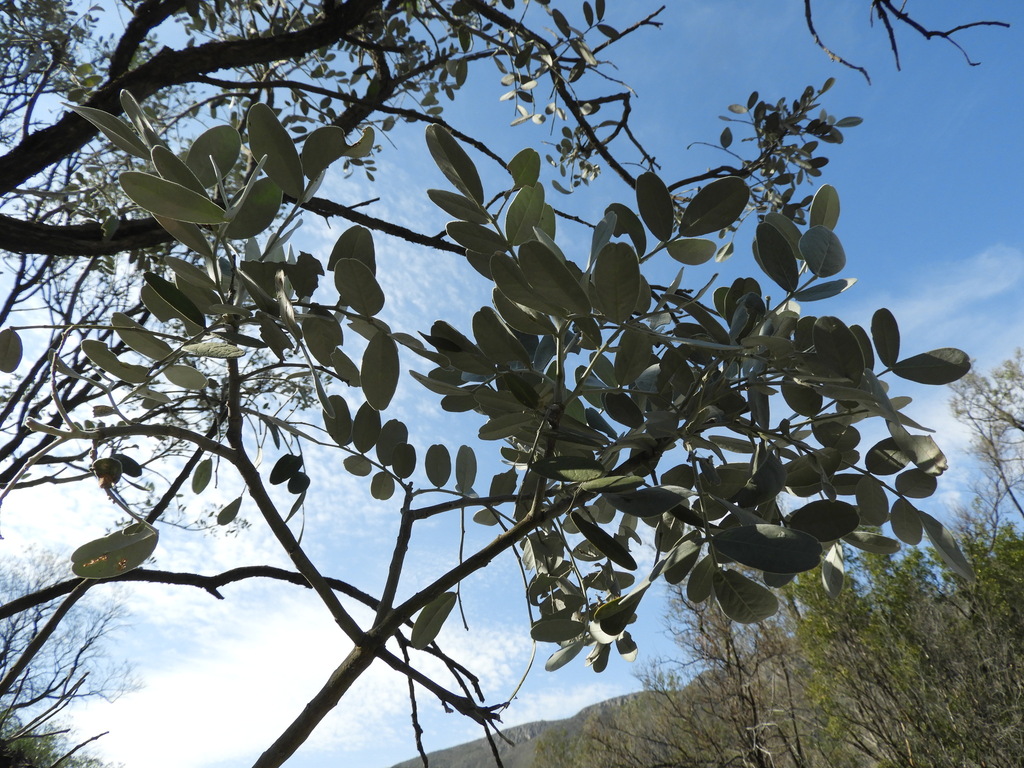
(c) Karla M. Benítez, some rights reserved (CC BY) · licence
Family: Fabaceae · Type: Shrub / Tree · Not Native
Calia secundiflora (Texas mountain laurel) is a non-native California shrub / tree in the Fabaceae family, recognized by Occasional Texas escape in southern California, far from native range.
Texas mountain laurel is a naturalized shrub found in San Jacinto Valley in canyon and rocky chaparral habitats at elevations below 500 meters. Flowering in spring, this plant produces striking blue-purple flowers with white spots and darker purple streaks, creating dramatic pendulous clusters up to 10 centimeters long. Growing as an evergreen shrub up to 5 meters tall, it develops a compact, multi-stemmed structure with woody branches. Its leathery leaves are compound with 5 to 11 elliptic-obovate leaflets, each 2 to 5 centimeters long, arranged along stems 6 to 15 centimeters in length. The distinctive red seeds are large, measuring 1 to 1.5 centimeters in diameter, and develop in woody, pendulous seed pods.
Identification and appearance
Key characters: Occasional Texas escape in southern California, far from native range
Habitat and range
Habitat: Canyons, rocky slopes, chaparral
Elevation: < 500 m
California counties: Riverside
Outside California: Texas to northern and central Mexico
How to tell it apart
vs Wisteria: Wisteria is a deciduous woody vine with long, drooping racemes and pinnate leaves; Calia is a self-supporting evergreen shrub or small tree with leathery leaflets.; vs Robinia: Black locust has paired spiny stipules, deciduous leaves, and white to pink flowers; Calia is unarmed, evergreen, with blue-purple flowers.; vs Lupinus: Bush lupines have palmately compound (fan-like) leaves; Calia has odd-pinnate (feather-like) leaves.; vs Cercis: Redbud has simple, heart-shaped leaves; Calia has pinnately compound, leathery evergreen leaves.; vs Cytisus: Brooms have green, nearly leafless, rush-like stems and yellow flowers; Calia is densely leafy and evergreen with fragrant blue-purple flowers.
Frequently asked questions
Is Calia secundiflora native to California?
No. Calia secundiflora is not native to California (recorded as not native).
Where in California does Calia secundiflora grow?
Calia secundiflora occurs in Riverside, at elevations of < 500 m.
What plant family does Calia secundiflora belong to?
Calia secundiflora is in the Fabaceae family, genus Calia.
What habitat does Calia secundiflora grow in?
Calia secundiflora grows in Canyons, rocky slopes, chaparral.
Related species
Other California species in the same genus, family, or bioregion.
Sources: Jepson eFlora · CalPhotos
Last updated 2026-10-07
Data from The California Species Project — 14,000+ California species with verified data from CNPS, CDFW, USFWS, Cal-IPC, and more.