Calibrachoa parviflora
Wild petunia
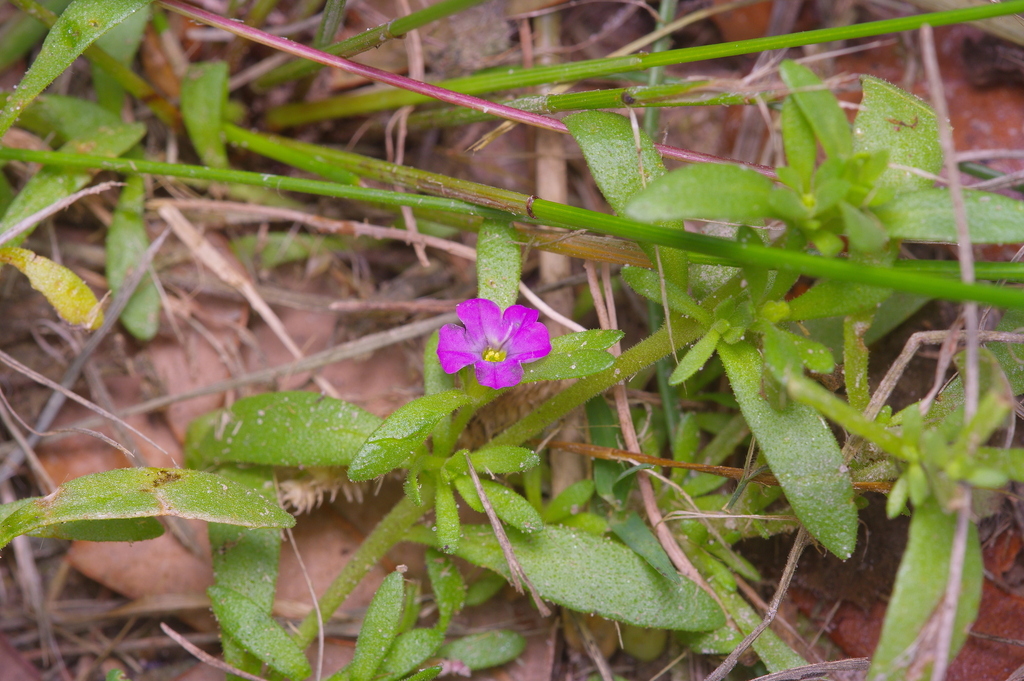
(c) Michelle W. (鍾偉瑋), some rights reserved (CC BY) · licence
Family: Solanaceae · Type: Herb · Native
Calibrachoa parviflora (Wild petunia) is a native California herb in the Solanaceae family, recognized by Widespread annual, recently separated from Petunia genus.
Wild petunia is a California native annual found in coastal western California, southern California, northern Channel Islands (Santa Rosa Island), peninsular ranges, and desert regions in open washes, dry streambeds, and drying shorelines at elevations below 1,700 meters. Flowering from March to November, this plant produces purple to white flowers with a distinctive white spot on the lower lip, approximately 4 to 10 millimeters long. Growing with prostrate to decumbent stems forming dense mats up to 70 centimeters long, it develops short, leafy axillary branches. Its leaves range from 5 to 20 millimeters long, varying from linear to oblong, oblanceolate, or obovate, and are either petioled or sessile. The small fruits are 2 to 4.5 millimeters long, containing pale brown seeds with a pitted surface.
Identification and appearance
Key characters: Widespread annual, recently separated from Petunia genus
Habitat and range
Habitat: Open washes, dry streambeds, drying shorelines
Elevation: < 1700 m
California counties: Santa Barbara, Riverside, Los Angeles, Monterey, Orange, Santa Clara, Imperial, San Mateo, San Bernardino, San Diego, Ventura, Alameda, San Benito, San Luis Obispo, Santa Cruz, Siskiyou, Napa, Yolo
Outside California: to southwestern Utah, southeastern United States, Mexico, Europe, South America, waif elsewhere in United States
Bloom period
Calibrachoa parviflora blooms Mar-Nov.
How to tell it apart
vs Petunia: Calibrachoa is a low sticky mat with tiny (< 1 cm) purple funnel-flowers whose calyx stays short (< 11 mm) in fruit; Petunia is coarser with much larger, showier flowers.; vs Solanum: Calibrachoa has a funnel- to trumpet-shaped, weakly 2-sided corolla; Solanum has a flat wheel-shaped (rotate) corolla with a protruding cone of yellow anthers.; vs Nicotiana: Calibrachoa is prostrate and mat-forming with minute flowers; Nicotiana (tobacco) is tall and erect with long trumpet-tubed flowers.; vs Physalis: Calibrachoa fruit sits in a short, open calyx; Physalis (ground-cherry) fruit is a berry wrapped in an inflated papery husk.; vs Nicandra: Calibrachoa has slender fleshy leaves and a solid decumbent stem; Nicandra has broad wavy-toothed leaves and a strongly 5-ribbed hollow stem.
Frequently asked questions
Is Calibrachoa parviflora native to California?
Yes. Calibrachoa parviflora is native to California (recorded as native).
When does Calibrachoa parviflora bloom?
Calibrachoa parviflora blooms Mar-Nov.
Where in California does Calibrachoa parviflora grow?
Calibrachoa parviflora occurs in Santa Barbara, Riverside, Los Angeles, Monterey, Orange, Santa Clara, Imperial, San Mateo and other counties, at elevations of < 1700 m.
What plant family does Calibrachoa parviflora belong to?
Calibrachoa parviflora is in the Solanaceae family, genus Calibrachoa.
What habitat does Calibrachoa parviflora grow in?
Calibrachoa parviflora grows in Open washes, dry streambeds, drying shorelines.
Related species
Other California species in the same genus, family, or bioregion.
Sources: Jepson eFlora · Index of California Plant Names · CalPhotos
Last updated 2026-10-07
Data from The California Species Project — 14,000+ California species with verified data from CNPS, CDFW, USFWS, Cal-IPC, and more.