Calliandra eriophylla
Pink fairy-duster, Pink Fairy-Duster
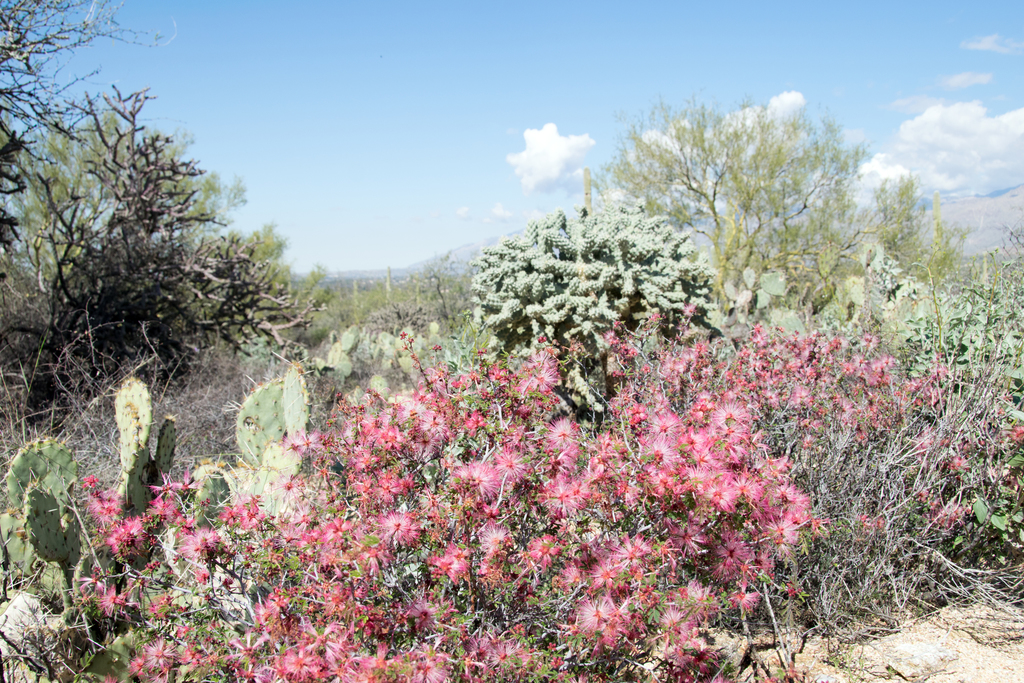
(c) Paul Asman and Jill Lenoble, some rights reserved (CC BY), uploaded by Paul Asman and Jill Lenoble · licence
Family: Fabaceae · Type: Shrub · Native
Conservation status: CNPS 2B.3
Calliandra eriophylla (Pink fairy-duster) is a native California shrub in the Fabaceae family, recognized by Genus reaches its northwestern range limit in California's Sonoran Desert.
Pink fairy-duster is a California native shrub found in the southern desert regions in sandy washes, slopes, and mesas at elevations around 1,500 meters. Flowering from February to April and again after September to October rains, this plant produces delicate pink flowers with elongated stamens 18 to 22 millimeters long. Growing as a compact shrub less than 60 centimeters tall, it spreads with many branches from its base and features a deciduous growth habit. Its leaves are complex, with 4 to 8 primary leaflets and 14 to 18 secondary leaflets, each small and approximately 2 to 3.5 millimeters long. The plant produces erect fruits 4 to 8 centimeters in length, containing 3 to 8 seeds.
Identification and appearance
Key characters: Genus reaches its northwestern range limit in California's Sonoran Desert
Habitat and range
Habitat: Sandy washes, slopes, mesas
Elevation: +- 1500 m.
California counties: San Diego, Riverside, Imperial, Kern, San Bernardino
Outside California: Arizona to Texas, northern Mexico
Bloom period
Calliandra eriophylla blooms Feb-Apr, after Sep--Oct rain.
Conservation status
CNPS 2B.3
How to tell it apart
vs Melaleuca: Calliandra has twice-compound feathery leaves; Melaleuca has simple narrow leaves arranged spirally around stems.; vs Albizia: Calliandra grows as desert shrubs with no petiole glands; Albizia are valley/coastal trees with tiny glands on leaf stalks.; vs Mimosa: Calliandra pods curl backward dramatically when open; Mimosa pods remain flat or slightly curved.; vs Erythrostemon: Calliandra has powder-puff flowers with numerous stamens; Erythrostemon has distinct petals and 10 or fewer stamens.; vs Grevillea: Calliandra has powder-puff flowers and feathery leaves; Grevillea has tubular flowers and simple or lobed leaves.
Frequently asked questions
Is Calliandra eriophylla native to California?
Yes. Calliandra eriophylla is native to California (recorded as native).
When does Calliandra eriophylla bloom?
Calliandra eriophylla blooms Feb-Apr, after Sep--Oct rain.
Where in California does Calliandra eriophylla grow?
Calliandra eriophylla occurs in San Diego, Riverside, Imperial, Kern, San Bernardino, at elevations of +- 1500 m..
What plant family does Calliandra eriophylla belong to?
Calliandra eriophylla is in the Fabaceae family, genus Calliandra.
Is Calliandra eriophylla rare or endangered?
Calliandra eriophylla carries California Rare Plant Rank 2B.3, state rank S3.
Related species
Other California species in the same genus, family, or bioregion.
Sources: Jepson eFlora · CNPS Rare Plant Inventory · Index of California Plant Names · CalPhotos · CDFW CNDDB
Last updated 2026-10-07
Data from The California Species Project — 14,000+ California species with verified data from CNPS, CDFW, USFWS, Cal-IPC, and more.