Callitriche heterophylla var. bolanderi
Bolander's water starwort
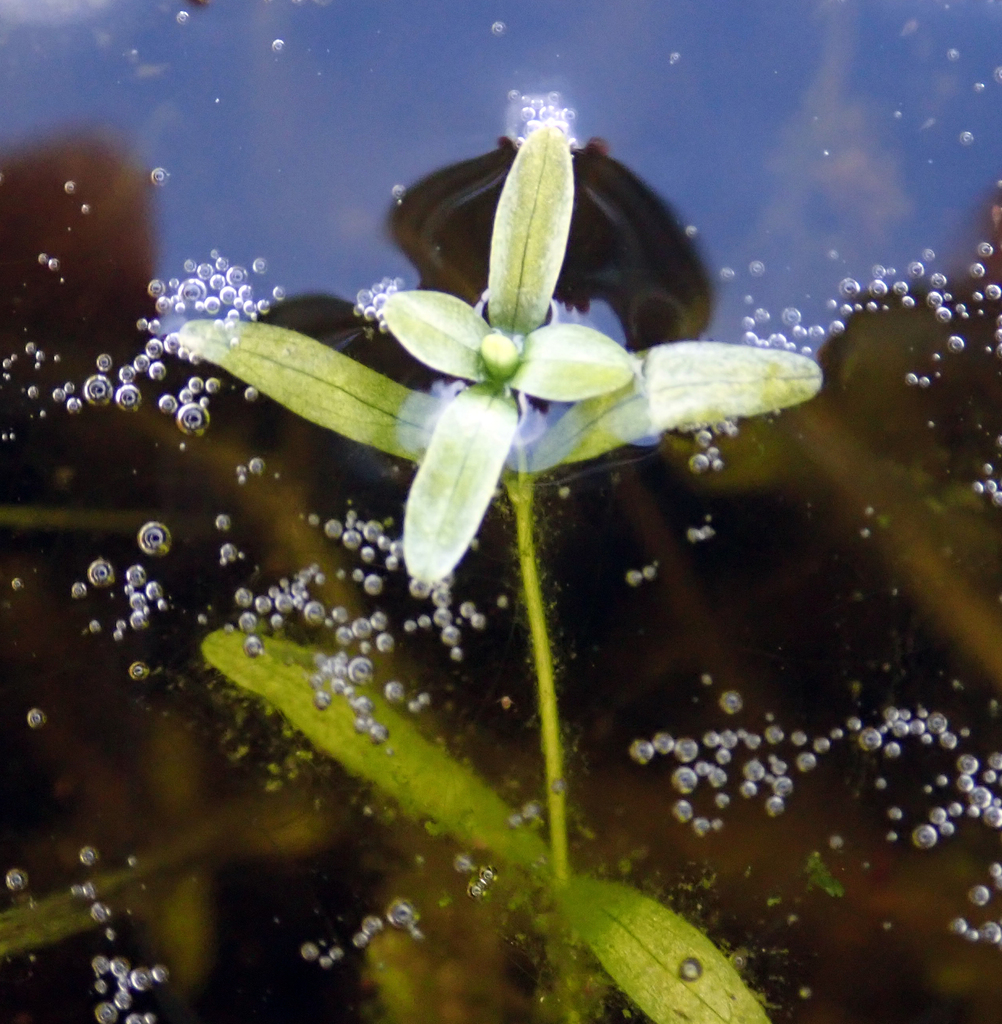
Photo: parent species Callitriche heterophylla · no rights reserved · CC0
Family: Plantaginaceae · Type: Herb · Native
Callitriche heterophylla var. bolanderi (Bolander's water starwort) is a native California herb in the Plantaginaceae family, recognized by distinguished primarily by fruit size and bract characteristics.
Bolander's water starwort is a California native perennial found in the California Floristic Province and North Coast Ranges in submerged aquatic habitats, including lakes, pools, and streams at elevations below 2,000 meters. Flowering from April to July, this aquatic plant produces small, inconspicuous flowers in delicate floating rosettes or stranded at water edges. Growing with slender, branching stems that spread across water surfaces, it forms dense, intricate clusters of fine vegetation. Its leaves are variable in shape, ranging from linear underwater leaves to broader floating leaves, creating a distinctive adaptation to changing aquatic environments. The fruit is tiny, measuring 0.8 to 1.4 millimeters long, contributing to its delicate and unobtrusive nature.
Identification and appearance
Key characters: Co-occurs with 7 species; distinguished primarily by fruit size and bract characteristics
Habitat and range
Habitat: Submerged, with floating rosettes or becoming stranded at edge of lake, pools, or streams
Elevation: < 2000 m
California counties: Lassen, Butte, Humboldt, Lake, Calaveras, Fresno, Sierra, Contra Costa, San Diego, Riverside, Modoc, Tehama, Sacramento, Mendocino, Yuba, Placer, Madera, Marin, Shasta, El Dorado, Napa, Sonoma, Mariposa, Stanislaus, Siskiyou, Mono, San Joaquin, Inyo, Alameda, Tuolumne, Amador, Santa Cruz, San Luis Obispo, Monterey, Ventura, Del Norte
Outside California: to British Columbia
Bloom period
Callitriche heterophylla var. bolanderi blooms Apr-Jul.
How to tell it apart
vs Nasturtium: Nasturtium has bright yellow or white 4-petaled flowers; Callitriche has no petals, just tiny styles.; vs Lemna: Lemna is free-floating duckweed with no roots in substrate; Callitriche is rooted with opposite-leaved stems.; vs Ludwigia: Ludwigia has showy yellow flowers and consistent leaf shape; Callitriche lacks petals and has dimorphic leaves.; vs Soleirolia: Soleirolia is terrestrial with round leaves; Callitriche is aquatic with narrow or spoon-shaped leaves.; vs Stellaria: Stellaria has notched white petals on terrestrial plants; Callitriche lacks petals and forms aquatic rosettes.
Frequently asked questions
Is Callitriche heterophylla var. bolanderi native to California?
Yes. Callitriche heterophylla var. bolanderi is native to California (recorded as native).
When does Callitriche heterophylla var. bolanderi bloom?
Callitriche heterophylla var. bolanderi blooms Apr-Jul.
Where in California does Callitriche heterophylla var. bolanderi grow?
Callitriche heterophylla var. bolanderi occurs in Lassen, Butte, Humboldt, Lake, Calaveras, Fresno, Sierra, Contra Costa and other counties, at elevations of < 2000 m.
What plant family does Callitriche heterophylla var. bolanderi belong to?
Callitriche heterophylla var. bolanderi is in the Plantaginaceae family, genus Callitriche.
What habitat does Callitriche heterophylla var. bolanderi grow in?
Callitriche heterophylla var. bolanderi grows in Submerged, with floating rosettes or becoming stranded at edge of lake, pools, or streams.
Related species
Other California species in the same genus, family, or bioregion.
Sources: Jepson eFlora · Index of California Plant Names · CalPhotos
Last updated 2026-10-07
Data from The California Species Project — 14,000+ California species with verified data from CNPS, CDFW, USFWS, Cal-IPC, and more.