Callitropsis nootkatensis
Alaska cedar
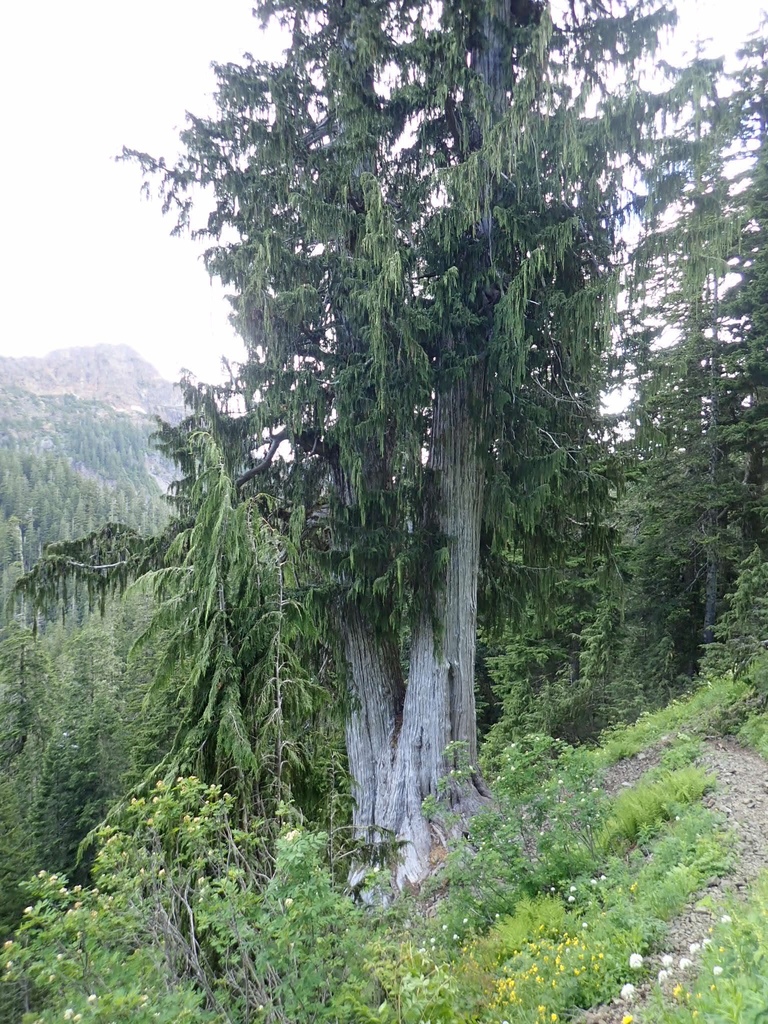
(c) John Brew, some rights reserved (CC BY), uploaded by John Brew · licence
Family: Cupressaceae · Type: Tree · Native
Conservation status: CNPS 4.3
Callitropsis nootkatensis (Alaska cedar) is a native California tree in the Cupressaceae family, recognized by Southern range limit of a primarily northern Pacific coast species.
Alaska cedar is a native tree found in the Klamath Ranges of Del Norte and Siskiyou counties on cool, moist, well-drained mountain slopes at elevations of 20 to 2,500 meters. The tree produces small, yellow pollen cones that are 2.4 to 4 millimeters long, developing in distinctive two-dimensional, pendent clusters. Growing 20 to 30 meters tall with a pyramidal shape when young, it has a unique bark that ranges from orange-red to gray-brown and purple-brown, which is fibrous and tends to peel. Its leaves are scale-like, closely appressed and overlapping, arranged in four ranks and appearing green without a glaucous coating. Seed cones are small and spherical, ash-gray in color, typically 6 to 12 millimeters wide, containing fewer than 15 brown to red-brown seeds that mature in the second year.
Identification and appearance
Key characters: Southern range limit of a primarily northern Pacific coast species
Habitat and range
Habitat: Cool, moist, forested, well-drained mountain slopes
Elevation: 20-2500 m
California counties: Del Norte, Humboldt, Siskiyou
Outside California: to Alaska
Conservation status
CNPS 4.3
How to tell it apart
vs Chamaecyparis: Callitropsis has drooping weeping branches; Chamaecyparis has upright or horizontal flat sprays.; vs Calocedrus: Callitropsis has drooping branch clusters; Calocedrus has upright or spreading flattened sprays with leaves appearing whorled.; vs Taxodium: Callitropsis is evergreen with drooping branches; Taxodium is deciduous with horizontal branches.; vs Sequoia: Callitropsis has drooping scale-leafed branches; Sequoia has horizontal branches with flat needles in two rows.; vs Sequoiadendron: Callitropsis has weeping branches and cones that open; Sequoiadendron has upright branches and persistent closed cones.
Frequently asked questions
Is Callitropsis nootkatensis native to California?
Yes. Callitropsis nootkatensis is native to California (recorded as native).
Where in California does Callitropsis nootkatensis grow?
Callitropsis nootkatensis occurs in Del Norte, Humboldt, Siskiyou, at elevations of 20-2500 m.
What plant family does Callitropsis nootkatensis belong to?
Callitropsis nootkatensis is in the Cupressaceae family, genus Callitropsis.
Is Callitropsis nootkatensis rare or endangered?
Callitropsis nootkatensis carries California Rare Plant Rank 4.3, state rank S3.
What habitat does Callitropsis nootkatensis grow in?
Callitropsis nootkatensis grows in Cool, moist, forested, well-drained mountain slopes.
Related species
Other California species in the same genus, family, or bioregion.
Sources: Jepson eFlora · CNPS Rare Plant Inventory · Index of California Plant Names · CalPhotos · CDFW CNDDB
Last updated 2026-10-07
Data from The California Species Project — 14,000+ California species with verified data from CNPS, CDFW, USFWS, Cal-IPC, and more.