Calochortus coeruleus
Beavertail-grass, Beavertail-Grass
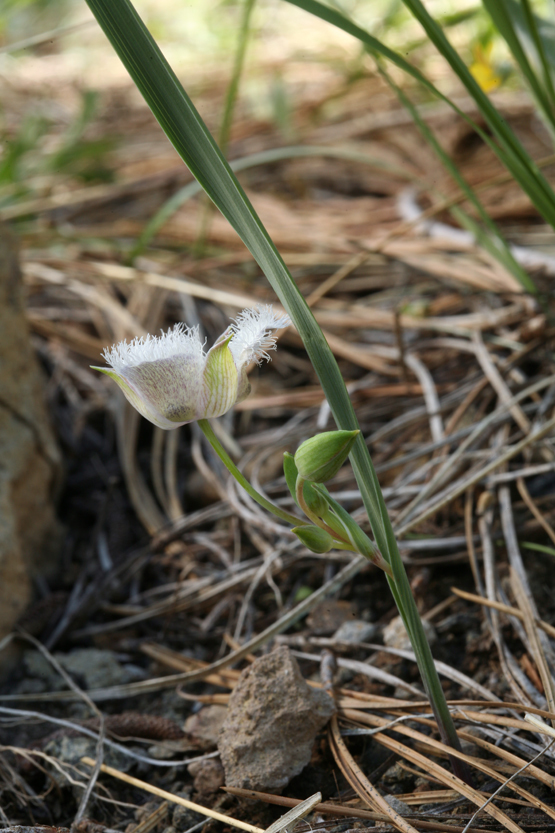
(c) Steve Matson, some rights reserved (CC BY) · licence
Family: Liliaceae · Type: Herb · Native
Calochortus coeruleus (Beavertail-grass) is a native California herb in the Liliaceae family, recognized by small size and blue flowers are distinctive.
Beavertail-grass is a California native perennial found in northwestern California, the Cascade Ranges, and the Sierra Nevada Mountains in gravelly woodland openings at elevations of 600 to 2,500 meters. Flowering from May to June, this plant produces blue flowers 8 to 12 millimeters long with obovate petals that are ciliate and hairy on the inner surface. Growing with slender stems 3 to 15 centimeters tall that are simple and sometimes wavy, it has long basal leaves up to 20 centimeters in length. Its distinctive blue petals feature a transverse, arched nectary bordered by delicate ciliate membranes and short hairs. The fruit is a nodding, widely elliptic structure 10 to 15 millimeters long.
Identification and appearance
Key characters: 20 sympatric species; small size and blue flowers are distinctive
Habitat and range
Habitat: Common. Gravelly openings in woodland
Elevation: 600-2500 m
California counties: El Dorado, Plumas, Nevada, Glenn, Siskiyou, Trinity, Del Norte, Shasta, Mendocino, Placer, Amador, Calaveras, Kern, Humboldt, Lassen, San Mateo, Yuba, Butte, Lake, Sierra, Tehama, Alpine, Solano, Madera
Bloom period
Calochortus coeruleus blooms May-Jun.
How to tell it apart
vs Clarkia: Calochortus has 6 stamens and grass-like leaves; Clarkia has 8 stamens and broad stem leaves.; vs Fritillaria: Calochortus flowers open upward/outward in cups; Fritillaria flowers hang downward like bells.; vs Thismia: Calochortus has green leaves and open flowers; Thismia is leafless with closed tubular flowers.; vs Eschscholzia: Calochortus has 6 petals and parallel-veined leaves; Eschscholzia has 4 petals and divided leaves.; vs Sidalcea: Calochortus has 6 petals and grass-like leaves; Sidalcea has 5 petals and rounded lobed leaves.
Frequently asked questions
Is Calochortus coeruleus native to California?
Yes. Calochortus coeruleus is native to California (recorded as native).
When does Calochortus coeruleus bloom?
Calochortus coeruleus blooms May-Jun.
Where in California does Calochortus coeruleus grow?
Calochortus coeruleus occurs in El Dorado, Plumas, Nevada, Glenn, Siskiyou, Trinity, Del Norte, Shasta and other counties, at elevations of 600-2500 m.
What plant family does Calochortus coeruleus belong to?
Calochortus coeruleus is in the Liliaceae family, genus Calochortus.
What habitat does Calochortus coeruleus grow in?
Calochortus coeruleus grows in Common. Gravelly openings in woodland.
Related species
Other California species in the same genus, family, or bioregion.
Sources: Jepson eFlora · Index of California Plant Names · CalPhotos
Last updated 2026-10-07
Data from The California Species Project — 14,000+ California species with verified data from CNPS, CDFW, USFWS, Cal-IPC, and more.