Calochortus kennedyi var. kennedyi
Desert mariposa lily
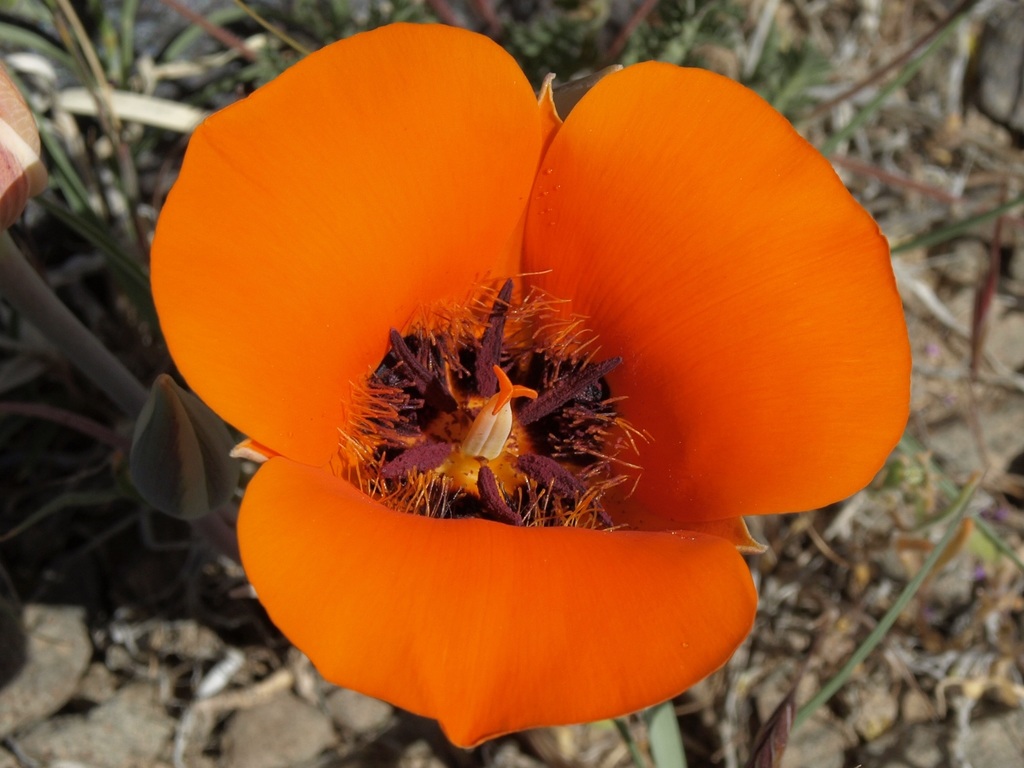
Photo: parent species Calochortus kennedyi · (c) Jim Morefield, some rights reserved (CC BY) · licence
Family: Liliaceae · Type: Vine · Native
Calochortus kennedyi var. kennedyi (Desert mariposa lily) is a native California vine in the Liliaceae family, recognized by orange-red petals and short stature.
Desert mariposa lily is a California native perennial found in northern Transverse Ranges, White and Inyo Mountains, and Desert Mountains in creosote-bush scrub and pinyon/juniper woodland at elevations of 600 to 2,200 meters. Flowering from April to June, this plant produces striking orange to red flowers with distinctive three-petaled blossoms. Growing 20 to 40 centimeters tall with slender, erect stems emerging from a bulbous base, it develops delicate, grass-like foliage. Its leaves are narrow and linear, typically 10 to 20 centimeters long, emerging directly from the bulb base. The flower petals are particularly vibrant in the eastern Desert Mountains, ranging from bright orange to deep red with intricate interior markings.
Identification and appearance
Key characters: 21 sympatric species; orange-red petals and short stature
Habitat and range
Habitat: Heavy or rocky soil in creosote-bush scrub, pinyon/juniper woodland
Elevation: 600-2200 m
California counties: San Bernardino, Los Angeles, Kern, Inyo, Ventura, Mariposa, Riverside
Outside California: Nevada, Arizona, Mexico
Bloom period
Calochortus kennedyi var. kennedyi blooms Apr-Jun.
How to tell it apart
vs Clarkia: Calochortus has 6 stamens and grass-like leaves; Clarkia has 8 stamens and broad stem leaves.; vs Fritillaria: Calochortus flowers open upward/outward in cups; Fritillaria flowers hang downward like bells.; vs Thismia: Calochortus has green leaves and open flowers; Thismia is leafless with closed tubular flowers.; vs Eschscholzia: Calochortus has 6 petals and parallel-veined leaves; Eschscholzia has 4 petals and divided leaves.; vs Sidalcea: Calochortus has 6 petals and grass-like leaves; Sidalcea has 5 petals and rounded lobed leaves.
Frequently asked questions
Is Calochortus kennedyi var. kennedyi native to California?
Yes. Calochortus kennedyi var. kennedyi is native to California (recorded as native).
When does Calochortus kennedyi var. kennedyi bloom?
Calochortus kennedyi var. kennedyi blooms Apr-Jun.
Where in California does Calochortus kennedyi var. kennedyi grow?
Calochortus kennedyi var. kennedyi occurs in San Bernardino, Los Angeles, Kern, Inyo, Ventura, Mariposa, Riverside, at elevations of 600-2200 m.
What plant family does Calochortus kennedyi var. kennedyi belong to?
Calochortus kennedyi var. kennedyi is in the Liliaceae family, genus Calochortus.
What habitat does Calochortus kennedyi var. kennedyi grow in?
Calochortus kennedyi var. kennedyi grows in Heavy or rocky soil in creosote-bush scrub, pinyon/juniper woodland.
Related species
Other California species in the same genus, family, or bioregion.
- Calochortus kennedyi var. munzii — Desert mariposa lily
- Calochortus leichtlinii — Leichtlin's mariposa lily
- Calochortus longebarbatus var. longebarbatus — Long-haired star-tulip
- Calochortus luteus — Yellow mariposa lily
- Calochortus macrocarpus — Sagebrush mariposa lily
- Calochortus minimus — Sierra mariposa lily
Sources: Jepson eFlora · Index of California Plant Names · CalPhotos
Last updated 2026-10-07
Data from The California Species Project — 14,000+ California species with verified data from CNPS, CDFW, USFWS, Cal-IPC, and more.