Calochortus obispoensis
San luis mariposa lily, San Luis Mariposa Lily
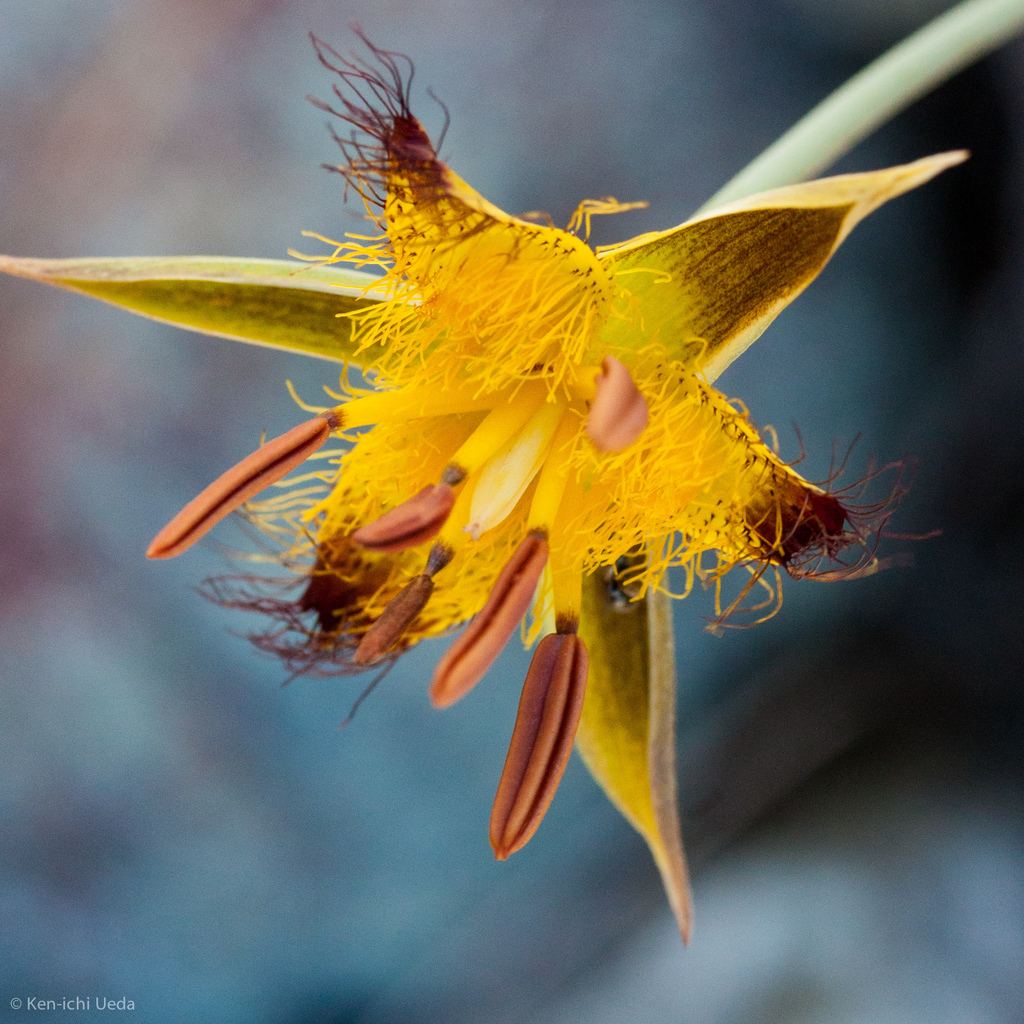
(c) Ken-ichi Ueda,保留部分权利(CC BY) · licence
Family: Liliaceae · Type: Herb · Native
Conservation status: CNPS 1B.2
Calochortus obispoensis (San luis mariposa lily) is a native California herb in the Liliaceae family, recognized by distinctive small fringed orange flowers.
San luis mariposa lily is a rare (CNPS 1B.2) California native perennial found in central Coast Ranges east of Morro Bay and southern San Luis Obispo County in dry serpentine chaparral at elevations of 100 to 500 meters. Flowering from May to June, this plant produces yellow to deep orange flowers with distinctive dark-hair-tufted petals, each approximately 10 to 20 millimeters long and fringed with dense, slender hairs. Growing with slender, generally branched stems 30 to 60 centimeters tall emerging from a fibrous bulb, it develops from a basal rosette of linear, long-tapered leaves. Its leaves are channeled and measure 20 to 30 centimeters long, with two reduced cauline leaves becoming progressively smaller and inrolled toward the stem's upper portion. The fruit is an erect, linear pod 3 to 4 centimeters long, containing light yellow to tan seeds with a fine net-like surface.
Identification and appearance
Key characters: 17 sympatric species; distinctive small fringed orange flowers
Habitat and range
Habitat: dry serpentine, generally open chaparral
Elevation: 100-500 m
California counties: San Luis Obispo
Bloom period
Calochortus obispoensis blooms May-Jun.
Conservation status
CNPS 1B.2
How to tell it apart
vs Clarkia: Calochortus has 6 stamens and grass-like leaves; Clarkia has 8 stamens and broad stem leaves.; vs Fritillaria: Calochortus flowers open upward/outward in cups; Fritillaria flowers hang downward like bells.; vs Thismia: Calochortus has green leaves and open flowers; Thismia is leafless with closed tubular flowers.; vs Eschscholzia: Calochortus has 6 petals and parallel-veined leaves; Eschscholzia has 4 petals and divided leaves.; vs Sidalcea: Calochortus has 6 petals and grass-like leaves; Sidalcea has 5 petals and rounded lobed leaves.
Frequently asked questions
Is Calochortus obispoensis native to California?
Yes. Calochortus obispoensis is native to California (recorded as native).
When does Calochortus obispoensis bloom?
Calochortus obispoensis blooms May-Jun.
Where in California does Calochortus obispoensis grow?
Calochortus obispoensis occurs in San Luis Obispo, at elevations of 100-500 m.
What plant family does Calochortus obispoensis belong to?
Calochortus obispoensis is in the Liliaceae family, genus Calochortus.
Is Calochortus obispoensis rare or endangered?
Calochortus obispoensis carries California Rare Plant Rank 1B.2, state rank S2.
Related species
Other California species in the same genus, family, or bioregion.
- Calochortus palmeri — Palmer's mariposa lily
- Calochortus palmeri var. munzii — San jacinto mariposa lily
- Calochortus palmeri var. palmeri — Palmer's mariposa lily
- Calochortus panamintensis — Panamint mariposa lily
- Calochortus persistens — Siskiyou mariposa lily
- Calochortus plummerae — Plummer's mariposa lily
Sources: Jepson eFlora · CNPS Rare Plant Inventory · Index of California Plant Names · CalPhotos · CDFW CNDDB
Last updated 2026-10-07
Data from The California Species Project — 14,000+ California species with verified data from CNPS, CDFW, USFWS, Cal-IPC, and more.