Calochortus uniflorus
Pink star-tulip, Pink Star-Tulip
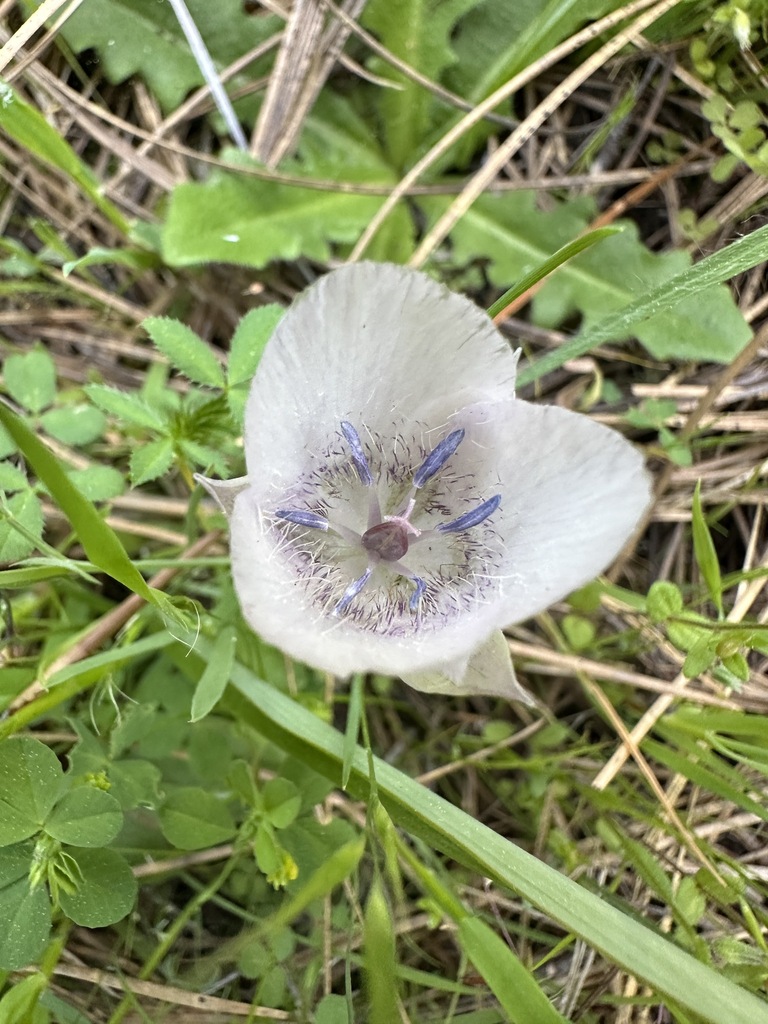
(c) Dee Shea Himes, some rights reserved (CC BY) · licence
Family: Liliaceae · Type: Herb · Native
Conservation status: CNPS 4.2
Calochortus uniflorus (Pink star-tulip) is a native California herb in the Liliaceae family, recognized by distinctive very short stem and moist habitat preference.
Pink star-tulip is a California native perennial ranked 4.2 by CNPS, found in northwestern California, the high Cascade Range, northern and central Coast Ranges, and San Francisco Bay Area in moist meadows at elevations below 500 meters. Flowering from April to June, this plant produces white to pink flowers with distinctive purple spots above the nectary, with blossoms 15 to 28 millimeters long in bell-shaped arrangements. Growing with slender stems less than 5 centimeters tall, it emerges from a bulb and produces 1 to 3 linear cauline leaves that become progressively smaller toward the top of the plant. Its basal leaves are persistent and can reach 10 to 40 centimeters in length, with flowers typically arranged in a small umbel-like cluster of 1 to 5 erect blooms. The fruit is a nodding, narrowly winged elliptic capsule 15 to 25 millimeters long, containing light brown seeds with a distinctive net-like texture.
Identification and appearance
Key characters: 22 sympatric species; distinctive very short stem and moist habitat preference
Habitat and range
Habitat: Moist meadows
Elevation: < 500 m
California counties: Sonoma, Monterey, Napa, Lake, Mendocino, Trinity, Siskiyou, Colusa, Marin, San Benito, San Luis Obispo, Santa Cruz, Shasta, Solano, Tehama, Alameda, Placer, San Mateo, Nevada, Yuba
Outside California: Oregon
Bloom period
Calochortus uniflorus blooms Apr-Jun.
Conservation status
CNPS 4.2
How to tell it apart
vs Clarkia: Calochortus has 6 stamens and grass-like leaves; Clarkia has 8 stamens and broad stem leaves.; vs Fritillaria: Calochortus flowers open upward/outward in cups; Fritillaria flowers hang downward like bells.; vs Thismia: Calochortus has green leaves and open flowers; Thismia is leafless with closed tubular flowers.; vs Eschscholzia: Calochortus has 6 petals and parallel-veined leaves; Eschscholzia has 4 petals and divided leaves.; vs Sidalcea: Calochortus has 6 petals and grass-like leaves; Sidalcea has 5 petals and rounded lobed leaves.
Frequently asked questions
Is Calochortus uniflorus native to California?
Yes. Calochortus uniflorus is native to California (recorded as native).
When does Calochortus uniflorus bloom?
Calochortus uniflorus blooms Apr-Jun.
Where in California does Calochortus uniflorus grow?
Calochortus uniflorus occurs in Sonoma, Monterey, Napa, Lake, Mendocino, Trinity, Siskiyou, Colusa and other counties, at elevations of < 500 m.
What plant family does Calochortus uniflorus belong to?
Calochortus uniflorus is in the Liliaceae family, genus Calochortus.
Is Calochortus uniflorus rare or endangered?
Calochortus uniflorus carries California Rare Plant Rank 4.2, state rank S4.
Related species
Other California species in the same genus, family, or bioregion.
Sources: Jepson eFlora · CNPS Rare Plant Inventory · Index of California Plant Names · CalPhotos · CDFW CNDDB
Last updated 2026-10-07
Data from The California Species Project — 14,000+ California species with verified data from CNPS, CDFW, USFWS, Cal-IPC, and more.