Caltha leptosepala
White marsh marigold
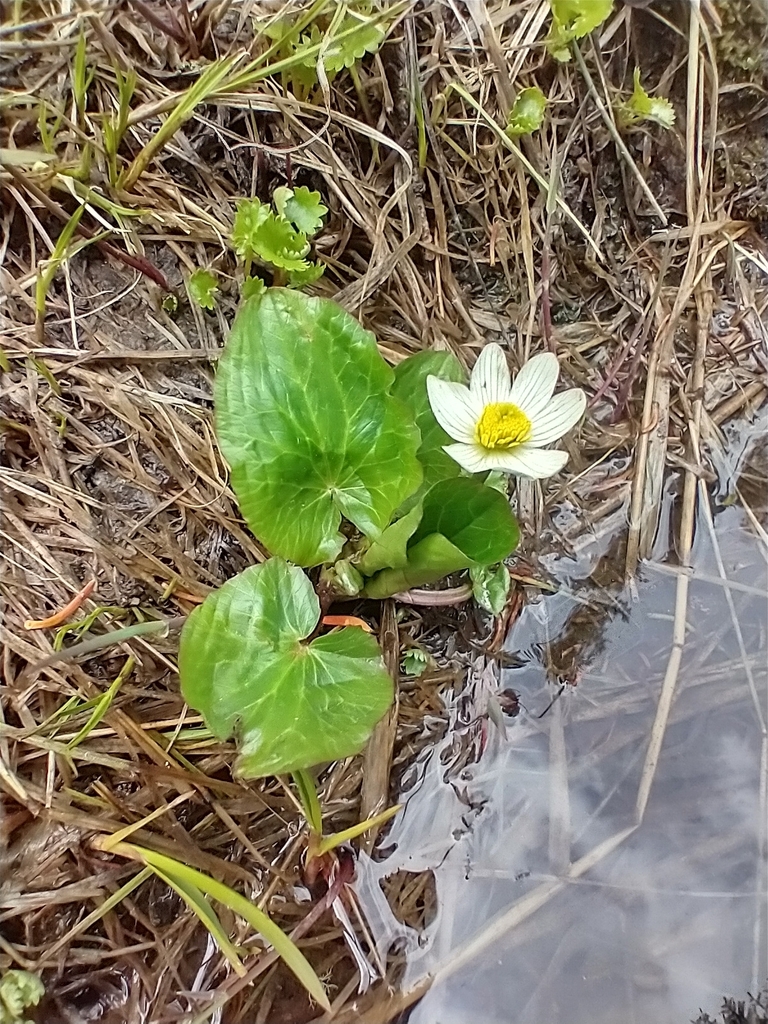
(c) Tom Norton, some rights reserved (CC BY) · licence
Family: Ranunculaceae · Type: Herb · Native
Caltha leptosepala (White marsh marigold) is a native California herb in the Ranunculaceae family, recognized by . Found in high-elevation mountain regions.
White marsh marigold is a California native perennial found in the Klamath Ranges, Cascade Range, Sierra Nevada Mountains, and North Coast Ranges in marshes, pond margins, streambanks, and conifer forests at elevations of 900 to 3,300 meters. Flowering from May to July, this plant produces white flowers with multiple rounded sepals in small clusters of one to four blooms. Growing 8 to 48 centimeters tall with erect stems and broad leaf bases, it has a distinctive spreading growth habit. Its leaves feature wide blades 2 to 9 centimeters across with slightly scalloped edges, supported by long petioles that can be longer or shorter than the leaf blade. When mature, the plant develops 4 to 15 elongated fruit structures 7 to 18 millimeters long with straight or slightly curved beaks.
Identification and appearance
Key characters: Geographically isolated with 0 sympatric species. Found in high-elevation mountain regions.
Habitat and range
Habitat: Marshes, pond margins, streambanks, conifer forest
Elevation: 900-3300 m
California counties: Tulare, Modoc, Siskiyou, Mono, Butte, Nevada, Alpine, Amador, Humboldt, Lassen, Plumas, Tehama, Sierra, Shasta, Trinity, Tuolumne, El Dorado, Fresno, Mariposa, Del Norte, Placer
Outside California: to Alaska, Montana, New Mexico
Bloom period
Caltha leptosepala blooms May-Jul.
How to tell it apart
vs Ranunculus: Caltha has thick, succulent stems and kidney-shaped leaves; Ranunculus has thinner stems and most species have divided or deeply lobed leaves.; vs Anemone: Caltha leaves are simple and undivided from the base; Anemone has compound leaves divided into separate leaflets.; vs Oxalis: Caltha has yellow/white flowers with showy sepals; Oxalis has clover-like trifoliate leaves and 5-petaled flowers.; vs Aquilegia: Caltha has simple undivided leaves; Aquilegia has compound leaves divided into rounded leaflets.; vs Coptis: Caltha has simple heart-shaped leaves; Coptis has compound leaves divided into 3+ toothed leaflets.
Frequently asked questions
Is Caltha leptosepala native to California?
Yes. Caltha leptosepala is native to California (recorded as native).
When does Caltha leptosepala bloom?
Caltha leptosepala blooms May-Jul.
Where in California does Caltha leptosepala grow?
Caltha leptosepala occurs in Tulare, Modoc, Siskiyou, Mono, Butte, Nevada, Alpine, Amador and other counties, at elevations of 900-3300 m.
What plant family does Caltha leptosepala belong to?
Caltha leptosepala is in the Ranunculaceae family, genus Caltha.
What habitat does Caltha leptosepala grow in?
Caltha leptosepala grows in Marshes, pond margins, streambanks, conifer forest.
Related species
Other California species in the same genus, family, or bioregion.
Sources: Jepson eFlora · Index of California Plant Names · CalPhotos
Last updated 2026-10-07
Data from The California Species Project — 14,000+ California species with verified data from CNPS, CDFW, USFWS, Cal-IPC, and more.