Calycadenia multiglandulosa
Rosin weed
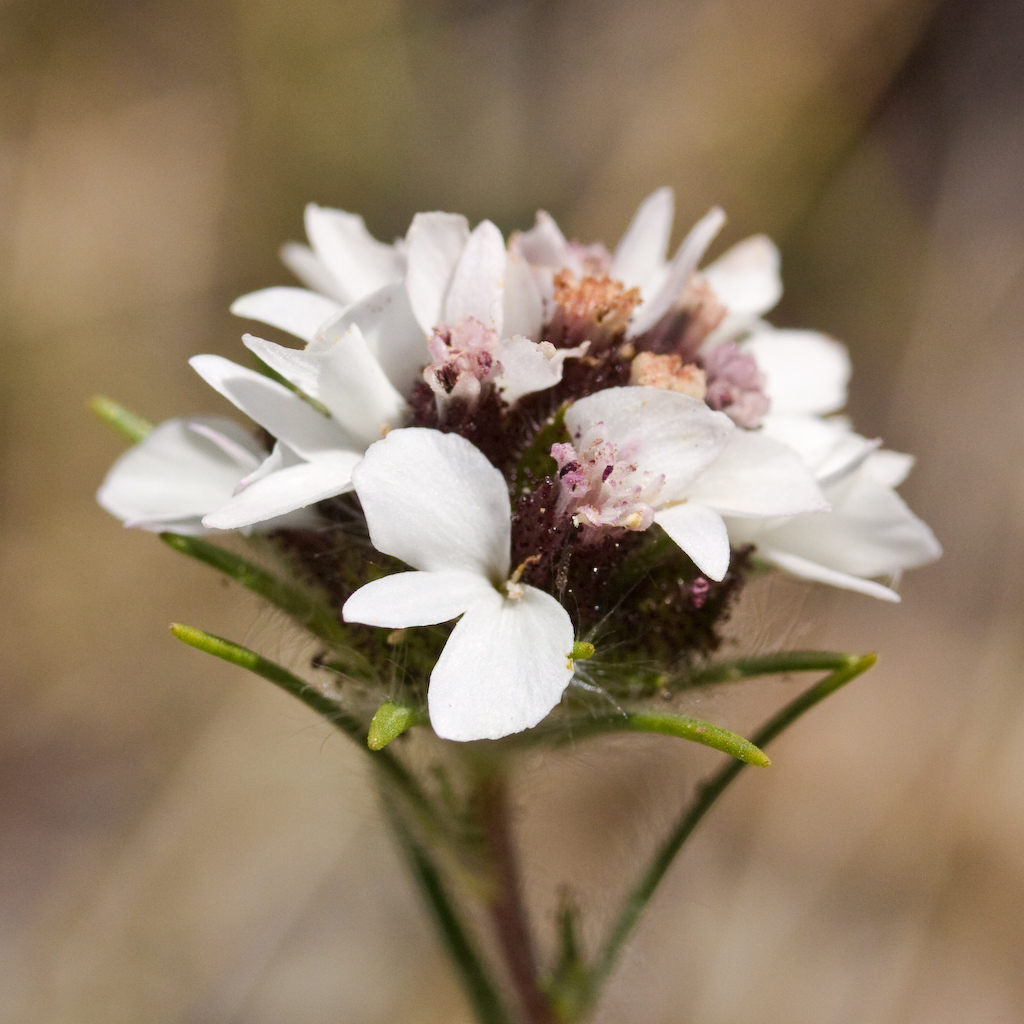
(c) Ken-ichi Ueda, some rights reserved (CC BY) · licence
Family: Asteraceae · Type: Herb · Native
Calycadenia multiglandulosa (Rosin weed) is a native California herb in the Asteraceae family, recognized by . Key features: spike-like congested inflorescence, numerous tack-like glands, strongly asymmetric rays with small central lobe.
Rosin weed is a California native annual found in northern Coast Ranges, Sierra Nevada, Central Valley, San Francisco Bay Area, and south coastal regions in dry, open valleys, hillsides, and rocky ridges at elevations of 50 to 1,100 meters. Flowering from May to October, this plant produces white to cream or rose-colored flowers with ray flowers 5 to 10 millimeters long, featuring asymmetric lateral lobes. Growing with stems 10 to 70 centimeters tall, often branched and covered in glandular hairs, particularly towards the upper portions. Its leaves are generally alternate, ranging 3 to 8 centimeters long, with lower leaves often persisting throughout the plant's life cycle. The inflorescence forms spike-like clusters with distinctive red-tinted linear bracts and multiple flower heads featuring 2 to 6 ray flowers and 4 to 20 disk flowers.
Identification and appearance
Key characters: 8 sympatric species. Key features: spike-like congested inflorescence, numerous tack-like glands, strongly asymmetric rays with small central lobe
Habitat and range
Habitat: Common. Generally dry, open valleys, hillsides, rocky ridges
Elevation: 50-1100 m
Bloom period
Calycadenia multiglandulosa blooms May-Oct.
How to tell it apart
vs Hemizonia: Calycadenia rays deeply fringed; Hemizonia rays shallowly lobed with ray fruits beaked.; vs Osmadenia: Calycadenia covered with tack glands; Osmadenia completely lacks sticky glands.; vs Deinandra: Calycadenia rays deeply split; Deinandra rays shallowly lobed or entire.; vs Madia: Calycadenia has tack glands and deeply split rays; Madia lacks tack glands, different ray shape.; vs Holocarpha: Calycadenia has tack glands (not pit glands); Holocarpha has pit-gland depressions on bracts.
Frequently asked questions
Is Calycadenia multiglandulosa native to California?
Yes. Calycadenia multiglandulosa is native to California (recorded as native).
When does Calycadenia multiglandulosa bloom?
Calycadenia multiglandulosa blooms May-Oct.
What plant family does Calycadenia multiglandulosa belong to?
Calycadenia multiglandulosa is in the Asteraceae family, genus Calycadenia.
What habitat does Calycadenia multiglandulosa grow in?
Calycadenia multiglandulosa grows in Common. Generally dry, open valleys, hillsides, rocky ridges.
Related species
Other California species in the same genus, family, or bioregion.
Sources: Jepson eFlora · Index of California Plant Names · CalPhotos
Last updated 2026-10-07
Data from The California Species Project — 14,000+ California species with verified data from CNPS, CDFW, USFWS, Cal-IPC, and more.