Calycadenia truncata
Rosin weed
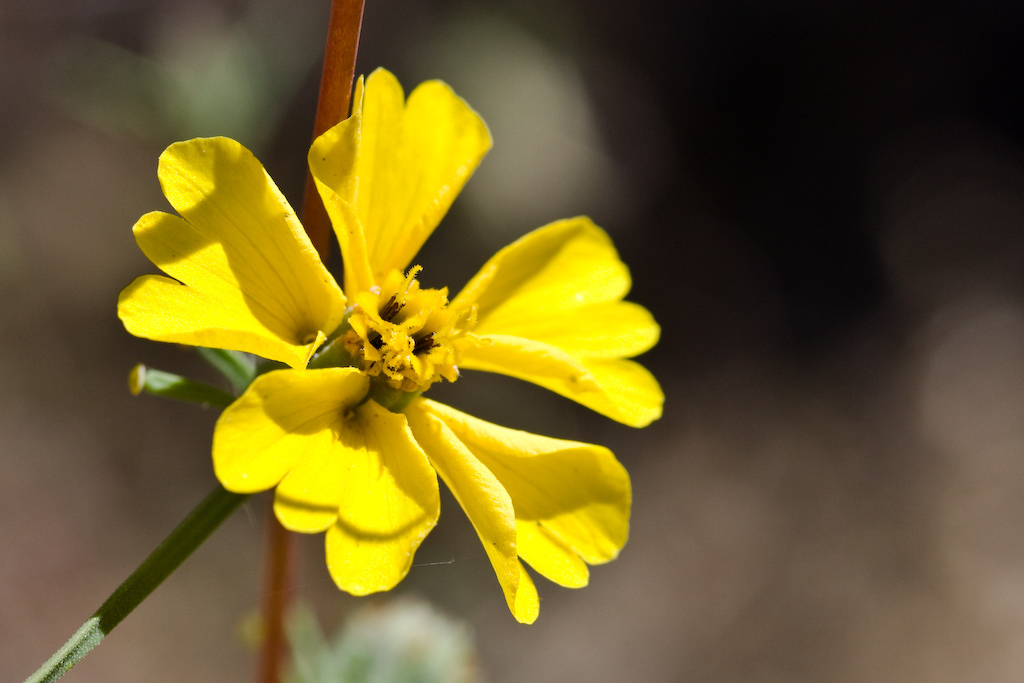
(c) Ken-ichi Ueda, some rights reserved (CC BY) · licence
Family: Asteraceae · Type: Herb · Native
Calycadenia truncata (Rosin weed) is a native California herb in the Asteraceae family, recognized by . Key features: large yellow rays 5-12mm, shallow sinuses <1/3 ray, reddish glabrous to slightly scabrous stems.
Rosin weed is a California native annual found in northwestern California, the Cascade Range, Sierra Nevada foothills, Central Valley, and central western California in dry, open hillsides, rocky ridges, grasslands, and foothill woodland openings at elevations of 50 to 1,600 meters. Flowering from May to October, this plant produces yellow ray flowers with heads generally 1 to 3 per node, creating distinctive clusters. Growing with reddish branched stems 20 to 120 centimeters tall that become somewhat rough toward the tips, it develops intricate branching beyond the middle of the plant. Its leaves reach up to 10 centimeters long, with proximal leaves showing the most pronounced development. The ray fruits are uniquely textured, with a rough, wrinkled surface that distinguishes this delicate annual wildflower.
Identification and appearance
Key characters: 8 sympatric species. Key features: large yellow rays 5-12mm, shallow sinuses <1/3 ray, reddish glabrous to slightly scabrous stems
Habitat and range
Habitat: Common. Dry, open hillsides, rocky ridges, talus, grassland, openings in foothill woodland, scrub
Elevation: 50-1600 m
Outside California: Oregon
Bloom period
Calycadenia truncata blooms May-Oct.
How to tell it apart
vs Hemizonia: Calycadenia rays deeply fringed; Hemizonia rays shallowly lobed with ray fruits beaked.; vs Osmadenia: Calycadenia covered with tack glands; Osmadenia completely lacks sticky glands.; vs Deinandra: Calycadenia rays deeply split; Deinandra rays shallowly lobed or entire.; vs Madia: Calycadenia has tack glands and deeply split rays; Madia lacks tack glands, different ray shape.; vs Holocarpha: Calycadenia has tack glands (not pit glands); Holocarpha has pit-gland depressions on bracts.
Frequently asked questions
Is Calycadenia truncata native to California?
Yes. Calycadenia truncata is native to California (recorded as native).
When does Calycadenia truncata bloom?
Calycadenia truncata blooms May-Oct.
What plant family does Calycadenia truncata belong to?
Calycadenia truncata is in the Asteraceae family, genus Calycadenia.
What habitat does Calycadenia truncata grow in?
Calycadenia truncata grows in Common. Dry, open hillsides, rocky ridges, talus, grassland, openings in foothill woodland, scrub.
Related species
Other California species in the same genus, family, or bioregion.
- Calycadenia villosa — Dwarf calycadenia
- Calycadenia fremontii — Fremont's calycadenia
- Calycadenia hooveri — Hoover's calycadenia
- Calycadenia micrantha — Small-flowered calycadenia
- Calycadenia mollis — Soft calycadenia
- Calycadenia multiglandulosa — Rosin weed
- Calycoseris parryi — Yellow tack-stem
- Calycoseris sp. — Tack-stem
- Calycoseris wrightii — White tack-stem
Sources: Jepson eFlora · Index of California Plant Names · CalPhotos
Last updated 2026-10-07
Data from The California Species Project — 14,000+ California species with verified data from CNPS, CDFW, USFWS, Cal-IPC, and more.