Calycanthus occidentalis
Sweet-shrub, spicebush, Spicebush
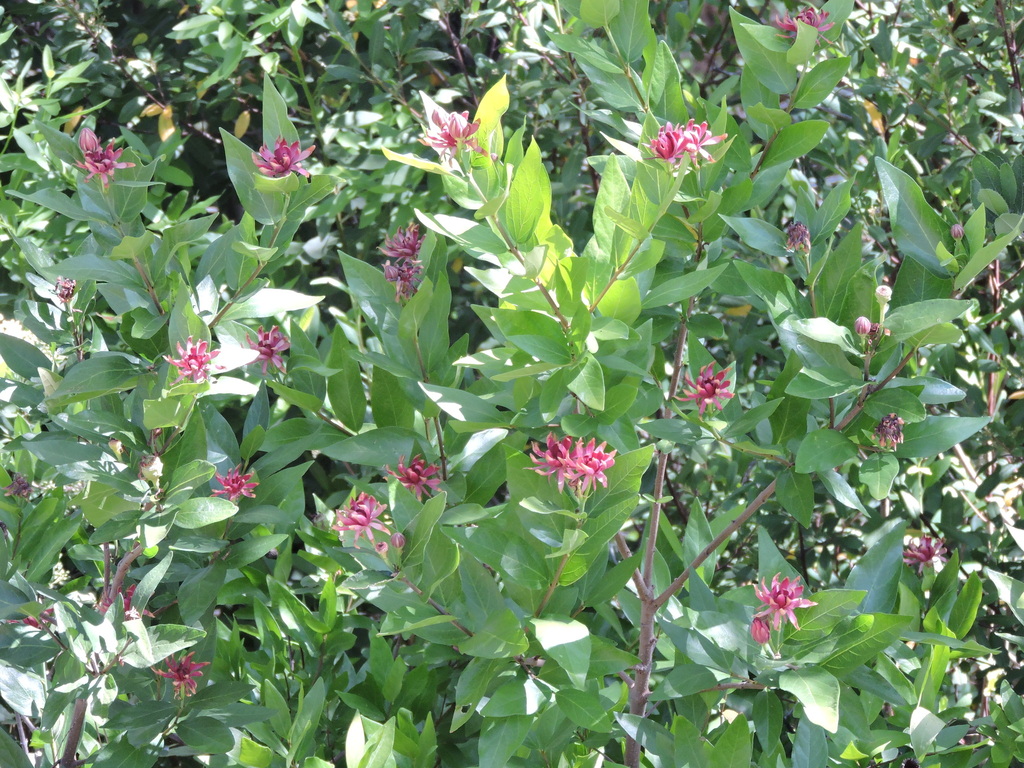
(c) Alex, some rights reserved (CC BY), uploaded by Alex · licence
Family: Calycanthaceae · Type: Shrub · Native
Calycanthus occidentalis (Sweet-shrub) is a native California shrub in the Calycanthaceae family, recognized by Only western North American representative of primarily eastern North American genus.
Sweet-shrub is a California native shrub found in the Klamath Ranges, northern Coast Ranges, Sierra Nevada, and San Joaquin Valley, particularly around the Kings River floodplain, in moist, shady canyons and streamsides at elevations generally below 1,500 meters. Flowering from March to August, this plant produces large, fleshy flowers approximately 5 centimeters in diameter with hairy perianth segments. Growing erectly to 1 to 3 meters tall with a rounded form, it develops sturdy branches that create an attractive, dense silhouette. Its leaves are firm and distinctive, with ovate to lance-oblong blades 5 to 15 centimeters long, having rounded bases, acute tips, and a somewhat scabrous surface that feels rough to the touch. The fruit develops as an ovoid receptacle bearing velvety achenes 7 to 10 millimeters long with granular margins.
Identification and appearance
Key characters: Only western North American representative of primarily eastern North American genus
Habitat and range
Habitat: Moist, shady places, canyons, streamsides
Elevation: generally < 1500 m
California counties: Fresno, Butte, Kern, Lake, Mariposa, Mendocino, Merced, Napa, Nevada, Plumas, Riverside, Shasta, Solano, Sonoma, Tulare, Yolo, San Diego, Colusa, Tuolumne, Marin, Yuba, Glenn, Tehama, Calaveras, Trinity, Los Angeles, Santa Barbara, Santa Cruz, Sacramento, Santa Clara, Alameda, Stanislaus
Bloom period
Calycanthus occidentalis blooms Mar-Aug.
How to tell it apart
vs Cornus: Dogwoods have opposite leaves with arching parallel veins and small flowers in clusters (sometimes ringed by white bracts); Calycanthus has coarse-veined opposite leaves and large, solitary, dark maroon flowers with many strap-shaped tepals.; vs Philadelphus: Mock orange has opposite leaves and white, 4-petaled fragrant flowers; Calycanthus has dark reddish-brown flowers whose numerous tepals spiral around a fleshy receptacle.; vs Fremontodendron: Flannelbush has alternate, lobed leaves and yellow flowers; Calycanthus has opposite, entire, ovate leaves and reddish flowers.; vs Ribes: Currants have alternate, palmately lobed leaves; Calycanthus has opposite, entire, ovate leaves.; vs Umbellularia: California bay is a tree with alternate, camphor-scented leaves; Calycanthus is a shrub with opposite, spicy-aromatic leaves and showy maroon flowers.
Frequently asked questions
Is Calycanthus occidentalis native to California?
Yes. Calycanthus occidentalis is native to California (recorded as native).
When does Calycanthus occidentalis bloom?
Calycanthus occidentalis blooms Mar-Aug.
Where in California does Calycanthus occidentalis grow?
Calycanthus occidentalis occurs in Fresno, Butte, Kern, Lake, Mariposa, Mendocino, Merced, Napa and other counties, at elevations of generally < 1500 m.
What plant family does Calycanthus occidentalis belong to?
Calycanthus occidentalis is in the Calycanthaceae family, genus Calycanthus.
What habitat does Calycanthus occidentalis grow in?
Calycanthus occidentalis grows in Moist, shady places, canyons, streamsides.
Related species
Other California species in the same genus, family, or bioregion.
Sources: Jepson eFlora · Index of California Plant Names · CalPhotos
Last updated 2026-10-07
Data from The California Species Project — 14,000+ California species with verified data from CNPS, CDFW, USFWS, Cal-IPC, and more.